Parasiliti-Caprino Mirko, Bioletto Fabio, Lopez Chiara, Bollati Martina, Maletta Francesca, Caputo Marina, Gasco Valentina, La Grotta Antonio, Limone Paolo, Borretta Giorgio, Volante Marco, Papotti Mauro, Pia Anna, Terzolo Massimo, Morino Mario, Pasini Barbara, Veglio Franco, Ghigo Ezio, Arvat Emanuela, Maccario Mauro
Endocrinology, Diabetes and Metabolism, Department of Medical Sciences, University of Turin, 10126 Turin, Italy.
Department of Oncology, University of Turin, 10043 Orbassano, Italy.
Biomedicines. 2022 Jun 3;10(6):1310. doi: 10.3390/biomedicines10061310.
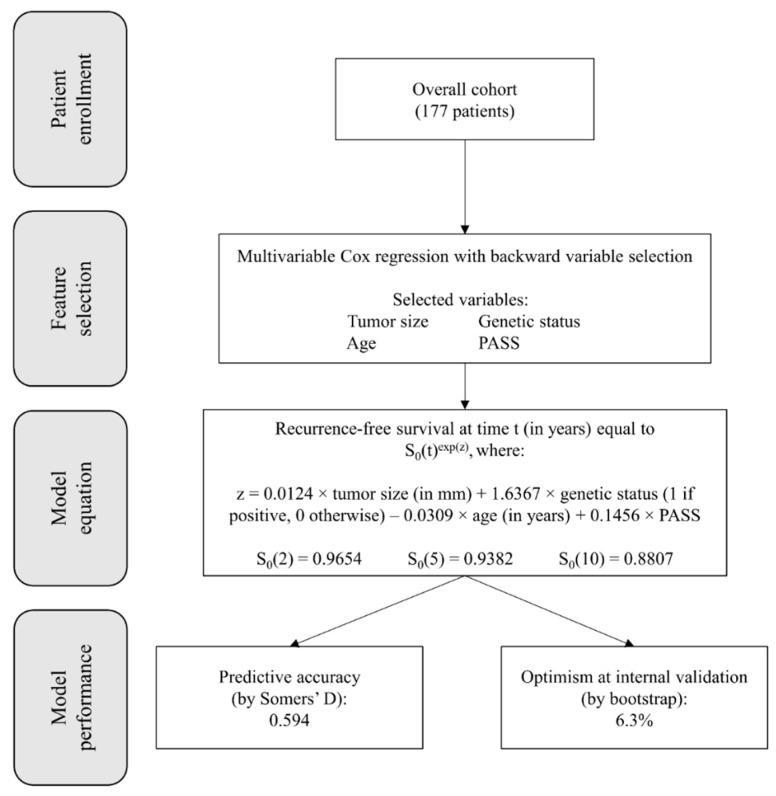
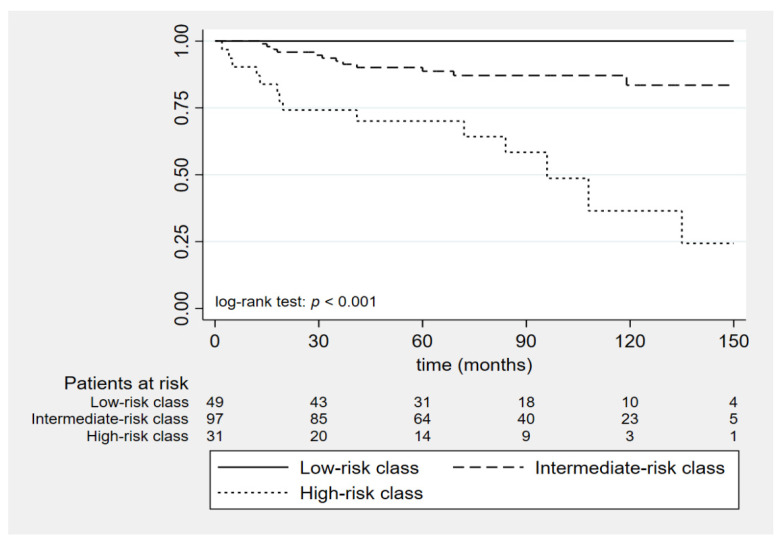
A reliable prediction of the recurrence risk of pheochromocytoma after radical surgery would be a key element for the tailoring/personalization of post-surgical follow-up. Recently, our group developed a multivariable continuous model that quantifies this risk based on genetic, histopathological, and clinical data. The aim of the present study was to simplify this tool to a discrete score for easier clinical use. Data from our previous study were retrieved, which encompassed 177 radically operated pheochromocytoma patients; supervised regression and machine-learning techniques were used for score development. After Cox regression, the variables independently associated with recurrence were tumor size, positive genetic testing, age, and PASS. In order to derive a simpler scoring system, continuous variables were dichotomized, using > 50 mm for tumor size, ≤ 35 years for age, and ≥ 3 for PASS as cut-points. A novel prognostic score was created on an 8-point scale by assigning 1 point for tumor size > 50 mm, 3 points for positive genetic testing, 1 point for age ≤ 35 years, and 3 points for PASS ≥ 3; its predictive performance, as assessed using Somers’ D, was equal to 0.577 and was significantly higher than the performance of any of the four dichotomized predictors alone. In conclusion, this simple scoring system may be of value as an easy-to-use tool to stratify recurrence risk and tailor post-surgical follow-up in radically operated pheochromocytoma patients.
对嗜铬细胞瘤根治性手术后复发风险进行可靠预测,将是术后随访个性化定制的关键要素。最近,我们团队开发了一种多变量连续模型,该模型基于基因、组织病理学和临床数据对这种风险进行量化。本研究的目的是将这个工具简化为一个离散分数,以便于临床使用。我们检索了之前研究的数据,其中包括177例接受根治性手术的嗜铬细胞瘤患者;使用监督回归和机器学习技术来制定分数。经过Cox回归分析,与复发独立相关的变量有肿瘤大小、基因检测阳性、年龄和PASS。为了得出更简单的评分系统,将连续变量进行二分法划分,肿瘤大小以>50mm、年龄以≤35岁、PASS以≥3作为分界点。通过为肿瘤大小>50mm赋予1分、基因检测阳性赋予3分、年龄≤35岁赋予1分、PASS≥3赋予3分,创建了一个8分制的新型预后评分;使用Somers’ D评估其预测性能,结果为0.577,显著高于任何一个单独的二分法预测指标的性能。总之,这个简单的评分系统作为一种易于使用的工具,对于对根治性手术后的嗜铬细胞瘤患者复发风险进行分层以及定制术后随访可能具有价值。