Chakraborty Nabarun, Srinivasan Seshamalini, Yang Ruoting, Miller Stacy-Ann, Gautam Aarti, Detwiler Leanne J, Carney Bonnie C, Alkhalil Abdulnaser, Moffatt Lauren T, Jett Marti, Shupp Jeffrey W, Hammamieh Rasha
Medical Readiness Systems Biology, Walter Reed Army Institute of Research, Silver Spring, MD 20910, USA.
The Geneva Foundation, Walter Reed Army Institute of Research, Silver Spring, MD 20910, USA.
Biomedicines. 2022 Jun 14;10(6):1402. doi: 10.3390/biomedicines10061402.
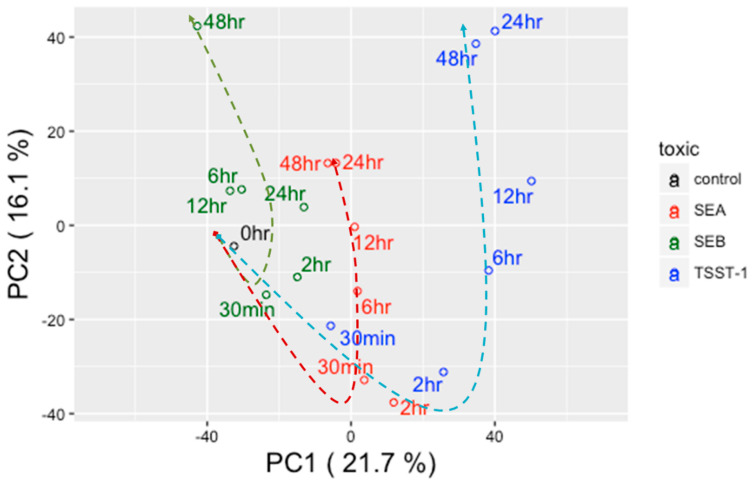
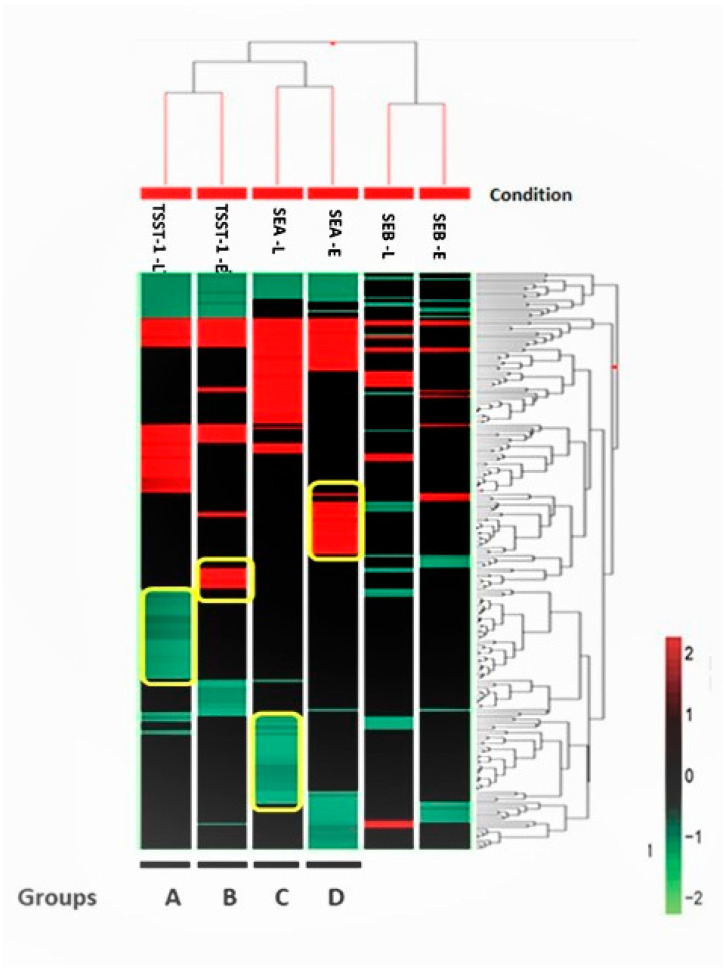
, a gram-positive bacterium, causes toxic shock through the production of superantigenic toxins (sAgs) known as Staphylococcal enterotoxins (SE), serotypes A-J (SEA, SEB, etc.), and toxic shock syndrome toxin-1 (TSST-1). The chronology of host transcriptomic events that characterizes the response to the pathogenesis of superantigenic toxicity remains uncertain. The focus of this study was to elucidate time-resolved host responses to three toxins of the superantigenic family, namely SEA, SEB, and TSST-1. Due to the evolving critical role of melanocytes in the host's immune response against environmental harmful elements, we investigated herein the transcriptomic responses of melanocytes after treatment with 200 ng/mL of SEA, SEB, or TSST-1 for 0.5, 2, 6, 12, 24, or 48 h. Functional analysis indicated that each of these three toxins induced a specific transcriptional pattern. In particular, the time-resolved transcriptional modulations due to SEB exposure were very distinct from those induced by SEA and TSST-1. The three superantigens share some similarities in the mechanisms underlying apoptosis, innate immunity, and other biological processes. Superantigen-specific signatures were determined for the functional dynamics related to necrosis, cytokine production, and acute-phase response. These differentially regulated networks can be targeted for therapeutic intervention and marked as the distinguishing factors for the three sAgs.
金黄色葡萄球菌是一种革兰氏阳性细菌,通过产生称为葡萄球菌肠毒素(SE)的超抗原毒素(sAg)、血清型A - J(SEA、SEB等)以及中毒性休克综合征毒素-1(TSST-1)引发中毒性休克。表征对超抗原毒性发病机制反应的宿主转录组事件的时间顺序仍不确定。本研究的重点是阐明宿主对超抗原家族的三种毒素,即SEA、SEB和TSST-1的时间分辨反应。由于黑素细胞在宿主针对环境有害元素的免疫反应中发挥着不断演变的关键作用,我们在此研究了用200 ng/mL的SEA、SEB或TSST-1处理0.5、2、6、12、24或48小时后黑素细胞的转录组反应。功能分析表明,这三种毒素中的每一种都诱导了特定的转录模式。特别是,由于SEB暴露引起的时间分辨转录调节与SEA和TSST-1诱导的调节非常不同。这三种超抗原在凋亡、先天免疫和其他生物学过程的潜在机制上有一些相似之处。确定了与坏死、细胞因子产生和急性期反应相关的功能动力学的超抗原特异性特征。这些差异调节的网络可作为治疗干预的靶点,并被标记为三种sAg的区分因素。