Aylmore Holly, Dimitrakakis Emmanouil, Carmichael Joshua, Khan Danyal Z, Stoyanov Danail, Dorward Neil L, Marcus Hani J
UCL Queen Square Institute of Neurology, University College London (UCL), London WC1N 3BG, UK.
Wellcome/EPSRC Centre for Surgical and Interventional Sciences (WEISS), University College London (UCL), London W1W 7TY, UK.
Cancers (Basel). 2022 Jun 14;14(12):2931. doi: 10.3390/cancers14122931.
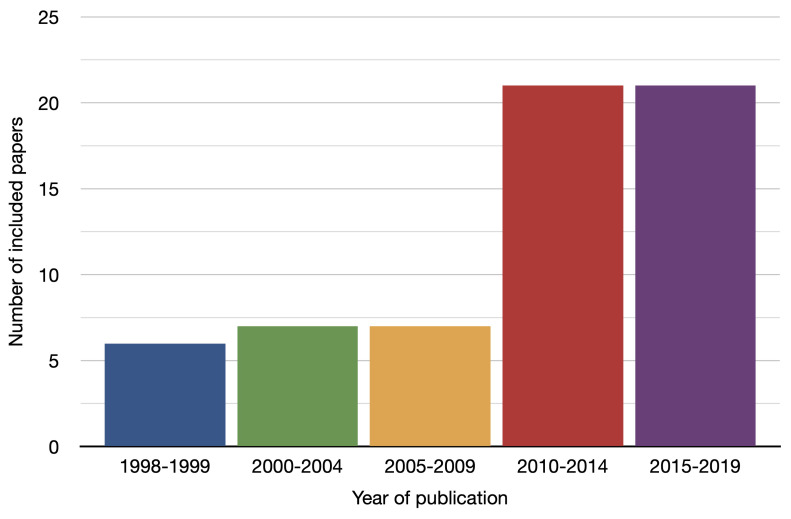
While there have been great strides in endoscopic and endoscope-assisted neurosurgical approaches, particularly in the treatment of deep-sited brain and skull base tumours, the greatest technical barrier to their adoption has been the availability of suitable surgical instruments. This systematic review seeks to identify specialised instruments for these approaches and evaluate their safety, efficacy and usability. Conducted in accordance with the PRISMA guidelines, Medline, Embase, CENTRAL, SCOPUS and Web of Science were searched. Original research studies that reported the use of specialised mechanical instruments that manipulate tissue in human patients, cadavers or surgical models were included. The results identified 50 specialised instruments over 62 studies. Objective measures of safety were reported in 32 out of 62 studies, and 20 reported objective measures of efficacy. Instruments were broadly safe and effective with one instrument malfunction noted. Measures of usability were reported in 15 studies, with seven reporting on ergonomics and eight on the instruments learning curve. Instruments with reports on usability were generally considered to be ergonomic, though learning curve was often considered a disadvantage. Comparisons to standard instruments were made in eight studies and were generally favourable. While there are many specialised instruments for endoscopic and endoscope-assisted neurosurgery available, the evidence for their safety, efficacy and usability is limited with non-standardised reporting and few comparative studies to standard instruments. Future innovation should be tailored to unmet clinical needs, and evaluation guided by structured development processes.
虽然内镜及内镜辅助神经外科手术方法已取得了长足进步,尤其是在深部脑肿瘤和颅底肿瘤的治疗方面,但这些方法应用的最大技术障碍一直是合适手术器械的可用性。本系统评价旨在确定这些手术方法的专用器械,并评估其安全性、有效性和易用性。按照PRISMA指南进行检索,检索了Medline、Embase、CENTRAL、SCOPUS和Web of Science数据库。纳入了报告在人类患者、尸体或手术模型中使用操作组织的专用机械器械的原始研究。结果在62项研究中确定了50种专用器械。62项研究中有32项报告了安全性的客观指标,20项报告了有效性的客观指标。器械总体上安全有效,仅记录到1例器械故障。15项研究报告了易用性指标,其中7项报告了人体工程学方面,8项报告了器械的学习曲线。有易用性报告的器械通常被认为符合人体工程学,不过学习曲线往往被视为一个缺点。8项研究对标准器械进行了比较,结果总体良好。虽然有许多用于内镜及内镜辅助神经外科手术的专用器械,但由于报告不规范且与标准器械的比较研究较少,其安全性、有效性和易用性的证据有限。未来的创新应针对未满足的临床需求,并以结构化开发流程为指导进行评估。