Department of Radiology, Charité-Universitätsmedizin Berlin, Charité Campus Virchow (CVK), Augustenburger Platz 1, 13353, Berlin, Germany.
Institute of Biometry and Clinical Epidemiology, Charité-Universitätsmedizin Berlin, Berlin, Germany.
Cardiovasc Intervent Radiol. 2024 Nov;47(11):1471-1484. doi: 10.1007/s00270-024-03869-9. Epub 2024 Oct 15.
The aim of the present meta-analysis was to systematically determine the overall complication rate and incidence of cryoshock in patients undergoing cryoablation of the liver.
A systematic review and meta-analysis adhering to the PRISMA guidelines and focusing on studies of cryotherapy for liver malignancies published after 2000 were conducted. PubMed, Web of Science, Embase, and Scopus were systematically searched for articles reporting incidences of adverse events associated with percutaneous cryoablation in patients with liver malignancies. Data extraction and screening were independently conducted by two reviewers, who resolved discrepancies through consensus. Statistical analysis was performed to assess heterogeneity and pooled complication rates and included a moderator analysis to explore factors influencing the occurrence of complications.
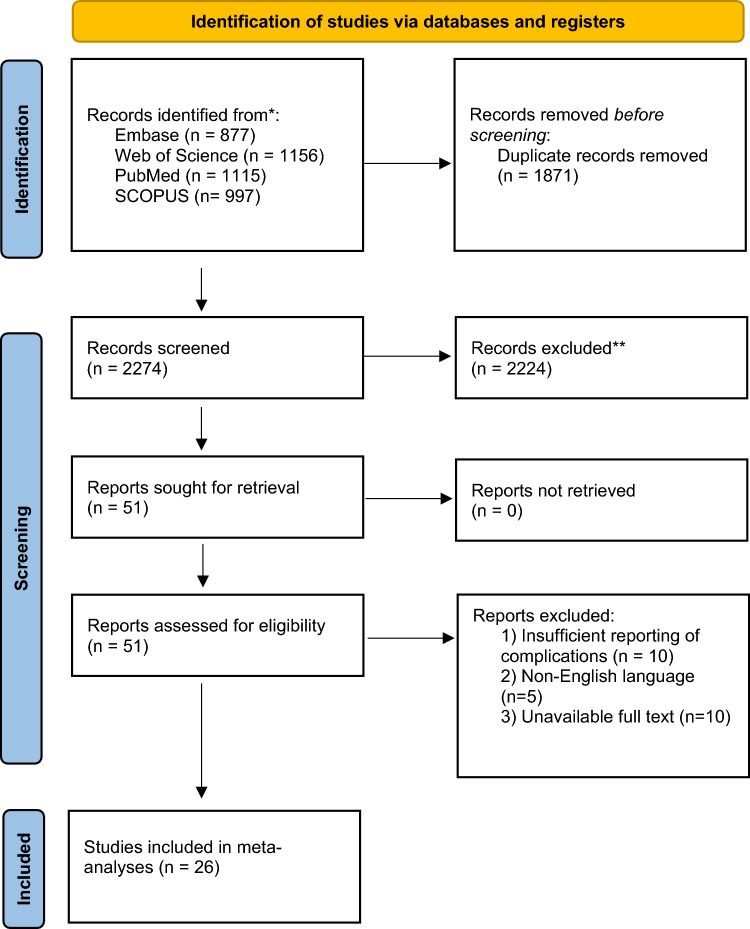
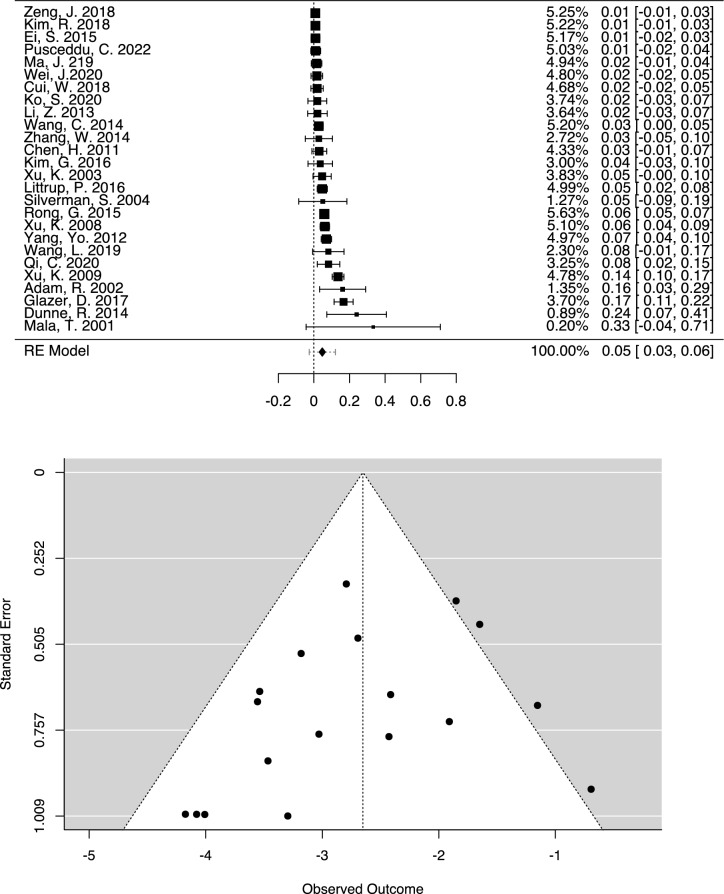
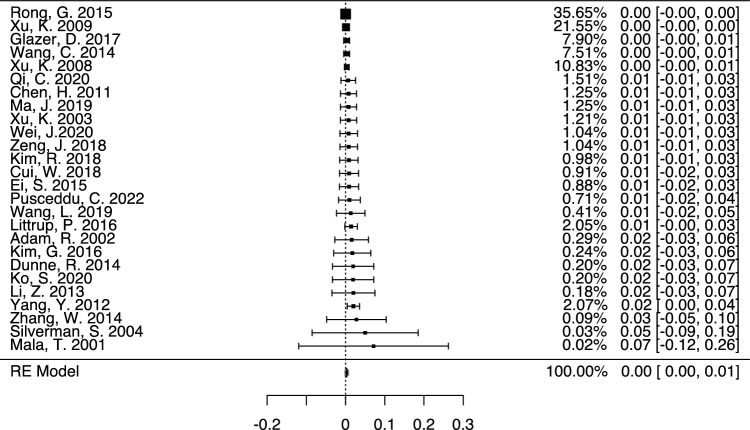
The initial search yielded 4,145 articles, of which 26 met our inclusion criteria. From these 26 articles, pooled data on 4,029 patients were extracted. Variance between studies reporting cryoshock was low (I = 13.15%), while variance among studies reporting major complications was high (I = 82.52%). The pooled weighted proportion of major complications was 4.71% while that of cryoshock was as low as 0.265%. Moderator analysis identified publication year as the only moderator for major complications and no moderator for the occurrence of cryoshock.
Analysis of currently available evidence indicates that cryoablation has a relative safe profile with a pooled incidence of major complications below 5%. Cryoshock occurred in less than 0.3% of procedures and was not reported for liver lesions smaller than 3 cm.
本荟萃分析旨在系统确定行肝冷冻消融术患者的总体并发症发生率和冷冻休克发生率。
按照 PRISMA 指南,对 2000 年后发表的有关肝脏恶性肿瘤冷冻治疗的研究进行系统评价和荟萃分析。系统检索 PubMed、Web of Science、Embase 和 Scopus 中报告与肝脏恶性肿瘤患者经皮冷冻消融相关不良事件发生率的文章。两名评审员独立进行数据提取和筛选,通过共识解决分歧。进行统计学分析以评估异质性和汇总并发症发生率,并进行了一项调节分析以探讨影响并发症发生的因素。
最初的搜索产生了 4145 篇文章,其中 26 篇符合我们的纳入标准。从这 26 篇文章中,提取了 4029 例患者的汇总数据。报告冷冻休克的研究之间的方差较低(I=13.15%),而报告主要并发症的研究之间的方差较高(I=82.52%)。汇总的主要并发症加权比例为 4.71%,而冷冻休克的比例低至 0.265%。调节分析确定发表年份是主要并发症的唯一调节因素,而不是冷冻休克发生的调节因素。
对现有证据的分析表明,冷冻消融术具有相对安全的特征,主要并发症的汇总发生率低于 5%。冷冻休克的发生率低于 0.3%,且小于 3cm 的肝脏病变未报告发生冷冻休克。