Wengert Laura A, Backe Sarah J, Bourboulia Dimitra, Mollapour Mehdi, Woodford Mark R
Department of Urology, SUNY Upstate Medical University, Syracuse, NY 13210, USA.
Upstate Cancer Center, SUNY Upstate Medical University, Syracuse, NY 13210, USA.
Biomolecules. 2022 Jun 4;12(6):786. doi: 10.3390/biom12060786.
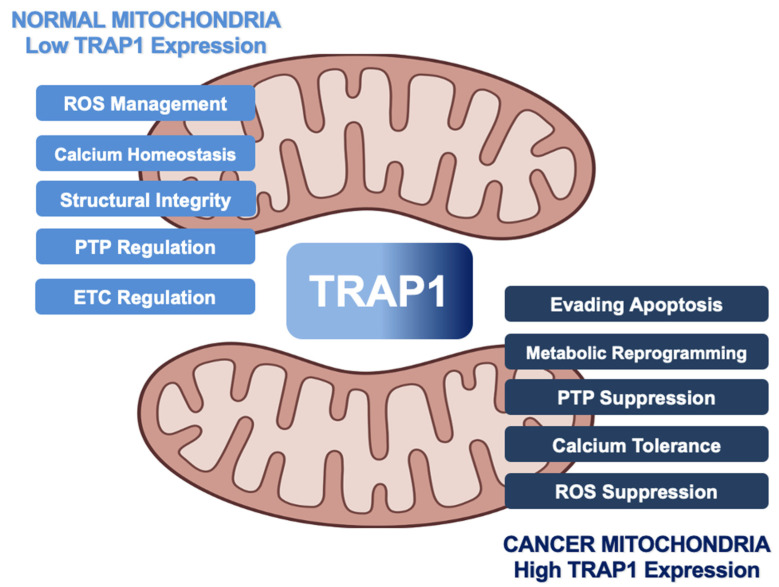
Mitochondrial function is dependent on molecular chaperones, primarily due to their necessity in the formation of respiratory complexes and clearance of misfolded proteins. Heat shock proteins (Hsps) are a subset of molecular chaperones that function in all subcellular compartments, both constitutively and in response to stress. The Hsp90 chaperone TNF-receptor-associated protein-1 (TRAP1) is primarily localized to the mitochondria and controls both cellular metabolic reprogramming and mitochondrial apoptosis. TRAP1 upregulation facilitates the growth and progression of many cancers by promoting glycolytic metabolism and antagonizing the mitochondrial permeability transition that precedes multiple cell death pathways. TRAP1 attenuation induces apoptosis in cellular models of cancer, identifying TRAP1 as a potential therapeutic target in cancer. Similar to cytosolic Hsp90 proteins, TRAP1 is also subject to post-translational modifications (PTM) that regulate its function and mediate its impact on downstream effectors, or 'clients'. However, few effectors have been identified to date. Here, we will discuss the consequence of TRAP1 deregulation in cancer and the impact of post-translational modification on the known functions of TRAP1.
线粒体功能依赖于分子伴侣,这主要是因为它们在呼吸复合物形成和错误折叠蛋白清除过程中是必需的。热休克蛋白(Hsps)是分子伴侣的一个子集,在所有亚细胞区室中都有作用,既有组成性作用,也有应激反应作用。热休克蛋白90(Hsp90)伴侣蛋白肿瘤坏死因子受体相关蛋白-1(TRAP1)主要定位于线粒体,控制细胞代谢重编程和线粒体凋亡。TRAP1上调通过促进糖酵解代谢和拮抗多种细胞死亡途径之前的线粒体通透性转变,促进许多癌症的生长和进展。TRAP1减弱在癌症细胞模型中诱导凋亡,这表明TRAP1是癌症潜在的治疗靶点。与胞质Hsp90蛋白类似,TRAP1也会发生翻译后修饰(PTM),这些修饰调节其功能并介导其对下游效应物或“客户”的影响。然而,迄今为止仅鉴定出少数效应物。在这里,我们将讨论癌症中TRAP1失调的后果以及翻译后修饰对TRAP1已知功能的影响。