Quiñones John, Díaz Rommy, Beltrán Jorge F, Velazquez Lidiana, Cancino David, Muñoz Erwin, Dantagnan Patricio, Hernández Adrián, Sepúlveda Néstor, Farías Jorge G
Facultad de Ciencias Agropecuarias y Forestales, Universidad de La Frontera, Temuco 4780000, Chile.
Departamento de Ingeniería Química, Facultad de Ingeniería y Ciencias, Universidad de La Frontera, Temuco 4780000, Chile.
Biomolecules. 2022 Jun 9;12(6):805. doi: 10.3390/biom12060805.
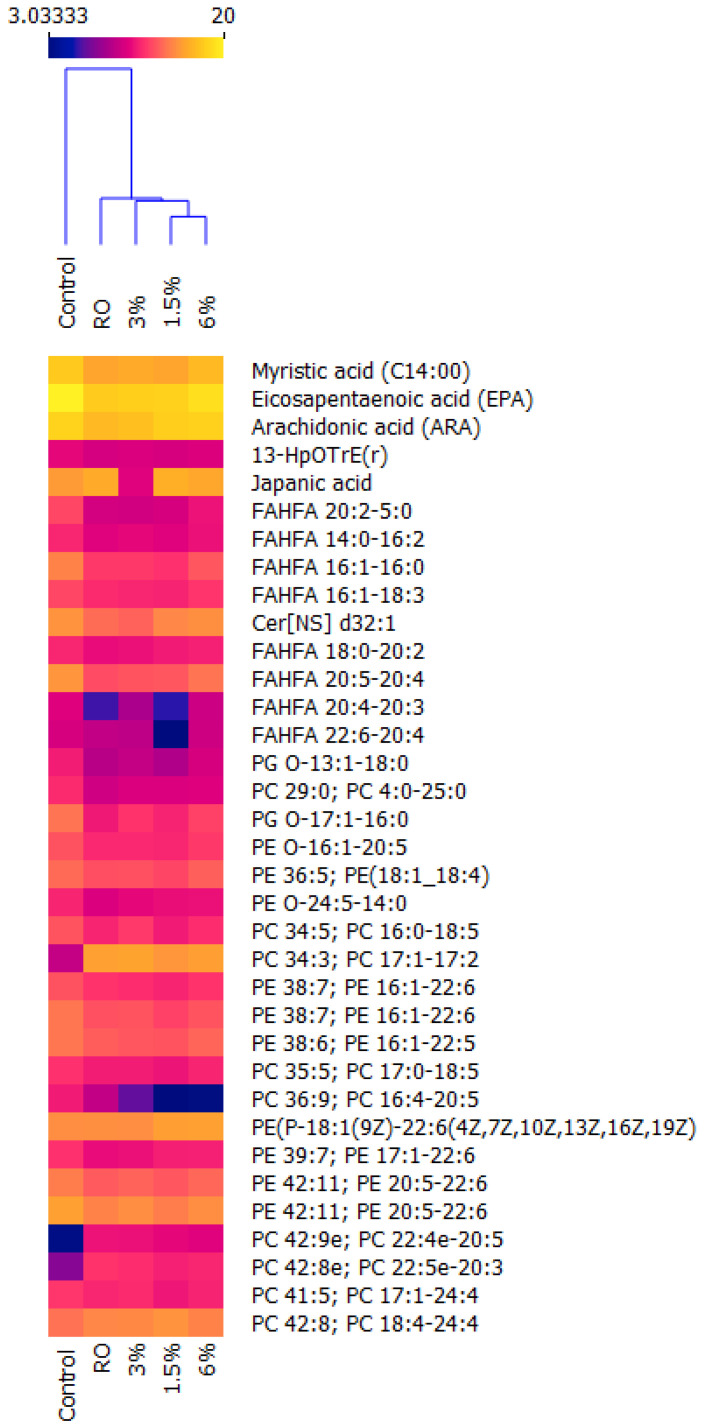
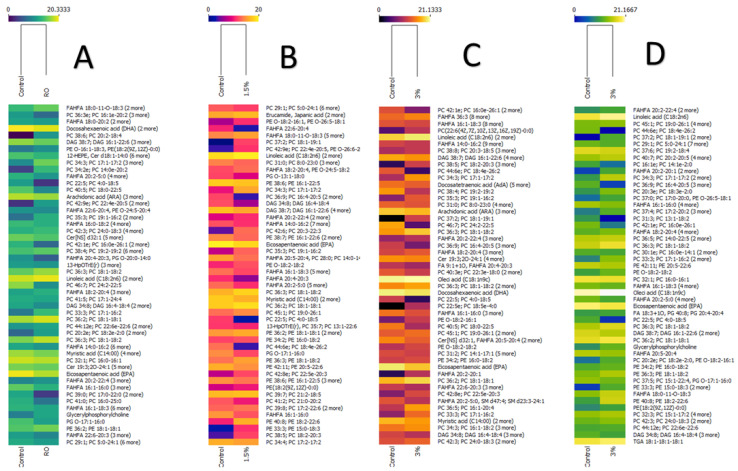
This study aimed to analyze the effects on the lipidome of juvenile muscle fed 90% "rapeseed" oil and different amounts of "Cochayuyo" meal (1.5, 3 and 6%) as a replacement for cellulose. The analysis allowed for the identification of 329 lipids, mainly represented by phospholipids and fatty esters. The inclusion of oil significantly increased the levels of C18:2 species and fatty esters of hydroxylated fatty acids, which could play a bioactive role in human health. One of the most abundant lipids in all fillets was Phosphatidylcholine 33:6, which, according to the literature, could be considered a biomarker for the identification of . In all experimental diets, the species Phosphatidylethanolamine 15:1-18:24 showed four-fold higher levels than the control; increments of n-3- and n-6-rich phospholipids were also observed. Diets containing meal did not generate more significant variation in fish muscle phospholipids relative to the muscle of the rapeseed-oil-only group. These lipid species consist of medium- and long-chain fatty acids with different degrees of unsaturation. Still, it appears that the rapeseed oil masks the lipid contribution of the meal, possibly due to the low levels of total lipids in the macroalgae.
本研究旨在分析用90%的“菜籽油”和不同量(1.5%、3%和6%)的“海蕴”粉替代纤维素对幼鱼肌肉脂质组的影响。该分析鉴定出329种脂质,主要为磷脂和脂肪酸酯。添加菜籽油显著提高了C18:2种类和羟基化脂肪酸的脂肪酸酯水平,这些可能对人类健康具有生物活性作用。所有鱼片中含量最丰富的脂质之一是磷脂酰胆碱33:6,根据文献,它可被视为识别……的生物标志物。在所有实验饲料中,磷脂酰乙醇胺15:1-18:24的含量比对照组高四倍;还观察到富含n-3和n-6的磷脂有所增加。相对于仅喂食菜籽油组的鱼肌肉,含有海蕴粉的饲料在鱼肌肉磷脂方面并未产生更显著的变化。这些脂质种类由不同不饱和程度的中链和长链脂肪酸组成。不过,菜籽油似乎掩盖了海蕴粉的脂质贡献,这可能是由于大型藻类中总脂质含量较低。