Laboratory of Medical Genetics, Faculty of Biology and Environmental Protection, University of Lodz, 90-236 Lodz, Poland.
Department of Medical Biochemistry, Medical University of Lodz, 92-216 Lodz, Poland.
Genes (Basel). 2022 Jun 20;13(6):1101. doi: 10.3390/genes13061101.
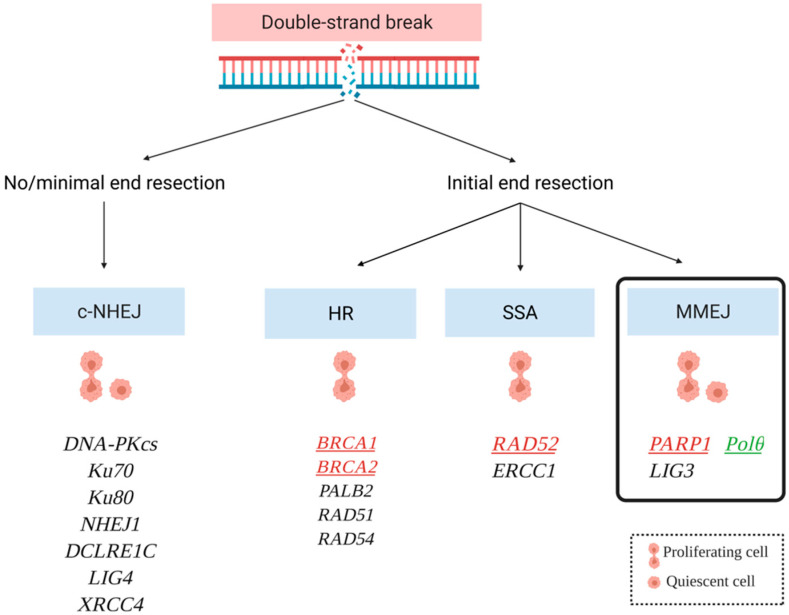
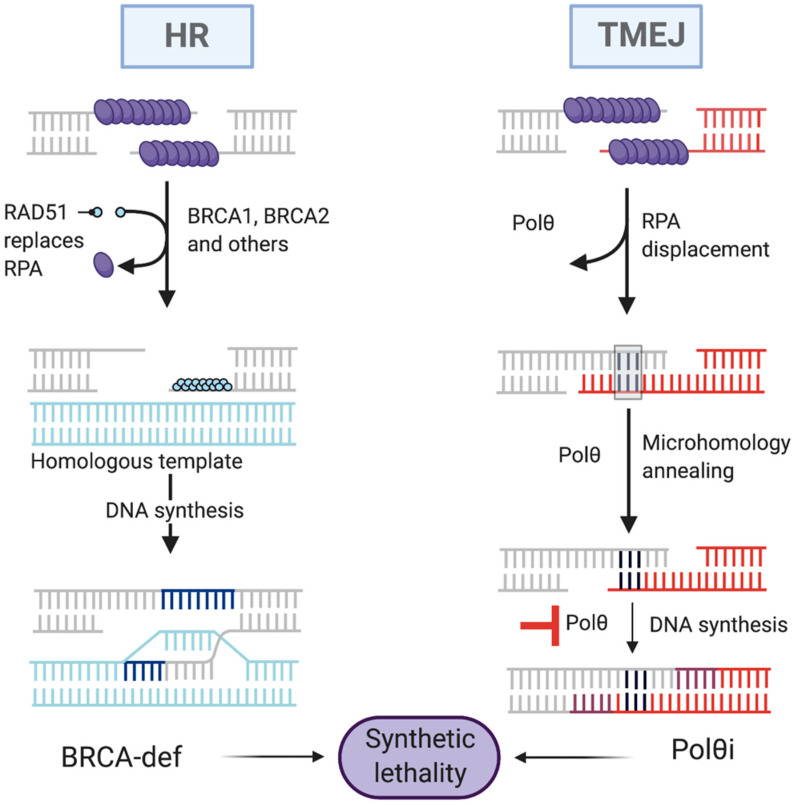
Research studies regarding synthetic lethality (SL) in human cells are primarily motivated by the potential of this phenomenon to be an effective, but at the same time, safe to the patient's anti-cancer chemotherapy. Among the factors that are targets for the induction of the synthetic lethality effect, those involved in DNA repair seem to be the most relevant. Specifically, when mutation in one of the canonical DNA double-strand break (DSB) repair pathways occurs, which is a frequent event in cancer cells, the alternative pathways may be a promising target for the elimination of abnormal cells. Currently, inhibiting RAD52 and/or PARP1 in the tumor cells that are deficient in the canonical repair pathways has been the potential target for inducing the effect of synthetic lethality. Unfortunately, the development of resistance to commonly used PARP1 inhibitors (PARPi) represents the greatest obstacle to working out a successful treatment protocol. DNA polymerase theta (Polθ), encoded by the POLQ gene, plays a key role in an alternative DSB repair pathway-theta-mediated end joining (TMEJ). Thus, it is a promising target in the treatment of tumors harboring deficiencies in homologous recombination repair (HRR), where its inhibition can induce SL. In this review, the authors discuss the current state of knowledge on Polθ as a potential target for synthetic lethality-based anticancer therapies.
关于人类细胞中的合成致死性(SL)的研究主要是受到这种现象作为一种有效但同时对患者的抗癌化疗安全的潜力的推动。在可诱导合成致死效应的靶标因素中,涉及 DNA 修复的因素似乎最为相关。具体来说,当癌症细胞中经常发生的一种规范的 DNA 双链断裂(DSB)修复途径中的突变发生时,替代途径可能是消除异常细胞的有前途的靶标。目前,抑制在规范修复途径中缺乏的肿瘤细胞中的 RAD52 和/或 PARP1 一直是诱导合成致死效应的潜在靶标。不幸的是,对常用 PARP1 抑制剂(PARPi)的耐药性的发展是制定成功治疗方案的最大障碍。由 POLQ 基因编码的 DNA 聚合酶θ(Polθ)在替代的 DSB 修复途径——theta 介导的末端连接(TMEJ)中发挥关键作用。因此,它是同源重组修复(HRR)缺陷肿瘤治疗的有前途的靶标,其抑制可诱导 SL。在这篇综述中,作者讨论了 Polθ 作为基于合成致死的抗癌治疗的潜在靶标的最新知识状态。