Management Department, College of Business Administration, King Faisal University, Al-Ahsaa 31982, Saudi Arabia.
Hotel Management Department, Faculty of Tourism and Hotel Management, Helwan University, Cairo 12612, Egypt.
Int J Environ Res Public Health. 2022 Jun 8;19(12):7040. doi: 10.3390/ijerph19127040.
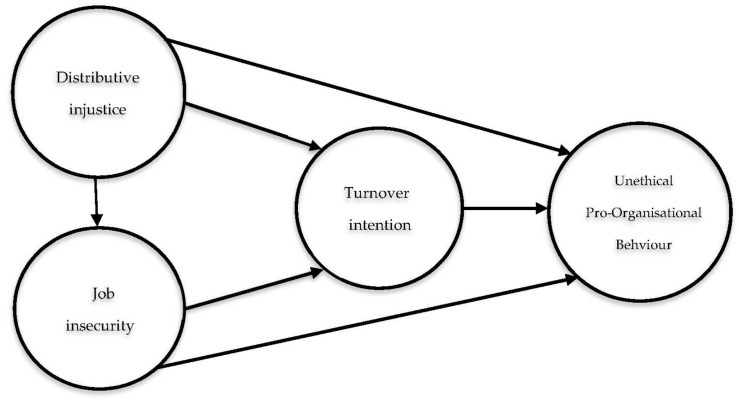
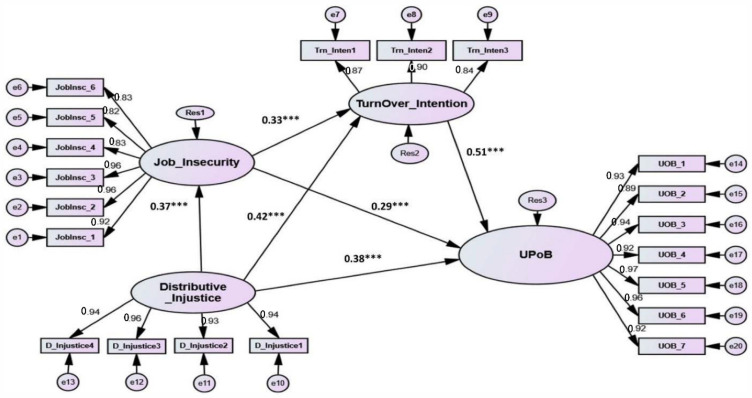
Drawn on Social Exchange Theory and Conservation of Resources Theory, this study developed a research model to examine the direct influence of job insecurity and distributive injustice, which were common in many hotels amid COVID-19, on unethical pro-organisation behaviour (UPoB) among hotel employees. The study also examines the mediating role of turnover intention in the relationship between job insecurity, and distributive injustice, which was result of the COVID-19 pandemic on UPoB. For this purpose, a questionnaire survey was self-dropped and collected through personal network to hotel employees in Eastern Province of Saudi Arabia. The results of structural equation modelling using AMOS (version 23) supported all the study hypotheses. The results showed a significant positive influence of distributive injustice and job insecurity on UPoB among hotel employees. Moreover, turnover intention was found to have a partial mediation role in the relationship between job insecurity, distributive injustice and UPoB. The results extend our understanding of Social Exchange Theory and Conservation of Resources Theory that employees in hotels are more likely to protect themselves and their job by engaging in UPoB if they perceived their job at threat due to a crisis, i.e., the COVID-19 pandemic. The major conclusion of current research is that when hotels employees perceived job insecurity and distributive injustice because of the pandemic, they responded with high turnover intention and as a last choice engaging in UPoB to save their resources, in this case their jobs, since they have no other alternatives outside the organisations. However, this inappropriate antisocial behaviour could have a negative influence on both employees and organisation at the long term. The results of current research have several theoretical implications for tourism scholars and managerial implication for hoteliers.
本研究以社会交换理论和资源保存理论为基础,构建了一个研究模型,旨在检验工作不安全感和分配不公(这在新冠疫情期间许多酒店普遍存在)对酒店员工不道德的亲组织行为(UPoB)的直接影响。此外,该研究还考察了新冠疫情期间工作不安全感和分配不公对 UPoB 的影响,以及这种影响是如何通过离职意愿产生的。为此,通过个人网络向沙特阿拉伯东部省份的酒店员工发放了自填式问卷进行调查。使用 AMOS(版本 23)的结构方程模型的结果支持了所有研究假设。结果表明,分配不公和工作不安全感对酒店员工的 UPoB 有显著的正向影响。此外,离职意愿在工作不安全感、分配不公与 UPoB 之间的关系中起到部分中介作用。研究结果扩展了我们对社会交换理论和资源保存理论的理解,即如果员工认为自己的工作受到危机(即新冠疫情)的威胁,他们更有可能通过 UPoB 来保护自己和自己的工作。本研究的主要结论是,当酒店员工因疫情感到工作不安全和分配不公时,他们会做出高离职意愿的反应,作为最后的选择,他们会通过 UPoB 来保护自己的资源,在这种情况下,是他们的工作,因为他们在组织之外没有其他选择。然而,这种不恰当的反社会行为从长远来看可能会对员工和组织产生负面影响。本研究的结果对旅游学者具有理论意义,对酒店管理者具有管理启示。