State Key Laboratory of Subtropical Silviculture, College of Forestry and Biotechnology, Zhejiang A&F University, Hangzhou 311300, China.
Int J Mol Sci. 2022 Jun 17;23(12):6758. doi: 10.3390/ijms23126758.
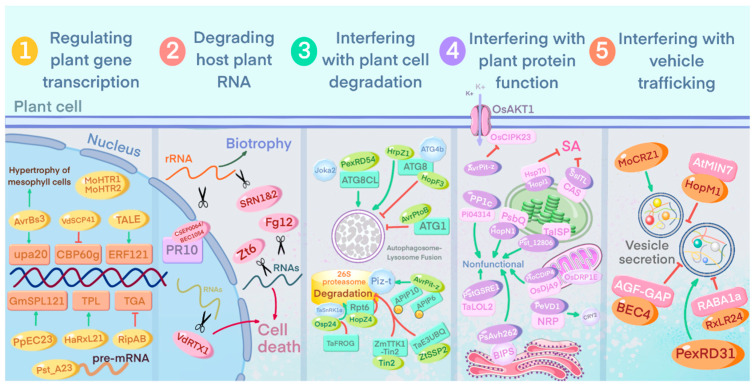
Plant pathogens are one of the main factors hindering the breeding of cash crops. Pathogens, including oomycetes, fungus, and bacteria, secrete effectors as invasion weapons to successfully invade and propagate in host plants. Here, we review recent advances made in the field of plant-pathogen interaction models and the action mechanisms of phytopathogenic effectors. The review illustrates how effectors from different species use similar and distinct strategies to infect host plants. We classify the main action mechanisms of effectors in plant-pathogen interactions according to the infestation process: targeting physical barriers for disruption, creating conditions conducive to infestation, protecting or masking themselves, interfering with host cell physiological activity, and manipulating plant downstream immune responses. The investigation of the functioning of plant pathogen effectors contributes to improved understanding of the molecular mechanisms of plant-pathogen interactions. This understanding has important theoretical value and is of practical significance in plant pathology and disease resistance genetics and breeding.
植物病原体是阻碍经济作物繁殖的主要因素之一。病原体,包括卵菌、真菌和细菌,会分泌效应子作为入侵武器,成功地在宿主植物中入侵和繁殖。在这里,我们回顾了植物-病原体相互作用模型领域和植物病原效应子作用机制的最新进展。该综述说明了来自不同物种的效应子如何使用相似和不同的策略来感染宿主植物。我们根据侵染过程将效应子在植物-病原体相互作用中的主要作用机制进行分类:靶向物理屏障进行破坏、创造有利于侵染的条件、保护或伪装自己、干扰宿主细胞生理活性以及操纵植物下游免疫反应。对植物病原体效应子功能的研究有助于更好地理解植物-病原体相互作用的分子机制。这种理解具有重要的理论价值,在植物病理学和抗病遗传与育种方面具有实际意义。