Lin Kuan-Hung, Lin Huey-Juan, Yeh Poh-Shiow
Chi-Mei Medical Center, Department of Neurology, 901 Chung-Hwa Road, Yung-Kang District, Tainan 71004, Taiwan.
J Clin Med. 2022 Jun 16;11(12):3457. doi: 10.3390/jcm11123457.
Long hospitalizations are associated with a high comorbidity and considerable hospital cost. Admissions of severe acute ischemic stroke are prone to longer hospitalizations. We aimed to explore the issue and method for improving the length of stay.
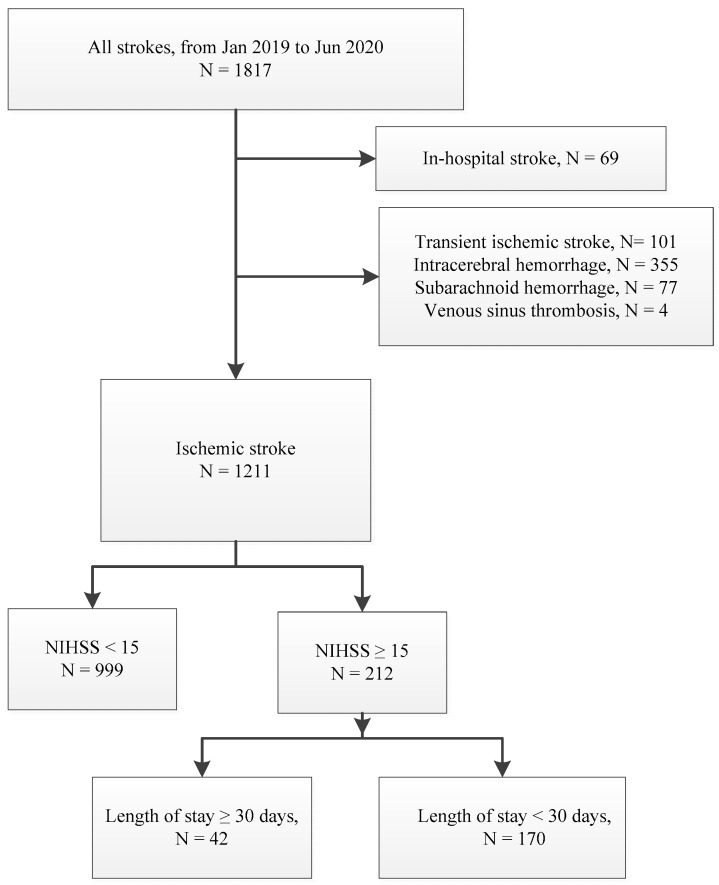
From the prospective Stroke Registry between January 2019 and June 2020, acute ischemic strokes with an admission National Institutes of Health Stroke Scale ≥ 15 were identified. Prolonged length-of-stay was defined as in-hospital-stay ≥ 30 days. All clinical characteristics were collected, and all do-not-resuscitate documentations were categorized if the order had been written within 7 days of onset.
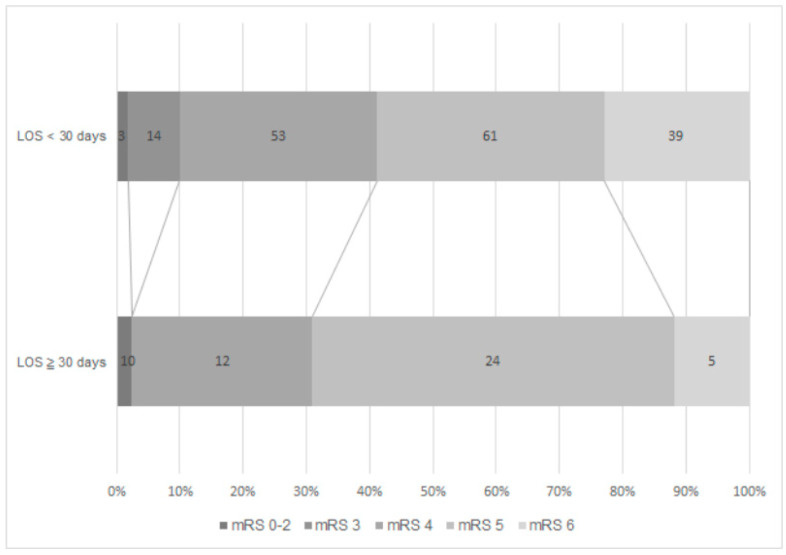
A total of 212 patients were eligible for severe stroke. Of these, 42 (19.8%) had prolonged length-of-stay and 170 had non-prolonged length-of-stay (median 43 vs. 13 days). The prolonged group was younger, mostly men, and was more likely to be in an independent state and more likely to receive reperfusion therapy, and there was a higher frequency of late do-not-resuscitate orders if signed. Although there was a lower in-hospital mortality rate in the prolonged group (12% vs. 23%), there was a higher proportion with a severe functional state (Modified Rankin Scale = 4-5) among the survivors (97% vs. 87%).
Severe acute ischemic stroke patients with a prolonged length-of-stay were younger, mostly male, more likely to receive reperfusion therapy, less likely to have an early do-not-resuscitate order if signed, and more likely to have poor functional status at discharge, although there was a lower rate of in-hospital mortality.
长期住院与高合并症及高昂的住院费用相关。重症急性缺血性卒中患者更容易出现长期住院情况。我们旨在探讨改善住院时长的问题及方法。
从2019年1月至2020年6月的前瞻性卒中登记中,确定入院时美国国立卫生研究院卒中量表评分≥15分的急性缺血性卒中患者。住院时间延长定义为住院时间≥30天。收集所有临床特征,并对所有“不要复苏”文件进行分类,前提是该医嘱在发病后7天内开具。
共有212例患者符合重症卒中标准。其中,42例(19.8%)住院时间延长,170例住院时间未延长(中位数分别为43天和13天)。住院时间延长组患者更年轻,男性居多,更可能处于独立状态,更可能接受再灌注治疗,且如果签署“不要复苏”医嘱,晚期签署的频率更高。尽管住院时间延长组的院内死亡率较低(12%对23%),但幸存者中功能状态严重(改良Rankin量表评分=4 - 5分)的比例更高(97%对87%)。
住院时间延长的重症急性缺血性卒中患者更年轻,男性居多,更可能接受再灌注治疗,如果签署“不要复苏”医嘱,早期签署的可能性较小,出院时功能状态较差的可能性更大,尽管院内死亡率较低。