Pepe Pietro, Roscigno Marco, Pepe Ludovica, Panella Paolo, Tamburo Marinella, Marletta Giulia, Savoca Francesco, Candiano Giuseppe, Cosentino Sebastiano, Ippolito Massimo, Tsirgiotis Andreas, Pennisi Michele
Urology Unit, Cannizzaro Hospital, 95126 Catania, Italy.
Department of Surgery, UOC Urologia, ASST Papa Giovanni XXIII, 24127 Bergamo, Italy.
J Clin Med. 2022 Jun 16;11(12):3473. doi: 10.3390/jcm11123473.
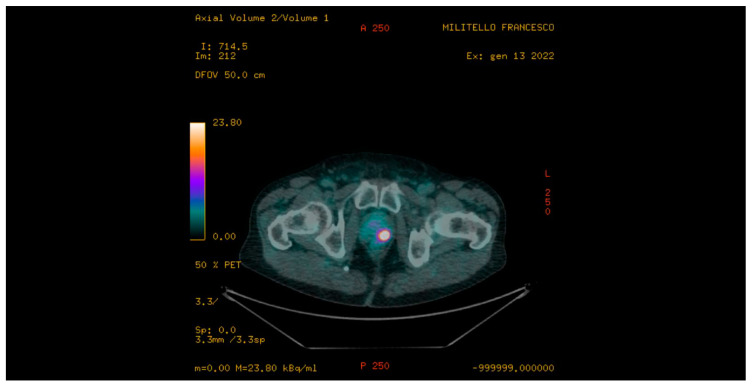
Background: To evaluate the accuracy of 68Ga-prostate specific membrane antigen (PSMA) PET/CT in the diagnosis of clinically significant prostate cancer (csPCa) (Grade Group > 2) in men enrolled in Active Surveillance (AS) protocol. Methods: From May 2013 to May 2021, 173 men with very low-risk PCa were enrolled in an AS protocol study. During the follow-up, 38/173 (22%) men were upgraded and 8/173 (4.6%) decided to leave the AS protocol. After four years from confirmatory biopsy (range: 48−52 months), 30/127 (23.6%) consecutive patients were submitted to mpMRI and 68Ga-PSMA PET/CT scan before scheduled repeated biopsy. All the mpMRI (PI-RADS > 3) and 68Ga-PET/TC standardised uptake value (SUVmax) > 5 g/mL index lesions underwent targeted cores (mpMRI-TPBx and PSMA-TPBx) combined with transperineal saturation prostate biopsy (SPBx: median 20 cores). Results: mpMRI and 68Ga-PSMA PET/CT showed 14/30 (46.6%) and 6/30 (20%) lesions suspicious for PCa. In 2/30 (6.6%) men, a csPCa was found; 68Ga-PSMA-TPBx vs. mpMRI-TPBx vs. SPBx diagnosed 1/2 (50%) vs. 1/2 (50%) vs. 2/2 (100%) csPCa, respectively. In detail, mpMRI and 68Ga-PSMA PET/TC demonstrated 13/30 (43.3%) vs. 5/30 (16.7%) false positive and 1 (50%) vs. 1 (50%) false negative results. Conclusion: 68Ga-PSMA PET/CT did not improve the detection for csPCa of SPBx but would have spared 24/30 (80%) scheduled biopsies showing a lower false positive rate in comparison with mpMRI (20% vs. 43.3%) and a negative predictive value of 85.7% vs. 57.1%, respectively.
评估68Ga-前列腺特异性膜抗原(PSMA)PET/CT在诊断参与主动监测(AS)方案的男性临床显著前列腺癌(csPCa)(分级组>2)中的准确性。方法:2013年5月至2021年5月,173例极低风险前列腺癌男性患者参与了一项AS方案研究。随访期间,173例中有38例(22%)患者病情进展,173例中有8例(4.6%)决定退出AS方案。在确诊性活检四年后(范围:48 - 52个月),127例中的30例(23.6%)连续患者在计划的重复活检前接受了多参数磁共振成像(mpMRI)和68Ga-PSMA PET/CT扫描。所有mpMRI(前列腺影像报告和数据系统(PI-RADS)>3)及68Ga-PET/TC标准化摄取值(SUVmax)>5 g/mL的索引病灶均接受靶向穿刺(mpMRI引导的靶向穿刺活检(mpMRI-TPBx)和PSMA引导的靶向穿刺活检(PSMA-TPBx))并联合经会阴饱和前列腺穿刺活检(SPBx:中位穿刺20针)。结果:mpMRI和68Ga-PSMA PET/CT分别显示30例中有14例(46.6%)和6例(20%)病灶可疑为前列腺癌。在30例中的2例(6.6%)男性中发现了csPCa;68Ga-PSMA-TPBx、mpMRI-TPBx和SPBx分别诊断出2例中的1例(50%)、2例中的1例(50%)和2例中的2例(100%)csPCa。具体而言,mpMRI和68Ga-PSMA PET/TC分别显示30例中有13例(43.3%)和5例(16.7%)假阳性结果,以及1例(50%)和1例(50%)假阴性结果。结论:68Ga-PSMA PET/CT并未提高SPBx对csPCa的检测率,但可避免30例中的24例(80%)计划活检,与mpMRI相比,其假阳性率更低(20%对43.3%),阴性预测值分别为85.7%和57.1%。