Kulemzin Sergey V, Sergeeva Maria V, Baranov Konstantin O, Gorchakov Andrey A, Guselnikov Sergey V, Belovezhets Tatyana N, Volkova Olga Yu, Najakshin Alexander M, Chikaev Nikolai A, Danilenko Daria M, Taranin Alexander V
Institute of Molecular and Cellular Biology, Siberian Branch of Russian Academy of Sciences, 630090 Novosibirsk, Russia.
Smorodintsev Research Institute of Influenza, 197376 St. Petersburg, Russia.
J Pers Med. 2022 May 29;12(6):895. doi: 10.3390/jpm12060895.
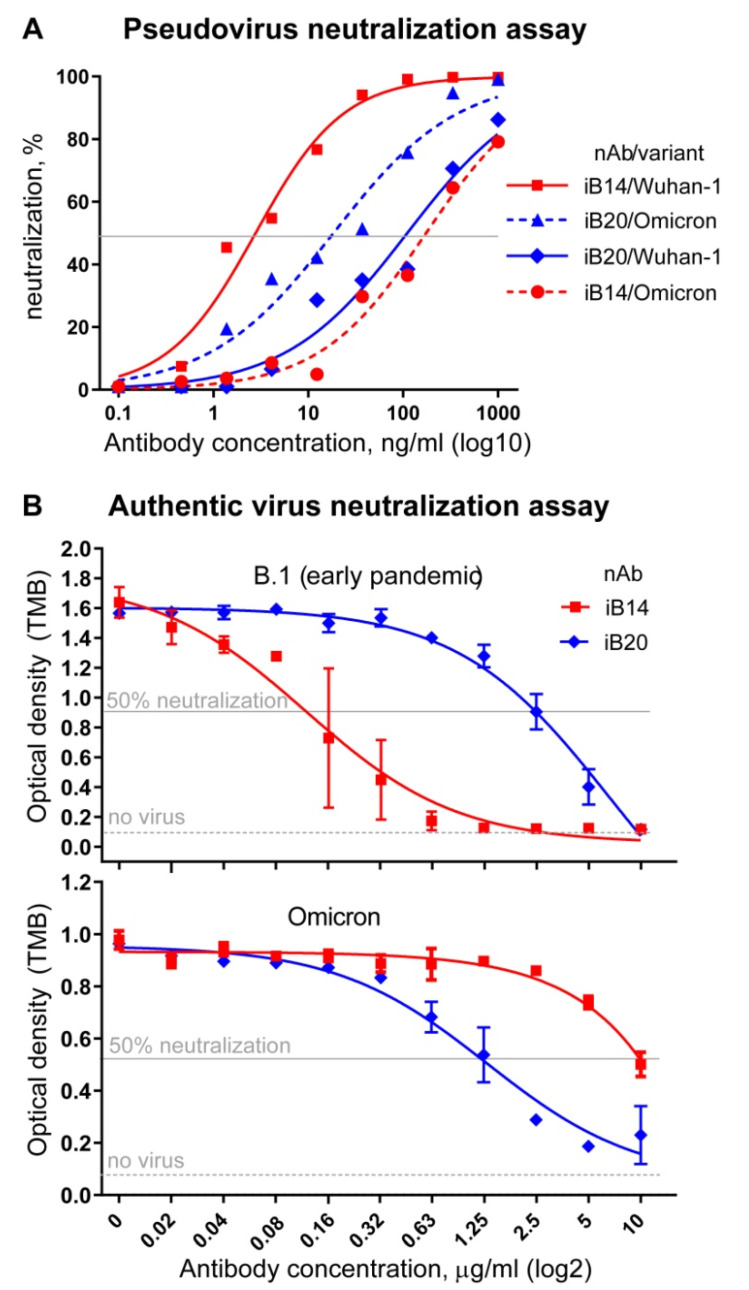
Immune evasion of SARS-CoV-2 undermines current strategies tocounteract the pandemic, with the efficacy of therapeutic virus-neutralizing monoclonal antibodies (nAbs) being affected the most. In this work, we asked whether two previously identified human cross-neutralizing nAbs, iB14 (class VH1-58) and iB20 (class VH3-53/66), are capable of neutralizing the recently emerged Omicron (BA.1) variant. Both nAbs were found to bind the Omicron RBD with a nanomolar affinity, yet they displayed contrasting functional features. When tested against Omicron, the neutralizing activity of iB14 was reduced 50-fold, whereas iB20 displayed a surprising increase in activity. Thus, iB20 is a unique representative of the VH3-53/66-class of nAbs in terms of breadth of neutralization, which establishes it as a candidate for COVID-19 therapy and prophylactics.
严重急性呼吸综合征冠状病毒2(SARS-CoV-2)的免疫逃逸削弱了当前应对这一疫情的策略,其中治疗性病毒中和单克隆抗体(nAbs)的疗效受到的影响最为严重。在这项研究中,我们探究了两种先前鉴定出的具有交叉中和作用的人源nAbs,即iB14(VH1-58类)和iB20(VH3-53/66类),是否能够中和最近出现的奥密克戎(BA.1)变体。结果发现,这两种nAbs均能以纳摩尔亲和力结合奥密克戎受体结合域(RBD),但它们表现出截然不同的功能特性。在针对奥密克戎进行测试时,iB14的中和活性降低了50倍,而iB20的活性则出现了惊人的增加。因此,就中和广度而言,iB20是VH3-53/66类nAbs的独特代表,这使其成为治疗和预防2019冠状病毒病(COVID-19)的候选药物。