Department of Physical Therapy, Graduate School, Sahmyook University, 815, Hwarang-ro, Seoul 01795, Korea.
Department of Physical Therapy, Sahmyook University, 815, Hwarang-ro, Seoul 01795, Korea.
Medicina (Kaunas). 2022 May 28;58(6):729. doi: 10.3390/medicina58060729.
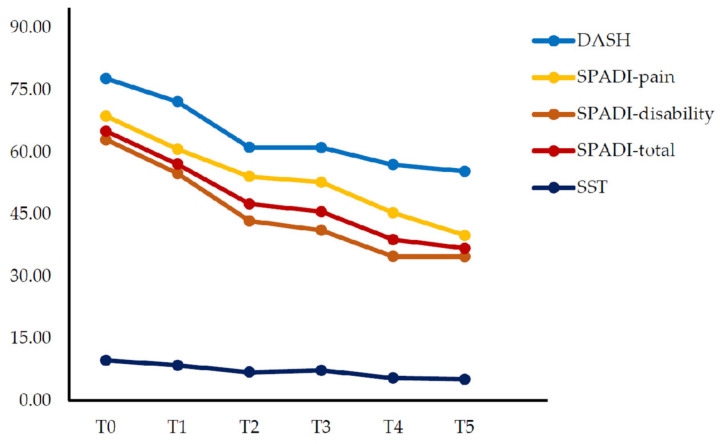
Background and Objectives: Rotator cuff tear is the most common cause of shoulder pain. If nonsurgical treatment fails, arthroscopic rotator cuff repair (ARCR) is recommended. Since the standards for rehabilitation after ARCR are not clear, various rehabilitation methods have been suggested. This study intends to investigate the effect on the recovery phase of ARCR patients through a postoperative rehabilitation protocol (PRP) that considers the healing process and rehabilitation trend. Materials and Methods: This single-arm, pragmatic intervention study was conducted on 30 patients, two weeks postoperative day (POD) after ARCR. ARCR patients received intervention for six weeks from POD two-week, and pain intensity and shoulder function were evaluated at two-week intervals until POD 12-week, and range of motion (ROM) was evaluated at POD four-week and eight-week. Results: In this study, all variables improved over time (p < 0.05). As a result of the comparison between time points, a significant improvement was found in shoulder function at POD 6-week. In addition, the effect size had a large effect on ROM (flexion, scaption flexion, abduction, and external rotation) and shoulder function. Conclusions: Management through the PRP based on scientific evidence in the strategy of postoperative rehabilitation of patients with ARCR is effective for pain intensity, ROM, and shoulder function.
肩袖撕裂是引起肩部疼痛的最常见原因。如果非手术治疗失败,推荐行关节镜下肩袖修复术(ARCR)。由于 ARCR 后康复的标准不明确,因此提出了各种康复方法。本研究旨在通过考虑愈合过程和康复趋势的术后康复方案(PRP),来研究其对 ARCR 患者康复阶段的影响。
这是一项单臂、实用干预研究,共纳入 30 例 ARCR 术后两周的患者。从术后第 2 周开始,ARCR 患者接受为期 6 周的干预,每两周评估一次疼痛强度和肩部功能,直至术后第 12 周,每 4 周和 8 周评估一次关节活动度(ROM)。
本研究中,所有变量均随时间推移而改善(p<0.05)。与时间点相比,在术后第 6 周时肩部功能有显著改善。此外,ROM(前屈、外展、外旋)和肩部功能的效应量具有较大的效果。
在 ARCR 患者的术后康复策略中,基于科学证据的 PRP 管理对疼痛强度、ROM 和肩部功能均有效。