Lodeserto Pietro, Rossi Martina, Blasi Paolo, Farruggia Giovanna, Orienti Isabella
Department of Pharmacy and Biotechnology, University of Bologna, Via San Donato 19/2, 40127 Bologna, Italy.
National Institute of Biostructures and Biosystems, Via delle Medaglie d'Oro 305, 00136 Rome, Italy.
Pharmaceutics. 2022 Jun 7;14(6):1215. doi: 10.3390/pharmaceutics14061215.
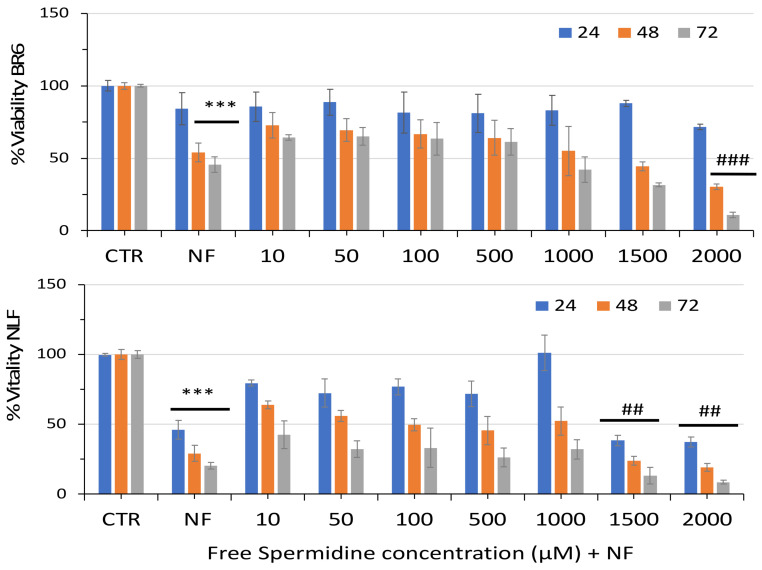
A new strategy to cause cell death in tumors might be the increase of intracellular polyamines at concentrations above their physiological values to trigger the production of oxidation metabolites at levels exceeding cell tolerance. To test this hypothesis, we prepared nanospermidine as a carrier for spermidine penetration into the cells, able to escape the polyamine transport system that strictly regulates intracellular polyamine levels. Nanospermidine was prepared by spermidine encapsulation in nanomicelles and was characterized by size, zeta potential, loading, dimensional stability to dilution, and stability to spermidine leakage. Antitumor activity, ROS production, and cell penetration ability were evaluated in vitro in two neuroblastoma cell lines (NLF and BR6). Nanospermidine was tested as a single agent and in combination with nanofenretinide. Free spermidine was also tested as a comparison. The results indicated that the nanomicelles successfully transported spermidine into the cells inducing cell death in a concentration range (150-200 μM) tenfold lower than that required to provide similar cytotoxicity with free spermidine (1500-2000 μM). Nanofenretinide provided a cytostatic effect in combination with the lowest nanospermidine concentrations evaluated and slightly improved nanospermidine cytotoxicity at the highest concentrations. These data suggest that nanospermidine has the potential to become a new approach in cancer treatment. At the cellular level, in fact, it exploits polyamine catabolism by means of biocompatible doses of spermidine and, in vivo settings, it can exploit the selective accumulation of nanomedicines at the tumor site. Nanofenretinide combination further improves its efficacy. Furthermore, the proven ability of spermidine to activate macrophages and lymphocytes suggests that nanospermidine could inhibit immunosuppression in the tumor environment.
一种导致肿瘤细胞死亡的新策略可能是将细胞内多胺浓度提高到生理值以上,以触发氧化代谢产物的产生,使其水平超过细胞耐受程度。为了验证这一假设,我们制备了纳米亚精胺作为亚精胺进入细胞的载体,它能够避开严格调节细胞内多胺水平的多胺转运系统。纳米亚精胺是通过将亚精胺包裹在纳米胶束中制备的,并通过尺寸、zeta电位、载药量、稀释后的尺寸稳定性以及亚精胺泄漏稳定性进行表征。在两种神经母细胞瘤细胞系(NLF和BR6)中体外评估了其抗肿瘤活性、活性氧生成以及细胞穿透能力。纳米亚精胺作为单一药物进行了测试,并与纳米维甲酸联合使用。游离亚精胺也作为对照进行了测试。结果表明,纳米胶束成功地将亚精胺转运到细胞中,在浓度范围(150 - 200μM)内诱导细胞死亡,该浓度比游离亚精胺产生类似细胞毒性所需的浓度(1500 - 2000μM)低十倍。纳米维甲酸与评估的最低纳米亚精胺浓度联合使用时具有细胞生长抑制作用,并且在最高浓度时略微提高了纳米亚精胺的细胞毒性。这些数据表明纳米亚精胺有潜力成为癌症治疗的一种新方法。事实上,在细胞水平上,它通过生物相容性剂量的亚精胺利用多胺分解代谢,在体内环境中,它可以利用纳米药物在肿瘤部位的选择性积累。纳米维甲酸联合使用进一步提高了其疗效。此外亚精胺激活巨噬细胞和淋巴细胞的能力已得到证实,这表明纳米亚精胺可以抑制肿瘤环境中的免疫抑制作用。