Biomedical Engineering Research Group-GIIB, Universidad Politécnica Salesiana (UPS), Cuenca 010105, Ecuador.
Department of Electrical Engineering, Universidade Federal do Espírito Santo (UFES), Vitoria 29075-910, Brazil.
Sensors (Basel). 2022 Jun 8;22(12):4341. doi: 10.3390/s22124341.
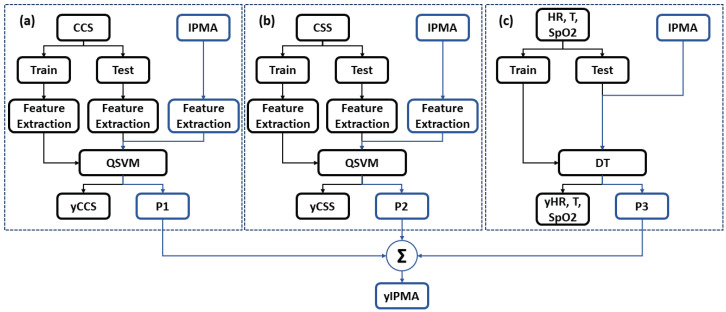
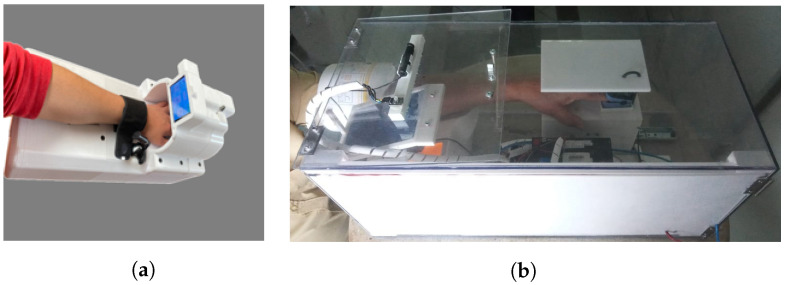
COVID-19 occurs due to infection through respiratory droplets containing the SARS-CoV-2 virus, which are released when someone sneezes, coughs, or talks. The gold-standard exam to detect the virus is Real-Time Polymerase Chain Reaction (RT-PCR); however, this is an expensive test and may require up to 3 days after infection for a reliable result, and if there is high demand, the labs could be overwhelmed, which can cause significant delays in providing results. Biomedical data (oxygen saturation level-SpO2, body temperature, heart rate, and cough) are acquired from individuals and are used to help infer infection by COVID-19, using machine learning algorithms. The goal of this study is to introduce the Integrated Portable Medical Assistant (IPMA), which is a multimodal piece of equipment that can collect biomedical data, such as oxygen saturation level, body temperature, heart rate, and cough sound, and helps infer the diagnosis of COVID-19 through machine learning algorithms. The IPMA has the capacity to store the biomedical data for continuous studies and can be used to infer other respiratory diseases. Quadratic kernel-free non-linear Support Vector Machine (QSVM) and Decision Tree (DT) were applied on three datasets with data of cough, speech, body temperature, heart rate, and SpO2, obtaining an Accuracy rate (ACC) and Area Under the Curve (AUC) of approximately up to 88.0% and 0.85, respectively, as well as an ACC up to 99% and AUC = 0.94, respectively, for COVID-19 infection inference. When applied to the data acquired with the IMPA, these algorithms achieved 100% accuracy. Regarding the easiness of using the equipment, 36 volunteers reported that the IPMA has a high usability, according to results from two metrics used for evaluation: System Usability Scale (SUS) and Post Study System Usability Questionnaire (PSSUQ), with scores of 85.5 and 1.41, respectively. In light of the worldwide needs for smart equipment to help fight the COVID-19 pandemic, this new equipment may help with the screening of COVID-19 through data collected from biomedical signals and cough sounds, as well as the use of machine learning algorithms.
COVID-19 是由含有 SARS-CoV-2 病毒的呼吸道飞沫感染引起的,当有人打喷嚏、咳嗽或说话时,这些飞沫就会释放出来。检测病毒的金标准是实时聚合酶链反应(RT-PCR);然而,这是一种昂贵的测试,在感染后可能需要长达 3 天才能得到可靠的结果,如果需求很高,实验室可能会不堪重负,这会导致结果提供的严重延迟。生物医学数据(血氧饱和度-SpO2、体温、心率和咳嗽)是从个体身上获得的,用于帮助通过机器学习算法推断 COVID-19 的感染。本研究的目的是介绍集成便携式医疗助手(IPMA),这是一种多模态设备,可以采集生物医学数据,如血氧饱和度、体温、心率和咳嗽声,并通过机器学习算法帮助推断 COVID-19 的诊断。IPMA 有能力存储生物医学数据进行连续研究,并可用于推断其他呼吸道疾病。二次核自由非线性支持向量机(QSVM)和决策树(DT)应用于三个数据集,数据包括咳嗽、语音、体温、心率和 SpO2,获得了大约 88.0%和 0.85 的准确率(ACC)和曲线下面积(AUC),以及高达 99%的 ACC 和 AUC=0.94,分别用于 COVID-19 感染推断。当应用于使用 IMPA 获得的数据时,这些算法的准确率达到了 100%。关于设备使用的易用性,根据用于评估的两个指标:系统可用性量表(SUS)和研究后系统可用性问卷(PSSUQ),36 名志愿者报告说 IPMA 的可用性很高,得分分别为 85.5 和 1.41。鉴于全球对帮助抗击 COVID-19 大流行的智能设备的需求,这种新设备可以通过收集生物医学信号和咳嗽声音的数据以及使用机器学习算法来帮助筛选 COVID-19。