Yuan Baohong, Sun Zhifeng, Lu Mingmin, Lillehoj Hyun, Lee Youngsub, Liu Liheng, Yan Xianghe, Yang Danchen Aaron, Li Charles
Animal Bioscience and Biotechnology Laboratory, Agricultural Research Service (ARS), United States Department of Agriculture (USDA), Beltsville, MD 20705, USA.
School of Basic Medicine Sciences, Guangdong Pharmaceutical University, Guangzhou 510006, China.
Vaccines (Basel). 2022 Jun 20;10(6):979. doi: 10.3390/vaccines10060979.
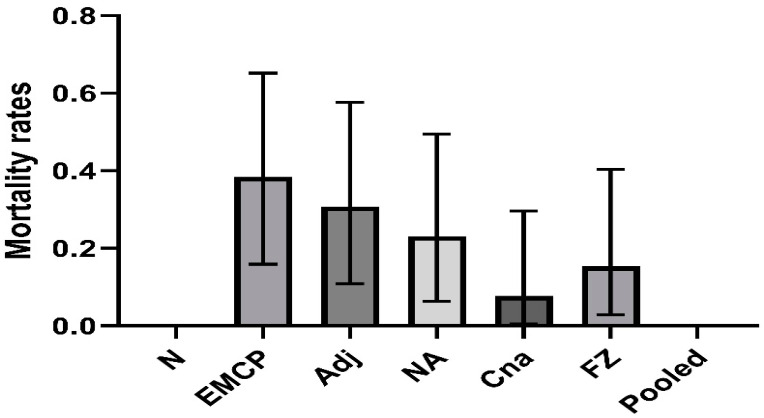
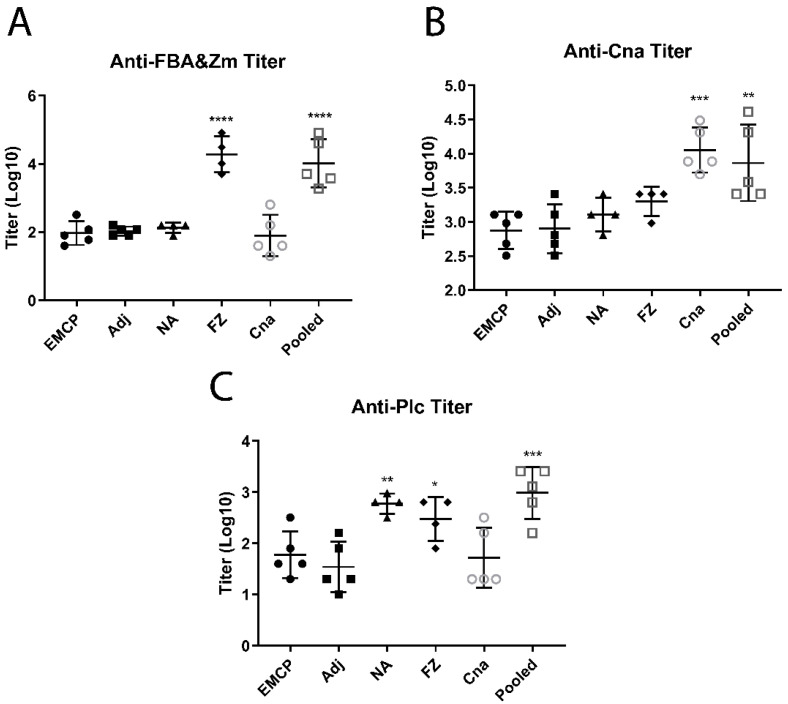
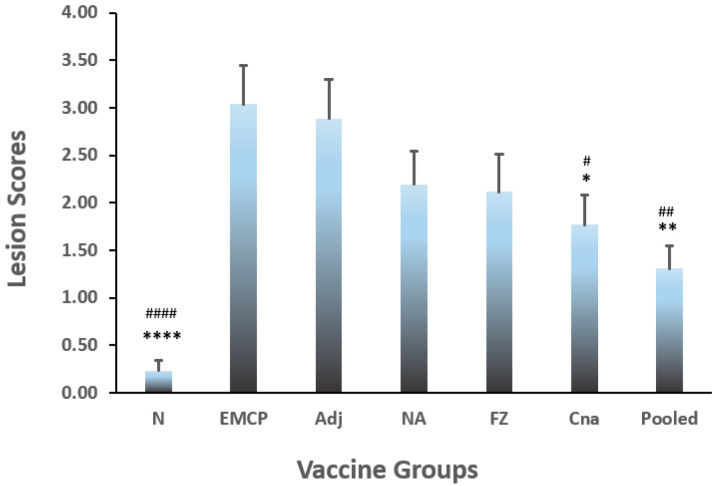
Necrotic enteritis (NE) is a multifactorial and important enteric infectious disease etiologically caused by pathogenic C. perfringens infection, accounting for the estimated loss of around USD 6 billion in the global poultry industry. The increasing incidence of NE was found to be associated with the voluntary reduction or withdrawal of antibiotic growth promoters from animal feed during recent years. Therefore, the development of effective vaccines specific to NE assumes a priority for the poultry industry. This study aimed to identify the potential C. perfringens proteins as vaccine targets for NE. Three recombinant C. perfringens proteins targeting five antigens were prepared: two chimeric proteins (alpha-toxin and NetB, fructose-1,6-bisphosphate aldolase (FBA) and a zinc metalloprotease (Zm)), and one single collagen adhesion protein (Cna). Their protection efficacies were evaluated with a potent challenge model of Eimeria maxima/C. perfringens dual infections using a netB+tpeL+ C. perfringens strain. Young chicks were immunized twice subcutaneously with adjuvanted C. perfringens proteins on Days 4 and 15. At six days after the second immunization, the chickens immunized with Cna, FBA, and Zm antigens, and alpha-toxin had much higher serum antibody titers than unvaccinated controls prior to the challenge. Following the challenge, the pooled antigen-immunized group demonstrated no mortality and the least lesion scores against virulent challenge. The results indicate that the immunization with multicomponent antigens, including C. perfringens housekeeping protein Cna, may confer partial protection.
坏死性肠炎(NE)是一种多因素引起的重要肠道传染病,病因是产气荚膜梭菌感染,据估计给全球家禽业造成约60亿美元的损失。近年来发现,NE发病率的上升与动物饲料中抗生素生长促进剂的自愿减少或停用有关。因此,开发针对NE的有效疫苗成为家禽业的当务之急。本研究旨在确定产气荚膜梭菌潜在的蛋白质作为NE的疫苗靶点。制备了三种针对五种抗原的重组产气荚膜梭菌蛋白:两种嵌合蛋白(α毒素和NetB、果糖-1,6-二磷酸醛缩酶(FBA)和一种锌金属蛋白酶(Zm)),以及一种单一的胶原蛋白粘附蛋白(Cna)。使用netB+tpeL+产气荚膜梭菌菌株,通过巨型艾美耳球虫/产气荚膜梭菌双重感染的有效攻毒模型评估它们的保护效果。在第4天和第15天,用佐剂化的产气荚膜梭菌蛋白对幼雏进行两次皮下免疫。第二次免疫后6天,用Cna、FBA、Zm抗原和α毒素免疫的鸡在攻毒前的血清抗体滴度比未接种疫苗的对照组高得多。攻毒后,联合抗原免疫组未出现死亡,对强毒攻击的病变评分最低。结果表明,用包括产气荚膜梭菌管家蛋白Cna在内的多组分抗原进行免疫可能提供部分保护。