Maldonado David R, Fox James D, Kyin Cynthia, Jimenez Andrew E, Saks Benjamin R, Curley Andrew J, Lall Ajay C, Domb Benjamin G
American Hip Institute Research Foundation, Chicago, Illinois, U.S.A.
American Hip Institute, Chicago, Illinois, U.S.A.
Arthrosc Sports Med Rehabil. 2022 Apr 20;4(3):e1007-e1013. doi: 10.1016/j.asmr.2022.02.004. eCollection 2022 Jun.
To determine the percent maximal outcome improvement willingness thresholds (MOWTs) for the Nonarthritic Hip Score (NAHS) and the visual analog scale (VAS) for pain that were associated with a patient's willingness to undergo surgery, in retrospect, given the known outcome of their primary hip arthroscopy with concomitant endoscopy for gluteus medius (GM) tear repair.
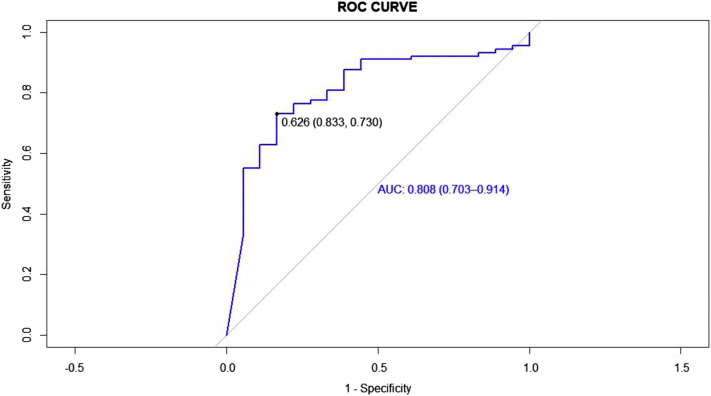
An anchor question was provided to patients who underwent primary hip arthroscopy for femoroacetabular impingement syndrome with concomitant endoscopic GM tear repair between April 2008 to April 2020. Patients were included if they answered the anchor question and had baseline and postoperative minimum 1-year follow-up scores for the NAHS and VAS. Patients were excluded if they had a previous ipsilateral hip surgery, Tönnis grade >1, hip dysplasia, previous hip conditions, or a preoperative score that was already at the maximum value for the NAHS and VAS scores. Receiver operating characteristic (ROC) analysis was used to determine the MOWT. Significance was indicated by a value <.05.
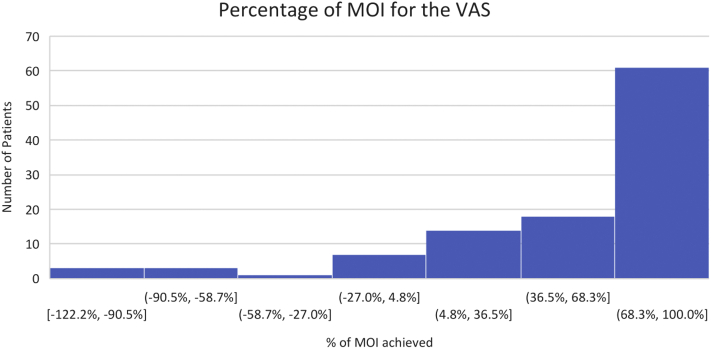
A total of 107 patients (107 hips) were included, with 101 (94.4%) females and 6 (5.6%) males. The average age and body mass index was 56.20 ± 9.88 years and 28.80 ± 4.92 kg/m, respectively. The average follow-up time was 54.89 ± 29.52 months. The ROC analysis determined that the MOWT for the mHHS and VAS were 54.7%, and 62.6%, respectively. The probability of a patient being willing to undergo surgery again if they met the MOWT was 85.8% and 85.6% for the NAHS and VAS, respectively.
The MOWTs that were predictive of willingness to undergo surgery again following primary hip arthroscopy with concomitant endoscopy for GM tear repair were 54.7% and 62.6% for the NAHS, and VAS, respectively.
Outcome assessment has been a point of increasing emphasis in hip preservation surgery. Having a tool to measure whether patients would go through the process of surgery again knowing their current outcome status is important to understanding outcomes after surgery.
回顾性确定非关节炎性髋关节评分(NAHS)和疼痛视觉模拟量表(VAS)的最大结果改善意愿阈值(MOWT),这些阈值与患者接受手术的意愿相关,已知其初次髋关节镜检查并同时进行内镜下臀中肌(GM)撕裂修复的结果。
向2008年4月至2020年4月期间因股骨髋臼撞击综合征接受初次髋关节镜检查并同时进行内镜下GM撕裂修复的患者提供一个锚定问题。如果患者回答了锚定问题并具有NAHS和VAS的基线及术后至少1年的随访评分,则纳入研究。如果患者既往有同侧髋关节手术史、Tönnis分级>1、髋关节发育不良、既往髋关节疾病,或术前评分已达到NAHS和VAS评分的最大值,则排除在外。采用受试者操作特征(ROC)分析来确定MOWT。P值<.05表示有统计学意义。
共纳入107例患者(107髋),其中女性101例(94.4%),男性6例(5.6%)。平均年龄和体重指数分别为56.20±9.88岁和28.80±4.92kg/m²。平均随访时间为54.89±29.52个月。ROC分析确定,NAHS和VAS的MOWT分别为54.7%和62.6%。如果患者达到MOWT,其再次愿意接受手术的概率,NAHS和VAS分别为85.8%和85.6%。
对于NAHS和VAS,预测初次髋关节镜检查并同时进行内镜下GM撕裂修复后再次接受手术意愿的MOWT分别为54.7%和62.6%。
结果评估在髋关节保留手术中越来越受到重视。拥有一种工具来衡量患者在知晓其当前结果状态的情况下是否会再次经历手术过程,对于理解手术后的结果很重要。