Students Research Committee, School of Medicine, Ardabil University of Medical Sciences, Ardabil, Iran.
School of Medicine and Allied Medical Sciences, Ardabil University of Medical Sciences, Ardabil, Iran.
J Mol Neurosci. 2022 Sep;72(9):1820-1830. doi: 10.1007/s12031-022-02039-1. Epub 2022 Jun 24.
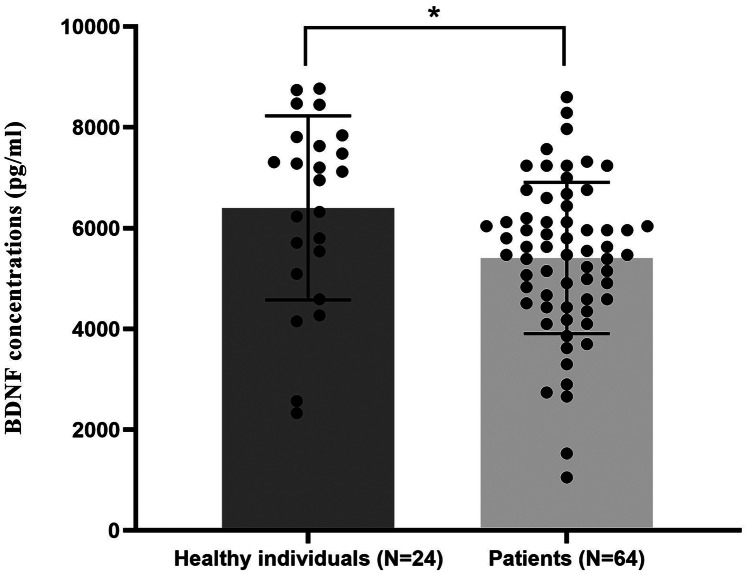
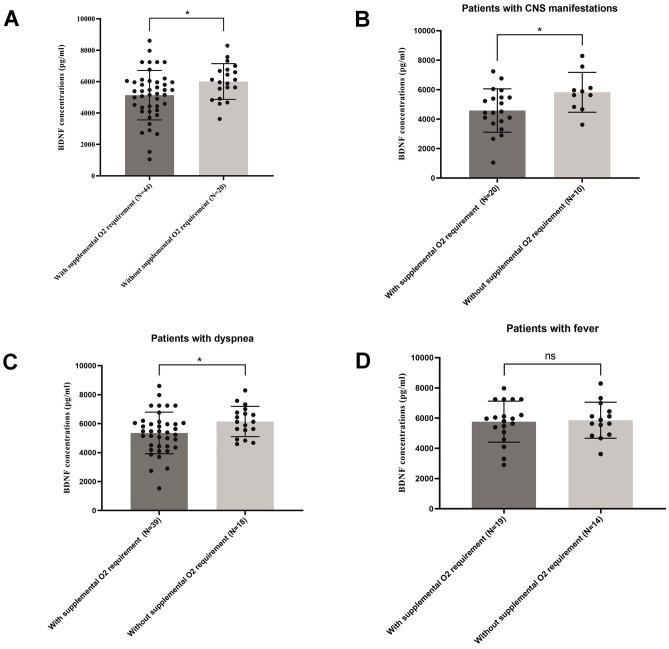
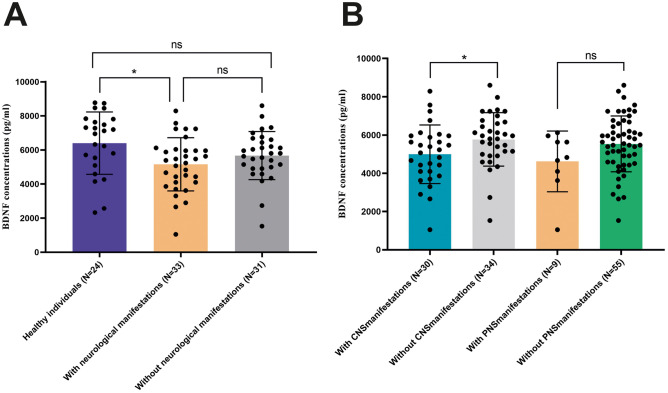
COVID-19 is a systematic disease that frequently implies neurological and non-neurological manifestations, predominantly by inducing hypoxia. Brain-derived neurotrophic factor (BDNF) is a key factor in regulating functions of nervous and respiratory systems and has been strongly related to hypoxia. Therefore, this study planned to investigate BDNF association with the COVID-19 manifestations especially neurological impairments and the infection-induced hypoxia. We enrolled sixty-four COVID-19 patients and twenty-four healthy individuals in this study. Patients were divided into two groups, with and without neurological manifestations, and their serum BDNF levels were measured by enzyme-linked immunosorbent assay (ELISA). COVID-19 patients had significantly lower BDNF levels than healthy individuals (p = 0.023). BDNF levels were significantly lower in patients with neurological manifestations compared to healthy individuals (p = 0.010). However, we did not observe a statistically significant difference in BDNF levels between patients with and without neurological manifestations (p = 0.175). BDNF's levels were significantly lower in patients with CNS manifestations (p = 0.039) and higher in patients with fever (p = 0.03) and dyspnea (p = 0.006). Secondly, BDNF levels have a significant negative association with oxygen therapy requirement (p = 0.015). These results strongly suggest the critical association between dysregulated BDNF and hypoxia in promoting COVID-19 manifestations, particularly neurological impairments.
新型冠状病毒肺炎(COVID-19)是一种系统性疾病,常伴有神经和非神经表现,主要通过诱导缺氧来实现。脑源性神经营养因子(BDNF)是调节神经和呼吸系统功能的关键因素,与缺氧密切相关。因此,本研究旨在探讨 BDNF 与 COVID-19 表现(特别是神经损伤)和感染诱导的缺氧之间的关系。我们纳入了 64 名 COVID-19 患者和 24 名健康对照者进行研究。患者分为有神经表现和无神经表现两组,通过酶联免疫吸附试验(ELISA)检测其血清 BDNF 水平。COVID-19 患者的 BDNF 水平显著低于健康对照组(p=0.023)。有神经表现的患者 BDNF 水平明显低于健康对照组(p=0.010)。然而,我们并未观察到有神经表现和无神经表现的 COVID-19 患者之间 BDNF 水平存在统计学差异(p=0.175)。有中枢神经系统(CNS)表现的患者 BDNF 水平显著降低(p=0.039),发热(p=0.03)和呼吸困难(p=0.006)患者的 BDNF 水平较高。其次,BDNF 水平与氧疗需求呈显著负相关(p=0.015)。这些结果强烈提示,BDNF 失调与缺氧在促进 COVID-19 表现,特别是神经损伤方面存在密切关联。