Nepal Injury Research Centre, Kathmandu Medical College Public Limited, P O Box 21266, Kathmandu, Nepal.
Centre for Public Health and Wellbeing, University of the West of England, Bristol, UK.
BMC Psychiatry. 2022 Jun 25;22(1):429. doi: 10.1186/s12888-022-04074-z.
Suicide is a significant public health concern in Nepal and there is a need for an evidence-based suicide prevention programme to facilitate stakeholders working towards suicide prevention in Nepal. Collaborative research between stakeholders focussing on shared priorities can help to prevent and control suicide. Hence, we aimed to develop a consensus list of research priorities for suicide prevention in Nepal.
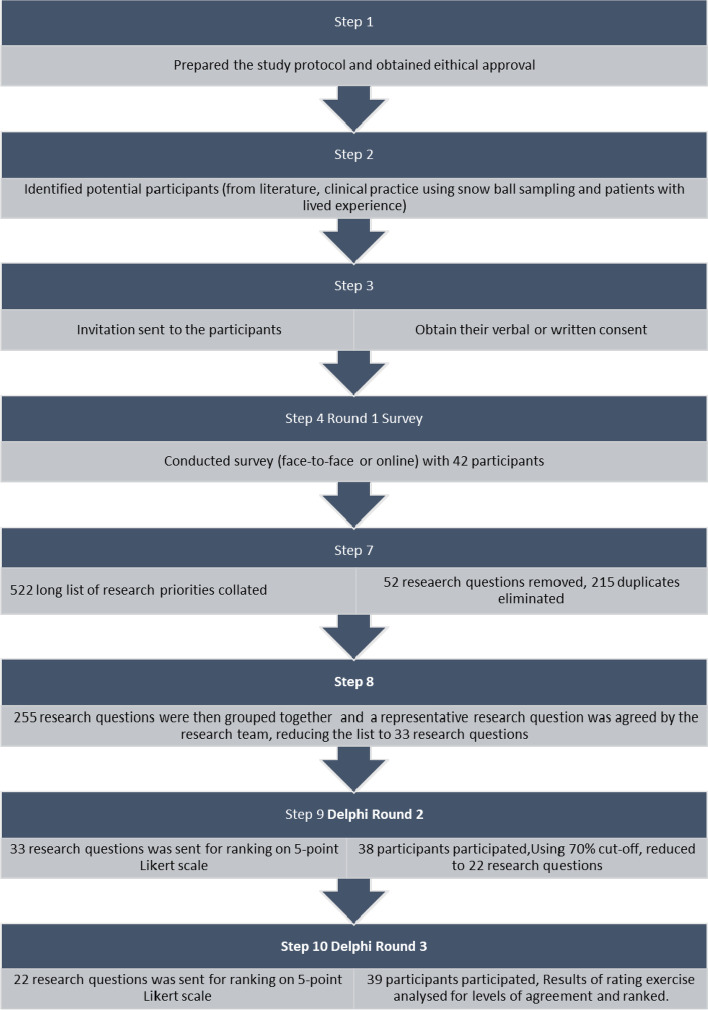
The Delphi expert consensus method was used to elicit the prioritized research questions for suicide prevention in Nepal. Participants comprised suicide prevention experts (psychologists, psychiatrists, psychiatric nurses, researchers and advocates) and people with lived experience. Three rounds of Delphi were conducted; round 1: one to one interviews involving open ended questions used to generate research questions; round 2: ranking of the research questions using a 5-point Likert scale, and round 3: re-ranking of research questions in light of individual and group responses.
Forty-two participants participated in round 1 followed by 38 in round 2 and 39 in round 3 . 522 research questions were generated through round 1 which were grouped together and reduced to 33 research questions sent for ranking in round 2. Using a cut off of at least 70% of the panel ranking questions as 'very important' or 'important', 22 questions were retained. These research questions were sent for re-rating in round 3 resulting in a final list of prioritized questions.
This is the first expert consensus study to identify the top research priorities for suicide prevention in Nepal, and used experts in suicide prevention and those with lived experience. A consensus was reached regarding the studies needed to improve suicide data quality, assess the burden and identify factors associated with suicide. A priority driven approach to suicide prevention research may ensure that the research endeavour provides the most useful information for those whose day-to-day work involves trying to prevent suicide.
自杀是尼泊尔一个重大的公共卫生问题,需要制定一个基于证据的预防自杀方案,以促进尼泊尔各利益攸关方开展预防自杀工作。利益攸关方之间专注于共同优先事项的合作研究有助于预防和控制自杀。因此,我们旨在制定尼泊尔预防自杀的研究重点清单。
采用德尔菲专家共识法,征集尼泊尔预防自杀的优先研究问题。参与者包括预防自杀专家(心理学家、精神科医生、精神科护士、研究人员和倡导者)以及有自杀经历的人。进行了三轮德尔菲调查;第一轮:一对一访谈,采用开放式问题,以生成研究问题;第二轮:使用 5 分制李克特量表对研究问题进行排名;第三轮:根据个人和小组的回应重新对研究问题进行排名。
42 名参与者参加了第一轮,随后 38 名参与者参加了第二轮,39 名参与者参加了第三轮。第一轮共提出了 522 个研究问题,这些问题被分组并简化为 33 个研究问题,发送给第二轮进行排名。使用至少 70%的专家小组将问题评为“非常重要”或“重要”的标准,保留了 22 个问题。这些研究问题在第三轮中重新进行了评分,最终确定了一份优先研究问题清单。
这是第一项确定尼泊尔预防自杀研究重点的专家共识研究,研究对象包括预防自杀专家和有自杀经历的人。专家组就改善自杀数据质量、评估负担以及确定与自杀相关的因素所需的研究达成了共识。以优先事项为导向的预防自杀研究方法可能确保研究成果为那些日常工作涉及预防自杀的人提供最有用的信息。