Lee Hyuk Joo, Hong Jung Kyung, Choi Hayun, Chung Seockhoon, Yoon In-Young
Department of Public Medical Service, Seoul National University Bundang Hospital, Seongnam, Republic of Korea.
Department of Psychiatry, Seoul National University Bundang Hospital, Seongnam, Republic of Korea.
Psychiatry Investig. 2022 Jun;19(6):451-461. doi: 10.30773/pi.2021.0374. Epub 2022 Jun 15.
Insomnia disorder is a common condition with considerable harmful effects on health. We investigated the therapeutic efficacy and safety of low-frequency transcutaneous electric nerve stimulation (LF-TENS) as an alternative treatment option for insomnia disorder.
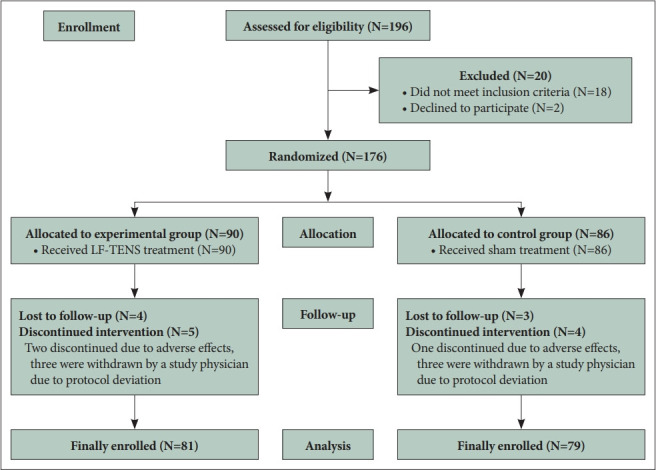
A 4-week, multi-center, randomized controlled study was conducted. A total of 160 individuals aged 40 to 80 years with insomnia disorder were included and randomized to the experimental group receiving active device (n=81) or control group receiving sham device (n=79). Both groups used the device for four weeks, more than five days a week. The participants also completed pre- and post-intervention assessment with questionnaires, sleep diaries, wrist actigraphy, and blood tests.
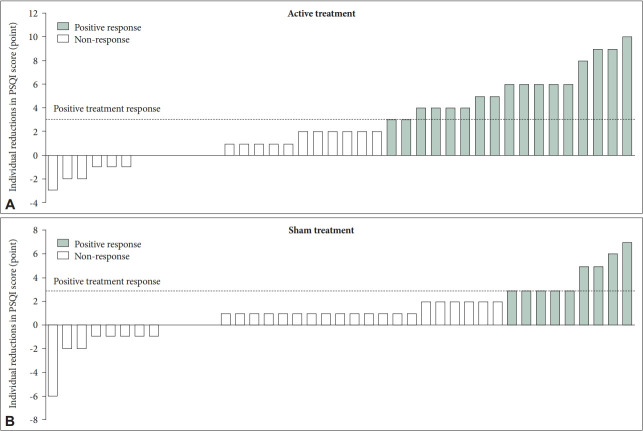
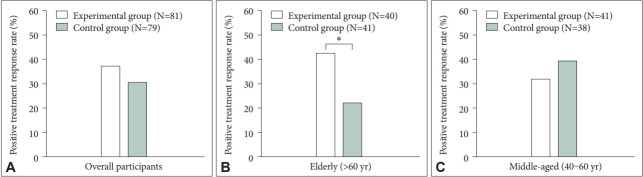
There was no significant between-group difference in the changes of mood and sleep parameters and blood test results among the two study groups. Meanwhile, in the exploratory sub-group analysis of patients aged over 60 years, the experimental group showed better improvement after intervention in the change of Pittsburgh Sleep Quality Index (PSQI) score (-2.63±3.25 vs. -1.20±2.28, p=0.039; Cohen's d=0.99 vs. 0.45) and blood cortisol level (-1.65±3.37 μg/dL vs. -0.16±3.49 μg/dL, p=0.007; Cohen's d=0.56 vs. 0.05). In addition, no serious adverse reaction occurred during the study period in both groups.
The effect of LF-TENS was limited to older patients aged over 60 years, which might be related to the modulation of hypothalamic-pituitary-adrenal axis activity.
失眠症是一种常见病症,对健康有相当大的有害影响。我们研究了低频经皮电神经刺激(LF-TENS)作为失眠症替代治疗方案的疗效和安全性。
进行了一项为期4周的多中心随机对照研究。共纳入160名年龄在40至80岁的失眠症患者,随机分为接受有源设备的实验组(n = 81)或接受假设备的对照组(n = 79)。两组均使用该设备四周,每周使用超过五天。参与者还通过问卷、睡眠日记、手腕活动记录仪和血液检测完成了干预前后的评估。
两个研究组在情绪、睡眠参数变化和血液检测结果方面没有显著的组间差异。同时,在60岁以上患者的探索性子组分析中,实验组在匹兹堡睡眠质量指数(PSQI)评分变化(-2.63±3.25 vs. -1.20±2.28,p = 0.039;Cohen's d = 0.99 vs. 0.45)和血液皮质醇水平(-1.65±3.37μg/dL vs. -0.16±3.49μg/dL,p = 0.007;Cohen's d = 0.56 vs. 0.05)方面干预后改善更好。此外,两组在研究期间均未发生严重不良反应。
LF-TENS的效果仅限于60岁以上的老年患者,这可能与下丘脑 - 垂体 - 肾上腺轴活动的调节有关。