Shirai Yuya, Nakanishi Yoshimitsu, Suzuki Akari, Konaka Hachirou, Nishikawa Rika, Sonehara Kyuto, Namba Shinichi, Tanaka Hiroaki, Masuda Tatsuo, Yaga Moto, Satoh Shingo, Izumi Mayuko, Mizuno Yumiko, Jo Tatsunori, Maeda Yuichi, Nii Takuro, Oguro-Igashira Eri, Morisaki Takayuki, Kamatani Yoichiro, Nakayamada Shingo, Nishigori Chikako, Tanaka Yoshiya, Takeda Yoshito, Yamamoto Kazuhiko, Kumanogoh Atsushi, Okada Yukinori
Department of Statistical Genetics, Osaka University Graduate School of Medicine, Suita, Japan.
Department of Respiratory Medicine and Clinical Immunology, Osaka University Graduate School of Medicine, Suita, Japan.
Ann Rheum Dis. 2022 Aug 11;81(9):1301-1312. doi: 10.1136/annrheumdis-2022-222460.
Autoimmune and allergic diseases are outcomes of the dysregulation of the immune system. Our study aimed to elucidate differences or shared components in genetic backgrounds between autoimmune and allergic diseases.
We estimated genetic correlation and performed multi-trait and cross-population genome-wide association study (GWAS) meta-analysis of six immune-related diseases: rheumatoid arthritis, Graves' disease, type 1 diabetes for autoimmune diseases and asthma, atopic dermatitis and pollinosis for allergic diseases. By integrating large-scale biobank resources (Biobank Japan and UK biobank), our study included 105 721 cases and 433 663 controls. Newly identified variants were evaluated in 21 778 cases and 712 767 controls for two additional autoimmune diseases: psoriasis and systemic lupus erythematosus. We performed enrichment analyses of cell types and biological pathways to highlight shared and distinct perspectives.
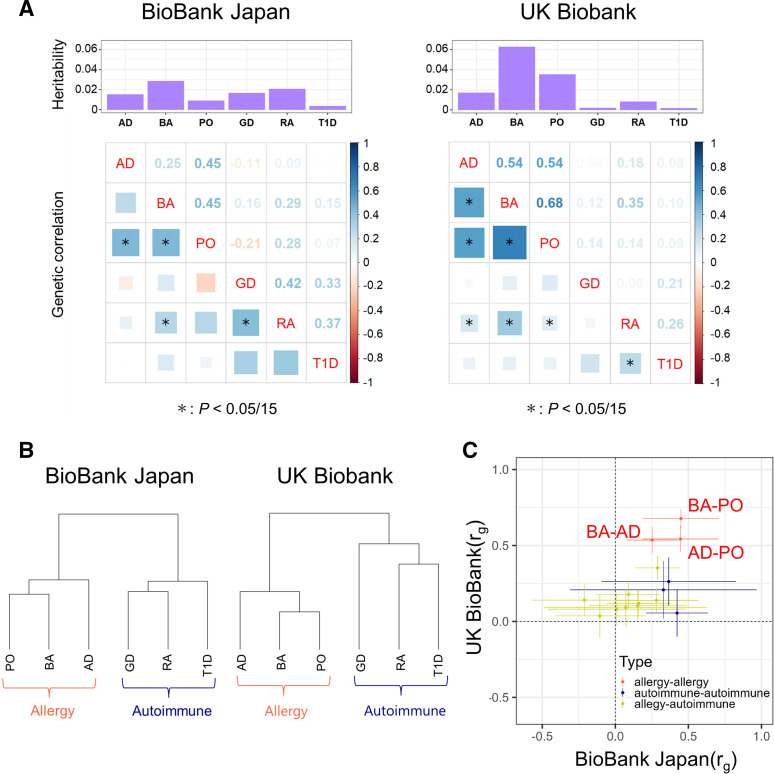
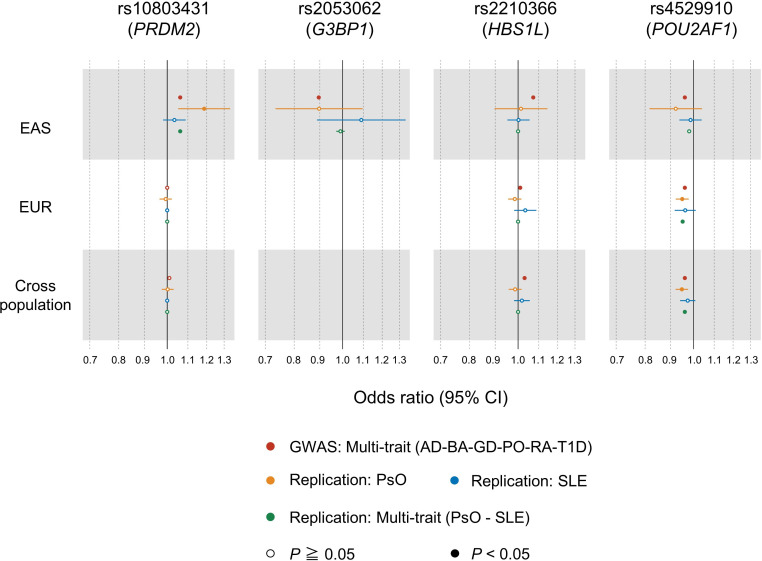
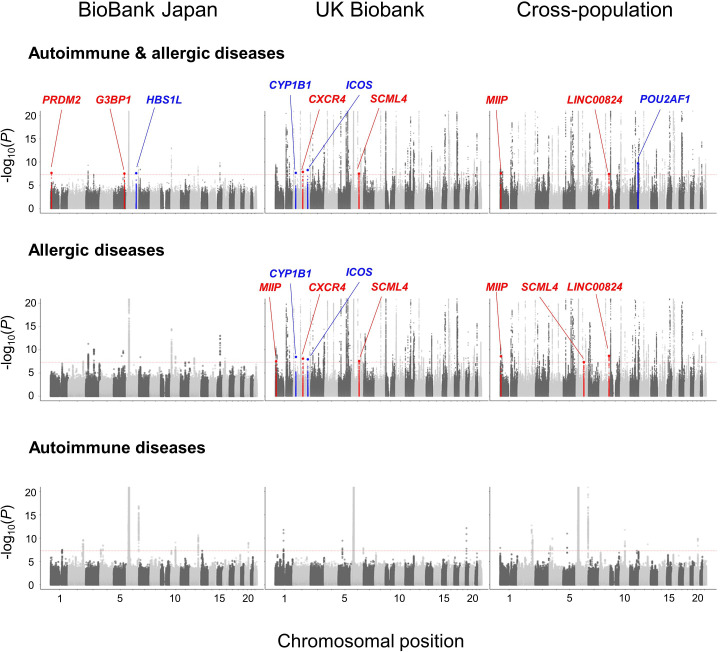
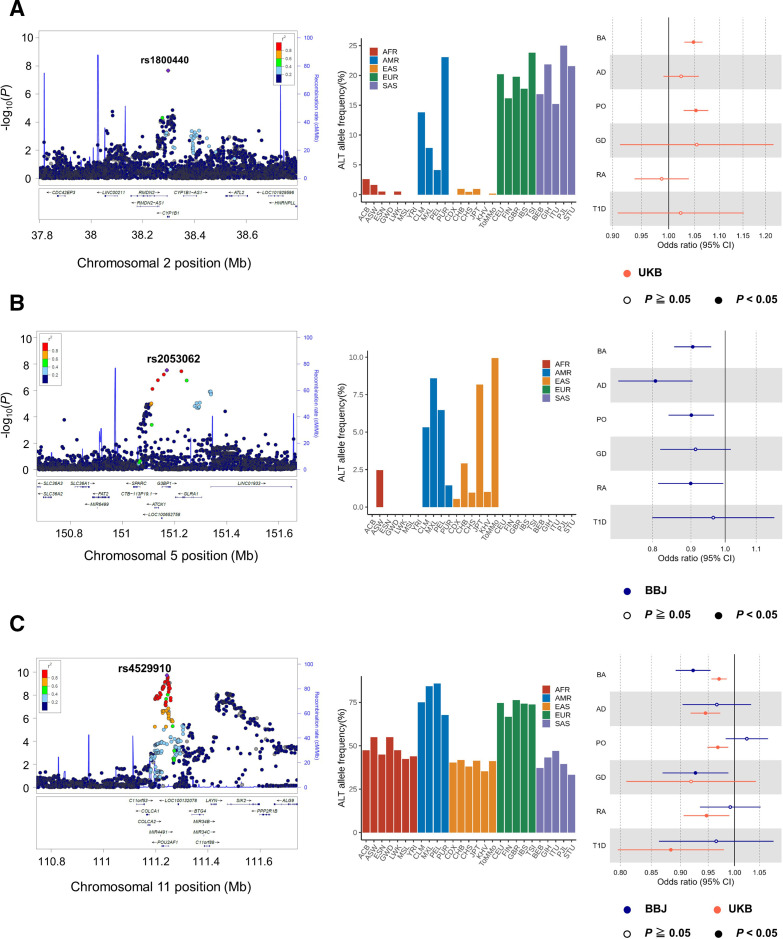
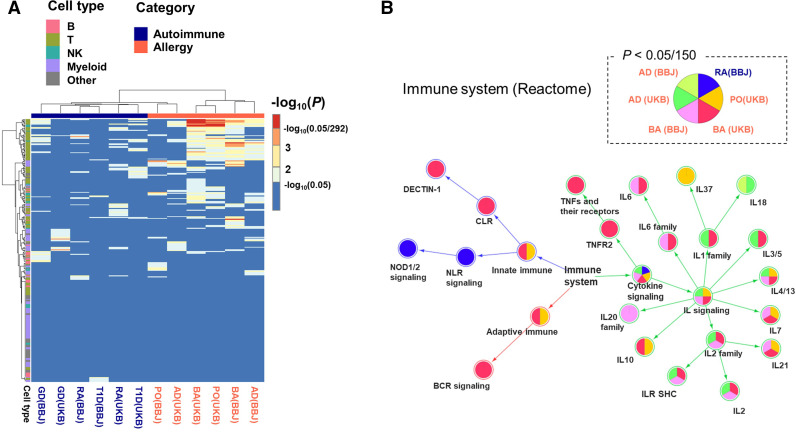
Autoimmune and allergic diseases were not only mutually classified based on genetic backgrounds but also they had multiple positive genetic correlations beyond the classifications. Multi-trait GWAS meta-analysis newly identified six allergic disease-associated loci. We identified four loci shared between the six autoimmune and allergic diseases (rs10803431 at , OR=1.07, p=2.3×10, rs2053062 at , OR=0.90, p=2.9×10, rs2210366 at , OR=1.07, p=2.5×10 in Japanese and rs4529910 at , OR=0.96, p=1.9×10 across ancestries). Associations of rs10803431 and rs4529910 were confirmed at the two additional autoimmune diseases. Enrichment analysis demonstrated link to T cells, natural killer cells and various cytokine signals, including innate immune pathways.
Our multi-trait and cross-population study should elucidate complex pathogenesis shared components across autoimmune and allergic diseases.
自身免疫性疾病和过敏性疾病是免疫系统失调的结果。我们的研究旨在阐明自身免疫性疾病和过敏性疾病在遗传背景上的差异或共同成分。
我们估计了遗传相关性,并对六种免疫相关疾病进行了多性状和跨人群全基因组关联研究(GWAS)荟萃分析,这六种疾病分别是:自身免疫性疾病中的类风湿性关节炎、格雷夫斯病、1型糖尿病,以及过敏性疾病中的哮喘、特应性皮炎和花粉症。通过整合大规模生物样本库资源(日本生物样本库和英国生物样本库),我们的研究纳入了105721例病例和433663例对照。在另外两种自身免疫性疾病——银屑病和系统性红斑狼疮的21778例病例和712767例对照中,对新发现的变异进行了评估。我们对细胞类型和生物途径进行了富集分析,以突出共同和不同的方面。
自身免疫性疾病和过敏性疾病不仅根据遗传背景相互分类,而且在分类之外还存在多个正遗传相关性。多性状GWAS荟萃分析新发现了六个与过敏性疾病相关的基因座。我们在六种自身免疫性疾病和过敏性疾病之间鉴定出四个共同的基因座(日本人群中位于的rs10803431,比值比=1.07,p=2.3×10;位于的rs2053062,比值比=0.90,p=2.9×10;位于的rs2210366,比值比=1.07,p=2.5×10;以及不同祖先人群中位于的rs4529910,比值比=0.96,p=1.9×10)。rs10803431和rs4529910的关联在另外两种自身免疫性疾病中得到了证实。富集分析表明与T细胞、自然杀伤细胞以及各种细胞因子信号有关,包括先天免疫途径。
我们的多性状和跨人群研究应能阐明自身免疫性疾病和过敏性疾病之间复杂的共同发病机制成分。