Genomics and Health Group, Department of Biochemistry, Microbiology, Cell Biology and Genetics, Universidad de La Laguna (ULL), San Cristóbal de La Laguna, Tenerife, Spain.
Division of Respiratory Medicine, Department of Internal Medicine, Mayo Clinic, Scottsdale, Arizona, USA.
Pediatr Allergy Immunol. 2022 Jun;33(6):e13802. doi: 10.1111/pai.13802.
Asthma exacerbations are a serious public health concern due to high healthcare resource utilization, work/school productivity loss, impact on quality of life, and risk of mortality. The genetic basis of asthma exacerbations has been studied in several populations, but no prior study has performed a multi-ancestry meta-analysis of genome-wide association studies (meta-GWAS) for this trait. We aimed to identify common genetic loci associated with asthma exacerbations across diverse populations and to assess their functional role in regulating DNA methylation and gene expression.
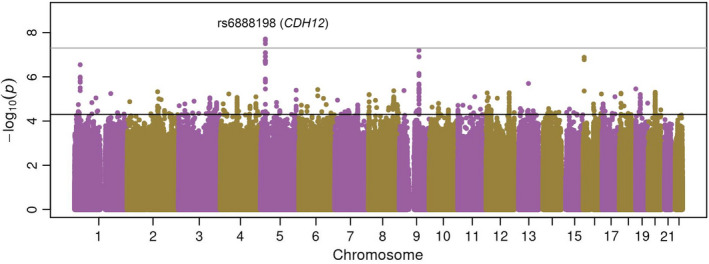
A meta-GWAS of asthma exacerbations in 4989 Europeans, 2181 Hispanics/Latinos, 1250 Singaporean Chinese, and 972 African Americans analyzed 9.6 million genetic variants. Suggestively associated variants (p ≤ 5 × 10 ) were assessed for replication in 36,477 European and 1078 non-European asthma patients. Functional effects on DNA methylation were assessed in 595 Hispanic/Latino and African American asthma patients and in publicly available databases. The effect on gene expression was evaluated in silico.
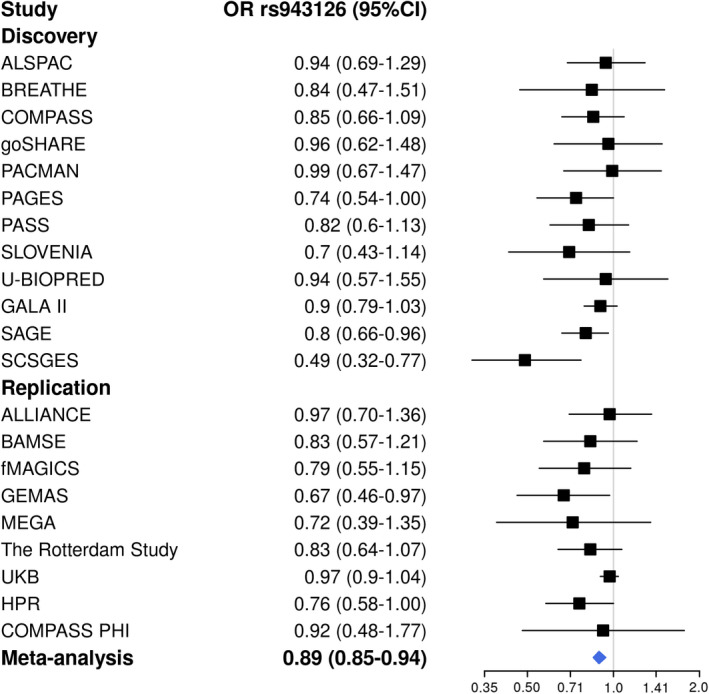
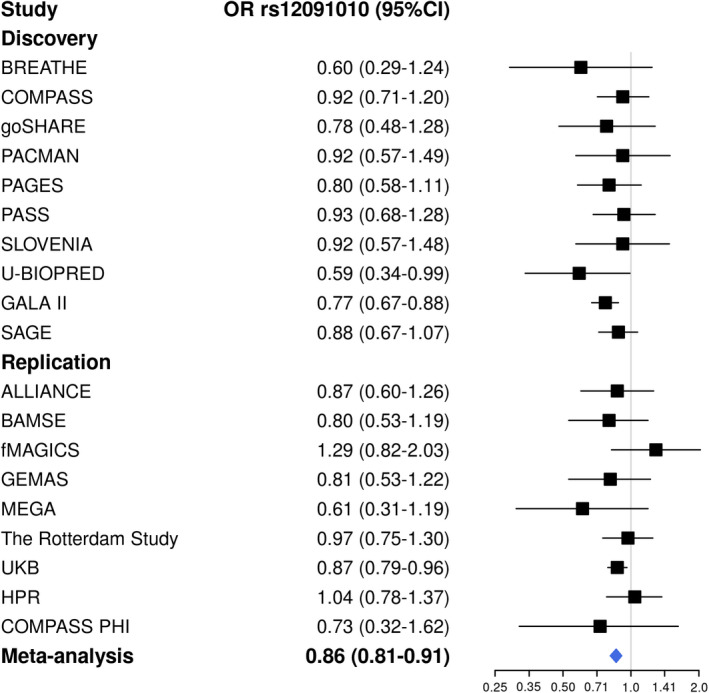
One hundred and twenty-six independent variants were suggestively associated with asthma exacerbations in the discovery phase. Two variants independently replicated: rs12091010 located at vascular cell adhesion molecule-1/exostosin like glycosyltransferase-2 (VCAM1/EXTL2) (discovery: odds ratio (OR ) = 0.82, p = 9.05 × 10 and replication: OR = 0.89, p = 5.35 × 10 ) and rs943126 from pantothenate kinase 1 (PANK1) (discovery: OR = 0.85, p = 3.10 × 10 and replication: OR = 0.89, p = 1.30 × 10 ). Both variants regulate gene expression of genes where they locate and DNA methylation levels of nearby genes in whole blood.
This multi-ancestry study revealed novel suggestive regulatory loci for asthma exacerbations located in genomic regions participating in inflammation and host defense.
哮喘恶化是一个严重的公共卫生问题,因为它会导致医疗资源利用增加、工作/学业生产力下降、生活质量受到影响以及死亡率上升。哮喘恶化的遗传基础已在多个人群中进行了研究,但之前没有研究对该特征进行全基因组关联研究(meta-GWAS)的多祖先进化分析。我们旨在确定与不同人群的哮喘恶化相关的常见遗传位点,并评估它们在调节 DNA 甲基化和基因表达中的功能作用。
对 4989 名欧洲人、2181 名西班牙裔/拉丁裔、1250 名新加坡华人以及 972 名非裔美国人进行了哮喘恶化的 meta-GWAS,分析了 960 万个遗传变异。对具有统计学意义的关联变异(p≤5×10 )进行了欧洲裔 36477 例和非欧洲裔 1078 例哮喘患者的复制评估。在 595 名西班牙裔/拉丁裔和非裔美国人哮喘患者以及公开可用的数据库中评估了对 DNA 甲基化的功能影响。通过计算机模拟评估了对基因表达的影响。
在发现阶段,有 126 个独立的变异与哮喘恶化具有统计学意义的关联。有两个变异独立复制:位于血管细胞黏附分子 1/外切聚糖样糖基转移酶 2(VCAM1/EXTL2)的 rs12091010(发现:比值比(OR)=0.82,p=9.05×10 和复制:OR=0.89,p=5.35×10 )和来自泛酸激酶 1(PANK1)的 rs943126(发现:OR=0.85,p=3.10×10 和复制:OR=0.89,p=1.30×10 )。这两个变异均调节了它们所在位置附近基因的基因表达和全血中的 DNA 甲基化水平。
这项多祖先进化研究揭示了哮喘恶化的新的具有统计学意义的调控位点,这些位点位于参与炎症和宿主防御的基因组区域。