Aldakhil Lina O, Abaalkhail Bahaa A, Abu Ibrahim I
Department of Community Medicine, Faculty of Medicine, King Abdulaziz University, Jeddah, Saudi Arabia.
J Family Community Med. 2022 May-Aug;29(2):138-144. doi: 10.4103/jfcm.jfcm_85_22. Epub 2022 May 13.
In Saudi Arabia, there is not much research on the risk of eating disorders and the influence of sociocultural factors on increasing the risk among university students. The objective of this study was to assess the prevalence of the risk of eating disorder (EDs) in King Abdulaziz University students, the influence of sociocultural factors, and any differences between males and females.
A cross-sectional study was conducted on 763 university students in Jeddah, Saudi Arabia. The data were collected in 3 months from February 2021 to April 2021. A self-administered Eating Attitude Test-26 scale was used to assess the risk of eating disorder among the students. The sociocultural attitude toward appearance questionnaire was used to measure the internalization of thinness, masculinity, and family, peer, and media attitude toward appearance. To test for statistical significance, -test was used for continuous variables, whereas Ch-square test was performed for categorical variables. Logistic regression analysis were performed to determine factors associated with ED risk; all tests were performed at 0.05 significance level.
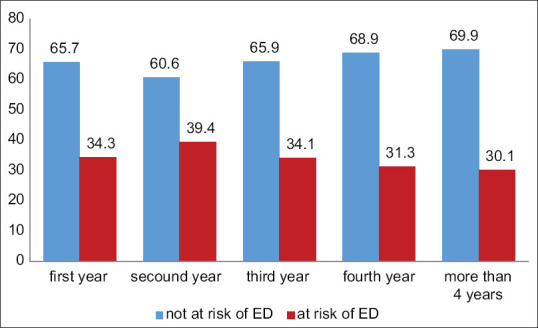
The prevalence of the risk of eating disorder among the students was observed as 34%. The sociocultural attitude toward appearance was significantly higher among at risk of eating disorder students. The multiple logistic regression analysis showed that females are twice more likely to be at risk for eating disorder than males (2.25) with 95% confidence interval (1.50,3.39). Peer influence was significantly higher among males than females; however, females were significantly more influenced by the media than males.
The prevalence of eating disorder risk in Saudi university students in Jeddah was observed as alarming and highly influenced by sociocultural factors; therefore, screening university students for eating disorder is very necessary. In addition, there should be media and health promotion campaigns on eating disorder and body image issues.
在沙特阿拉伯,关于饮食失调风险以及社会文化因素对大学生中此类风险增加的影响的研究并不多。本研究的目的是评估阿卜杜勒阿齐兹国王大学学生饮食失调风险的患病率、社会文化因素的影响以及男女之间的差异。
在沙特阿拉伯吉达对763名大学生进行了一项横断面研究。数据于2021年2月至2021年4月的3个月内收集。使用自我管理的饮食态度测试-26量表来评估学生中的饮食失调风险。使用社会文化对外表的态度问卷来衡量对瘦的内化、男子气概以及家庭、同伴和媒体对外表的态度。为检验统计学显著性,连续变量使用t检验,分类变量使用卡方检验。进行逻辑回归分析以确定与饮食失调风险相关的因素;所有检验均在0.05显著性水平下进行。
观察到学生中饮食失调风险的患病率为34%。饮食失调风险学生的社会文化对外表的态度明显更高。多元逻辑回归分析表明,女性患饮食失调症的风险是男性的两倍(2.25),95%置信区间为(1.50,3.39)。同伴影响在男性中显著高于女性;然而,女性受媒体的影响明显大于男性。
吉达沙特大学生中饮食失调风险的患病率令人担忧,且受到社会文化因素的高度影响;因此,对大学生进行饮食失调筛查非常必要。此外,应该开展关于饮食失调和身体形象问题的媒体宣传和健康促进活动。