Zhang Kechun, Chen Siyu, Chan Paul Shing-Fong, Fang Yuan, Cao He, Chen Hongbiao, Hu Tian, Chen Yaqi, Zhou Xiaofeng, Wang Zixin
Longhua District Center for Disease Control and Prevention, Shenzhen, China.
JC School of Public Health and Primary Care, The Chinese University of Hong Kong, Hong Kong, Hong Kong SAR, China.
Front Med (Lausanne). 2022 Jun 9;9:842121. doi: 10.3389/fmed.2022.842121. eCollection 2022.
The Coronavirus Diseases 2019 (COVID-19) directly affects HIV prevention and sexual health services utilization among men who have sex with men (MSM). This study investigated changes in human immunodeficiency virus (HIV) testing utilization among MSM before and after the COVID-19 pandemic received initial control in Shenzhen, China.
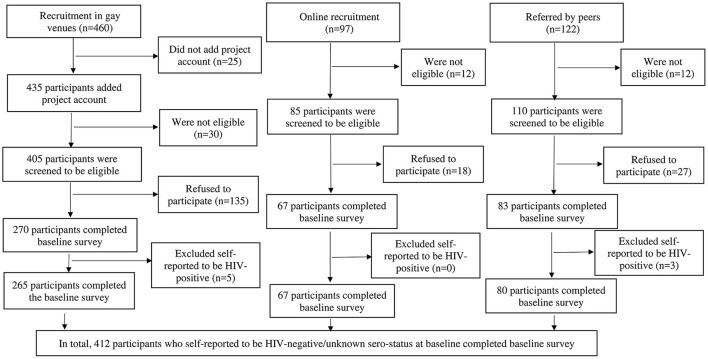
This study was a sub-analysis of a prospective observational cohort study conducted among MSM in Shenzhen, China between August 2020 and May 2021. Participants were recruited through outreaching in gay venues, online recruitment, and peer referral. Participants completed a baseline online survey between August and September 2020 and a follow-up online survey between April and May 2021. This study was based on 412 MSM who reported to be HIV-negative/unknown sero-status at baseline, 297 (72.1%) of them completed the follow-up online survey. Multilevel logistic regression models (level 1: sources of recruitment; level 2: individual participants) were fitted.
When comparing follow-up data with baseline data, a significant increase was observed in the uptake of any type of HIV testing (77.9% at Month 6 vs. 59.2% at baseline, < 0.001). After adjusting for age group, education level, current employment status and monthly personal income, two predisposing factors were associated with higher uptake of HIV testing during the follow-up period. They were: (1) condomless anal intercourse with male non-regular male sex partners at follow-up only (AOR: 5.29, 95%CI: 1.27, 22.01) and (2) sanitizing before and after sex at baseline (AOR: 1.26, 95%CI: 1.02, 1.47). Regarding enabling factors, utilization of HIV testing (AOR: 3.90, 95%CI: 2.27, 6.69) and STI testing (AOR: 2.43, 95%CI: 1.20, 4.93) 6 months prior to the baseline survey was associated with higher uptake of HIV testing during the follow-up period. Having the experience that HIV testing service providers reduced service hours during the follow-up period was also positively associated with the dependent variable (AOR: 3.45, 95%CI: 1.26, 9.41).
HIV testing utilization among MSM might rebound to the level before the COVID-19 outbreak after the pandemic received initial control in China. This study offered a comprehensive overview to identify potential reasons that can influence the uptake of HIV testing among Chinese MSM.
2019年冠状病毒病(COVID-19)直接影响男男性行为者(MSM)的艾滋病毒预防和性健康服务利用情况。本研究调查了在中国深圳COVID-19疫情初步得到控制前后,男男性行为者中人类免疫缺陷病毒(HIV)检测利用情况的变化。
本研究是对2020年8月至2021年5月在中国深圳的男男性行为者中进行的一项前瞻性观察队列研究的子分析。参与者通过在同性恋场所外展、在线招募和同伴推荐的方式招募。参与者在2020年8月至9月完成了基线在线调查,并在2021年4月至5月完成了随访在线调查。本研究基于412名在基线时报告为HIV阴性/血清学状态未知的男男性行为者,其中297人(72.1%)完成了随访在线调查。拟合了多级逻辑回归模型(第1层:招募来源;第2层:个体参与者)。
将随访数据与基线数据进行比较时,观察到任何类型的HIV检测接受率显著增加(第6个月时为77.9%,而基线时为59.2%,<0.001)。在调整了年龄组、教育水平、当前就业状况和月个人收入后,两个易患因素与随访期间更高的HIV检测接受率相关。它们是:(1)仅在随访时与男性非固定男性性伴侣进行无保护肛交(调整后比值比:5.29,95%置信区间:1.27,22.01)和(2)在基线时性行为前后进行清洁(调整后比值比:1.26,95%置信区间:1.02,1.47)。关于促成因素,在基线调查前6个月进行HIV检测(调整后比值比:3.90,95%置信区间:2.27,6.69)和性传播感染检测(调整后比值比:2.43,95%置信区间:1.20,4.93)与随访期间更高的HIV检测接受率相关。在随访期间有HIV检测服务提供者减少服务时间的经历也与因变量呈正相关(调整后比值比:3.45,95%置信区间:1.26,9.41)。
在中国COVID-19疫情初步得到控制后,男男性行为者中的HIV检测利用情况可能反弹至疫情爆发前的水平。本研究提供了一个全面的概述,以确定可能影响中国男男性行为者HIV检测接受率的潜在原因。