University of Bristol, Bristol, United Kingdom.
MRC Centre for Global Infectious Disease Analysis, Imperial College London, London, United Kingdom.
J Int AIDS Soc. 2021 Apr;24(4):e25697. doi: 10.1002/jia2.25697.
The COVID-19 pandemic is impacting HIV care globally, with gaps in HIV treatment expected to increase HIV transmission and HIV-related mortality. We estimated how COVID-19-related disruptions could impact HIV transmission and mortality among men who have sex with men (MSM) in four cities in China, over a one- and five-year time horizon.
Regional data from China indicated that the number of MSM undergoing facility-based HIV testing reduced by 59% during the COVID-19 pandemic, alongside reductions in ART initiation (34%), numbers of all sexual partners (62%) and consistency of condom use (25%), but initial data indicated no change in viral suppression. A mathematical model of HIV transmission/treatment among MSM was used to estimate the impact of disruptions on HIV infections/HIV-related deaths. Disruption scenarios were assessed for their individual and combined impact over one and five years for 3/4/6-month disruption periods, starting from 1 January 2020.
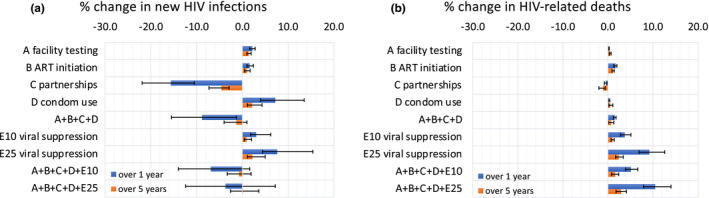
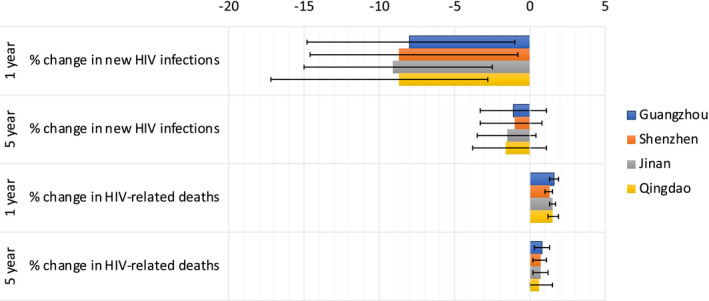
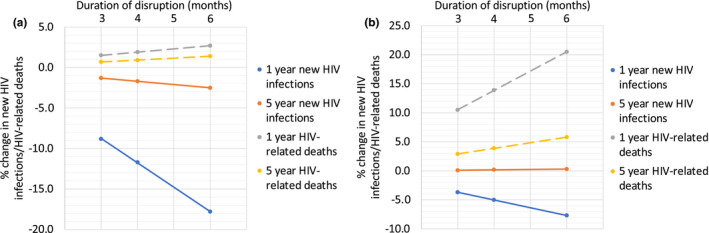
Our model predicted new HIV infections and HIV-related deaths would be increased most by disruptions to viral suppression, with 25% reductions (25% virally suppressed MSM stop taking ART) for a three-month period increasing HIV infections by 5% to 14% over one year and deaths by 7% to 12%. Observed reductions in condom use increased HIV infections by 5% to 14% but had minimal impact (<1%) on deaths. Smaller impacts on infections and deaths (<3%) were seen for disruptions to facility HIV testing and ART initiation, but reduced partner numbers resulted in 11% to 23% fewer infections and 0.4% to 1.0% fewer deaths. Longer disruption periods (4/6 months) amplified the impact of disruption scenarios. When realistic disruptions were modelled simultaneously, an overall decrease in new HIV infections occurred over one year (3% to 17%), but not for five years (1% increase to 4% decrease), whereas deaths mostly increased over one year (1% to 2%) and five years (1.2 increase to 0.3 decrease).
The overall impact of COVID-19 on new HIV infections and HIV-related deaths is dependent on the nature, scale and length of the various disruptions. Resources should be directed to ensuring levels of viral suppression and condom use are maintained to mitigate any adverse effects of COVID-19-related disruption on HIV transmission and control among MSM in China.
COVID-19 大流行正在全球范围内影响艾滋病毒的护理,预计艾滋病毒治疗方面的差距将会增加艾滋病毒的传播和与艾滋病毒相关的死亡率。我们估计了在中国四个城市,在一年和五年的时间内,与 COVID-19 相关的中断将如何影响男男性行为者(MSM)中的艾滋病毒传播和死亡率。
来自中国的区域数据表明,在 COVID-19 大流行期间,接受基于机构的艾滋病毒检测的 MSM 人数减少了 59%,同时接受抗逆转录病毒治疗(ART)的人数减少了 34%,所有性伴侣的人数减少了 62%,避孕套使用的一致性减少了 25%,但最初的数据表明病毒抑制没有变化。我们使用了一个 MSM 中艾滋病毒传播/治疗的数学模型来估计中断对艾滋病毒感染/与艾滋病毒相关的死亡的影响。对于从 2020 年 1 月 1 日开始的 3/4/6 个月的中断期,我们评估了中断情景对一年和五年的单独和综合影响。
我们的模型预测,病毒抑制的中断对新的艾滋病毒感染和与艾滋病毒相关的死亡的影响最大,三个月的抑制率降低 25%(25%的病毒抑制的 MSM 停止服用 ART)会使一年内的艾滋病毒感染增加 5%至 14%,死亡增加 7%至 12%。观察到的避孕套使用减少使艾滋病毒感染增加了 5%至 14%,但对死亡的影响很小(<1%)。对设施艾滋病毒检测和 ART 启动的中断的影响较小(<3%),但性伴侣人数的减少导致感染减少 11%至 23%,死亡减少 0.4%至 1.0%。中断期延长(4/6 个月)放大了中断情景的影响。当同时模拟现实中的中断时,一年内新的艾滋病毒感染总数下降(3%至 17%),但五年内没有(增加 1%至减少 4%),而死亡则大多在一年内增加(增加 1%至增加 2%)和五年内(增加 1.2%至减少 0.3%)。
COVID-19 对新的艾滋病毒感染和与艾滋病毒相关的死亡的总体影响取决于各种中断的性质、规模和长度。应将资源用于确保维持病毒抑制和避孕套使用的水平,以减轻 COVID-19 相关中断对中国 MSM 中艾滋病毒传播和控制的任何不利影响。