Werner E Rochelle, Arnold Charles D, Caswell Bess L, Iannotti Lora L, Lutter Chessa K, Maleta Kenneth M, Stewart Christine P
Institute for Global Nutrition, University of California, Davis, CA, USA.
E3 Nutrition Lab, Washington University in St. Louis, St. Louis, MO, USA.
Curr Dev Nutr. 2022 May 13;6(6):nzac094. doi: 10.1093/cdn/nzac094. eCollection 2022 Jun.
Young children with diets lacking diversity with low consumption of animal source foods are at risk of iron deficiency anemia (IDA).
Our objectives were to determine the impact of supplementing diets with 1 egg/d on ) plasma ferritin, soluble transferrin receptor (sTfR), body iron index (BII), and hemoglobin concentrations and ) the prevalence of iron deficiency (ID), anemia, and IDA.
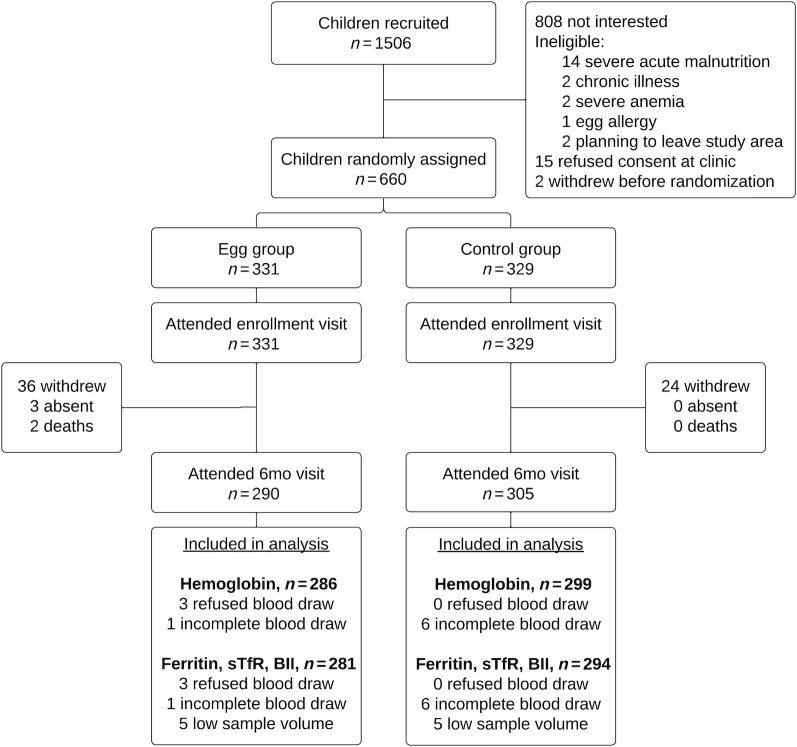
Malawian 6-9-mo-old infants in the Mazira trial (clinicaltrials.gov; NCT03385252) were individually randomly assigned to receive 1 egg/d for 6 mo ( = 331) or continue their usual diet ( = 329). In this secondary analysis, hemoglobin, plasma ferritin, sTfR, C-reactive protein (CRP), and α-1-acid glycoprotein (AGP) were measured at enrollment and 6-mo follow-up. Iron biomarkers were corrected for inflammation. Ferritin, sTfR, BII, and hemoglobin were compared between groups using linear regression. Prevalence ratios (PRs) for anemia (hemoglobin <11 g/dL) and ID (ferritin <12 µg/L, sTfR >8.3 mg/L, or BII <0 mg/kg) between groups were compared using log binomial or modified Poisson regression.
A total of 585 children were included in this analysis (Egg: = 286; Control: = 299). At enrollment, the total prevalence of anemia was 61% and did not differ between groups. At 6-mo follow-up, groups did not differ in geometric mean concentration of hemoglobin [mean (95% CI); Egg: 10.9 (10.7, 11.1) g/dL; Control: 11.1 (10.9, 11.2) g/dL] and inflammation-adjusted ferritin [Egg: 6.52 (5.98, 7.10) µg/L; Control: 6.82 (6.27, 7.42) µg/L], sTfR [Egg: 11.34 (10.92, 11.78) mg/L; Control: 11.46 (11.04, 11.89) mg/L] or BII [Egg: 0.07 (0.06, 0.09) mg/kg; Control: 0.07 (0.05, 0.08) mg/kg]. There were also no group differences in anemia [Egg: 46%; Control 40%; PR: 1.15 (95% CI: 0.96, 1.38)], ID [PR: 0.99 (0.94, 1.05)], or IDA [PR: 1.12 (0.92, 1.36)].
Providing eggs daily for 6 mo did not affect iron status or anemia prevalence in this context. Other interventions are needed to address the high prevalence of ID and anemia among young Malawian children. This trial is registered at http://www.clinicaltrials.gov as NCT03385252.
饮食缺乏多样性且动物源食物摄入量低的幼儿有缺铁性贫血(IDA)风险。
我们的目的是确定每天补充1个鸡蛋对(1)血浆铁蛋白、可溶性转铁蛋白受体(sTfR)、机体铁指数(BII)和血红蛋白浓度,以及(2)缺铁(ID)、贫血和IDA患病率的影响。
马齐拉试验(clinicaltrials.gov;NCT03385252)中的马拉维6至9月龄婴儿被个体随机分配,一组每天接受1个鸡蛋,为期6个月(n = 331),另一组继续其常规饮食(n = 329)。在这项二次分析中,在入组时和6个月随访时测量血红蛋白、血浆铁蛋白、sTfR、C反应蛋白(CRP)和α-1-酸性糖蛋白(AGP)。对铁生物标志物进行炎症校正。使用线性回归比较两组之间的铁蛋白、sTfR、BII和血红蛋白。使用对数二项式或修正泊松回归比较两组之间贫血(血红蛋白<11 g/dL)和ID(铁蛋白<12 μg/L、sTfR>8.3 mg/L或BII<0 mg/kg)的患病率比(PR)。
本分析共纳入585名儿童(鸡蛋组:n = 286;对照组:n = 299)。入组时,贫血总患病率为61%,两组之间无差异。在6个月随访时,两组在血红蛋白几何平均浓度[均值(95%CI);鸡蛋组:10.9(10.7, 11.1)g/dL;对照组:11.1(10.9, 11.2)g/dL]、炎症校正铁蛋白[鸡蛋组:6.52(5.98, 7.10)μg/L;对照组:6.82(6.27, 7.42)μg/L]、sTfR[鸡蛋组:11.34(10.92, 11.78)mg/L;对照组:11.46(11.04, 11.89)mg/L]或BII[鸡蛋组:0.07(0.06, 0.09)mg/kg;对照组:0.07(0.05, 0.08)mg/kg]方面无差异。贫血[鸡蛋组:46%;对照组40%;PR:1.15(95%CI:0.96, 1.38)]、ID[PR:0.99(0.94, 1.05)]或IDA[PR:1.12(0.92, 1.36)]方面也无组间差异。
在这种情况下,每天提供鸡蛋6个月对铁状态或贫血患病率没有影响。需要其他干预措施来解决马拉维幼儿中ID和贫血的高患病率问题。本试验在http://www.clinicaltrials.gov上注册,注册号为NCT03385252。