Department of Experimental and Clinical Medicine, & Department of Geriatric Medicine, Division of Rheumatology AOUC, University of Florence, Viale Largo BrambillaFirenze (FI), 3 - 50134, Florence, Italy.
Department of Experimental and Clinical Medicine, & Department of Emergency Medicine DEA, Division of Internal Medicine AOUC, University of Florence, Florence, Italy.
Clin Rheumatol. 2022 Feb;41(2):573-579. doi: 10.1007/s10067-021-05975-2. Epub 2021 Nov 5.
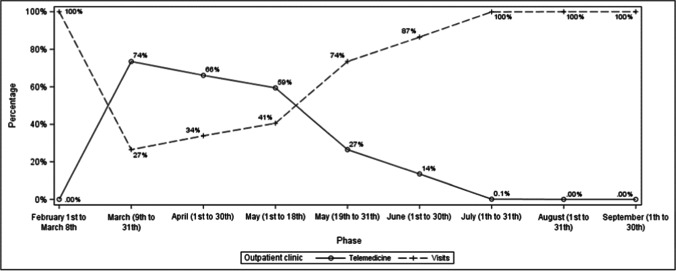
Patients and health workers were at high risk of infection during the Sars-Cov-2 pandemic lockdown. For this reason, other medical and clinical approaches such as Telemedicine were necessary. Despite Telemedicine was born before COVID-19, the pandemic was the opportunity to accelerate a process already underway for at least a decade and to blow all the barriers away. Our aim is to describe the experience of Telemedicine during and immediately after the first lockdown to assure the follow-up in a 'virtual' outpatient clinic dedicated to Rheumatic and Musculoskeletal Diseases (RMDs) and to give an overview of Telemedicine in the rheumatology field. We retrospectively evaluated the patient flow to our rheumatology division from March to September 2020 and, in accordance with local restrictions, three periods were selected. In the 1st period, 96.96% of the outpatient clinic cases were shifted to Telemedicine; these decreased to 52.45% in the 2nd period, while the 3rd period was characterized by the return of the patients at the clinic (97.6%). Diagnostic procedures were postponed during the 1st period, reduced drastically during the 2nd and performed regularly during the third period. Intravenous infusions were maintained as much as possible during the three periods, to assure therapeutic continuity. Shifting stable patients to Telemedicine has the potential to allow continuity of care, while reducing the risk of contagion during a pandemic. In the next future, the integration of Telemedicine as standard of care for specific clinical applications might assure assistance for RMDs patients also in non-pandemic conditions.
在 SARS-CoV-2 大流行封锁期间,患者和卫生工作者面临高感染风险。因此,需要其他医疗和临床方法,如远程医疗。尽管远程医疗在 COVID-19 之前就已经存在,但大流行是加速至少十年前已经开始的进程并消除所有障碍的机会。我们的目的是描述大流行期间和第一次封锁后远程医疗的经验,以确保在专门针对风湿和肌肉骨骼疾病(RMD)的“虚拟”门诊诊所进行随访,并概述远程医疗在风湿病领域的应用。我们回顾性评估了我们风湿病科 2020 年 3 月至 9 月的患者流量,并根据当地限制选择了三个时期。在第一个时期,96.96%的门诊病例转移到远程医疗;第二个时期减少到 52.45%,而第三个时期的特点是患者返回诊所(97.6%)。第一个时期推迟了诊断程序,第二个时期大幅减少,第三个时期定期进行。在三个时期中,尽可能维持静脉输液以确保治疗连续性。将稳定患者转移到远程医疗有潜力在大流行期间允许连续护理,同时降低感染风险。在未来,将远程医疗作为特定临床应用的标准护理的整合可能会确保 RMD 患者在非大流行情况下也能得到援助。