Makvandi Kianoush, Hockings Paul D, Jensen Gert, Unnerstall Tim, Leonhardt Henrik, Jarl Lisa V, Englund Camilla, Francis Susan, Sundgren Anna K, Hulthe Johannes, Baid-Agrawal Seema
Department of Molecular and Clinical Medicine/Nephrology, Institute of Medicine, Sahlgrenska Academy, University of Gothenburg, Gothenburg, Sweden.
Antaros Medical, Molndal, Sweden.
Clin Kidney J. 2022 Feb 24;15(7):1387-1402. doi: 10.1093/ckj/sfac054. eCollection 2022 Jul.
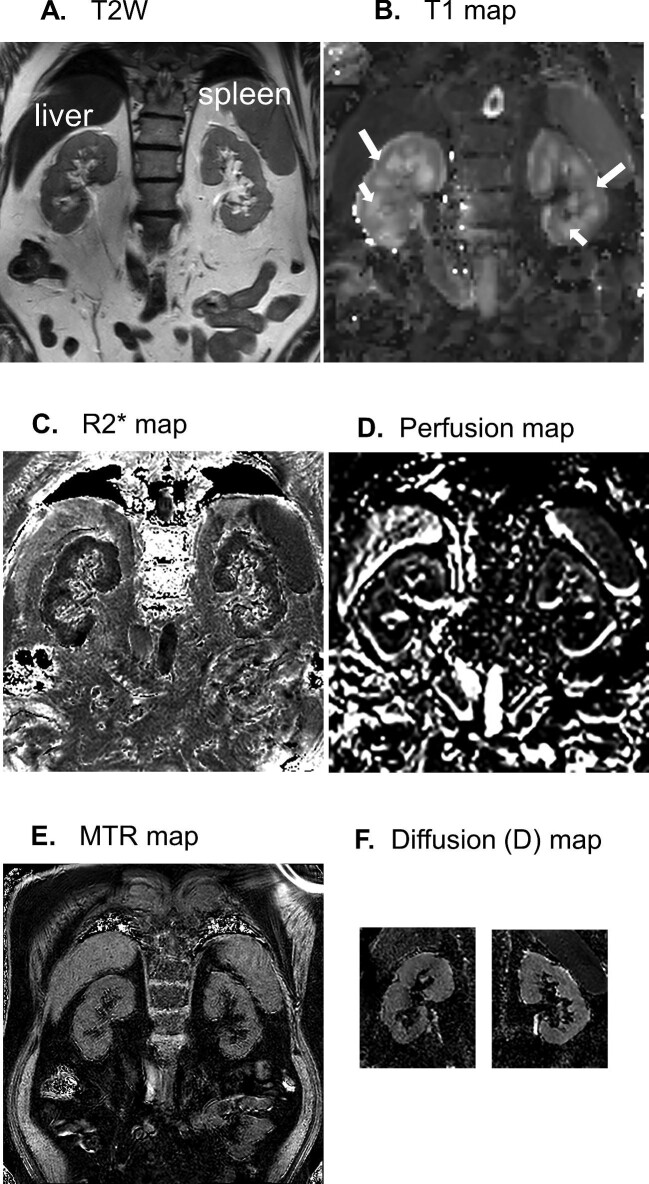
We sought to develop a novel non-contrast multiparametric MRI (mpMRI) protocol employing several complementary techniques in a single scan session for a comprehensive functional and structural evaluation of diabetic kidney disease (DKD).
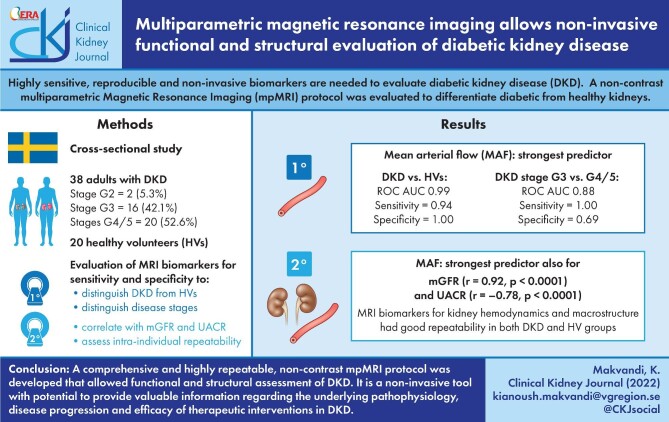
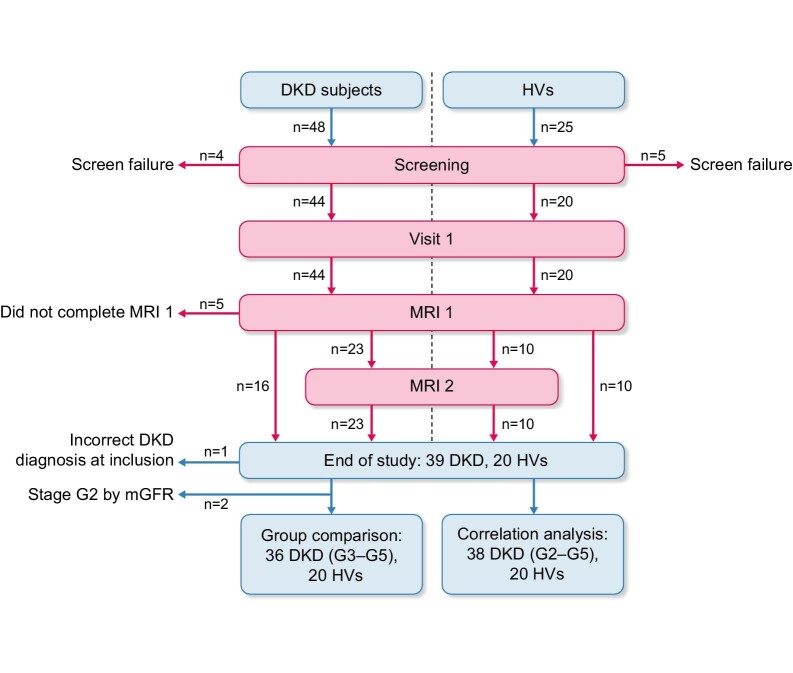
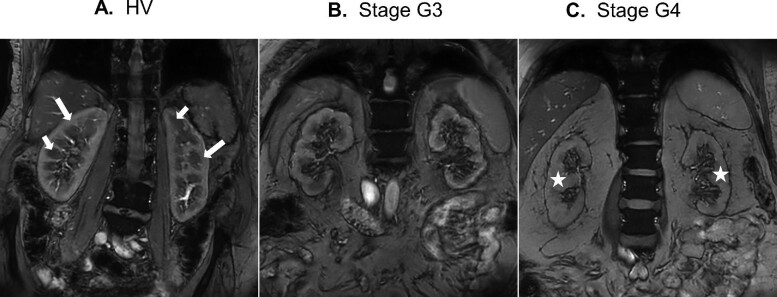
In the cross-sectional part of this prospective observational study, 38 subjects ages 18‒79 years with type 2 diabetes and DKD [estimated glomerular filtration rate (eGFR) 15‒60 mL/min/1.73 m] and 20 age- and gender-matched healthy volunteers (HVs) underwent mpMRI. Repeat mpMRI was performed on 23 DKD subjects and 10 HVs. By measured GFR (mGFR), 2 DKD subjects had GFR stage G2, 16 stage G3 and 20 stage G4/G5. A wide range of MRI biomarkers associated with kidney haemodynamics, oxygenation and macro/microstructure were evaluated. Their optimal sensitivity, specificity and repeatability to differentiate diabetic versus healthy kidneys and categorize various stages of disease as well as their correlation with mGFR/albuminuria was assessed.
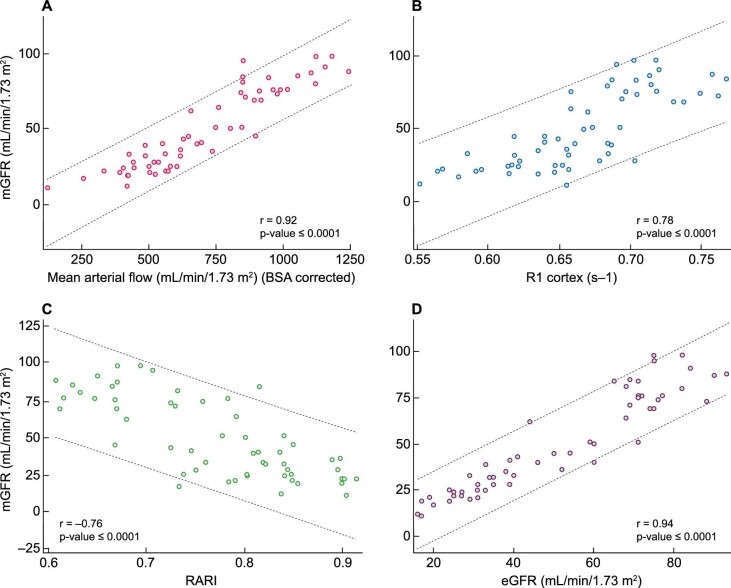
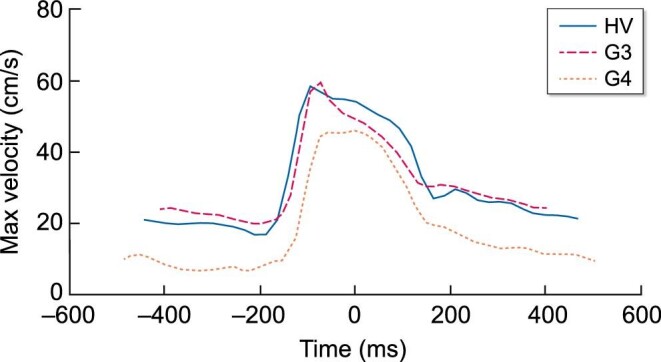
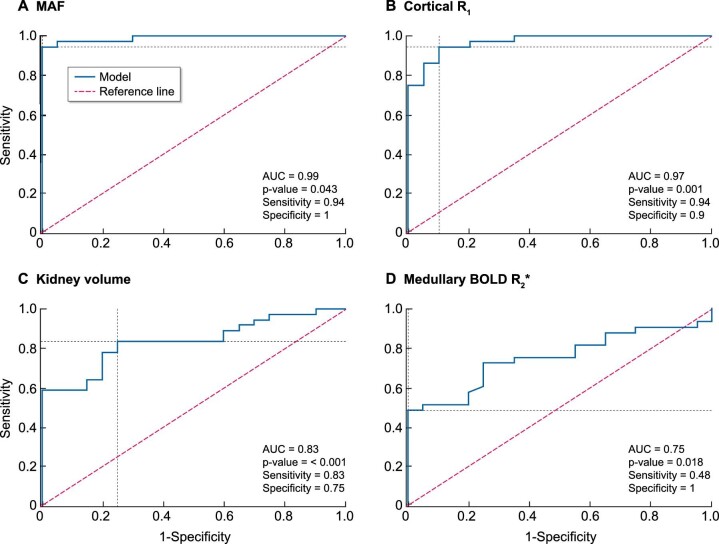
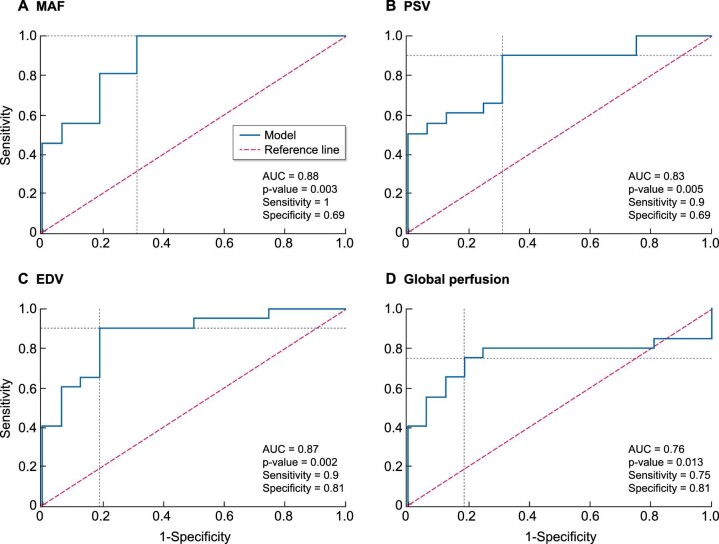
Several MRI biomarkers differentiated diabetic from healthy kidneys and distinct GFR stages (G3 versus G4/G5); mean arterial flow (MAF) was the strongest predictor (sensitivity 0.94 and 1.0, specificity 1.00 and 0.69; = .04 and .004, respectively). Parameters significantly correlating with mGFR were specific measures of kidney haemodynamics, oxygenation, microstructure and macrostructure, with MAF being the strongest univariate predictor ( = 0.92; < .0001).
A comprehensive and repeatable non-contrast mpMRI protocol was developed that, as a single, non-invasive tool, allows functional and structural assessment of DKD, which has the potential to provide valuable insights into underlying pathophysiology, disease progression and analysis of efficacy/mode of action of therapeutic interventions in DKD.
我们试图开发一种新型的非对比多参数磁共振成像(mpMRI)方案,在单次扫描中采用多种互补技术,对糖尿病肾病(DKD)进行全面的功能和结构评估。
在这项前瞻性观察研究的横断面部分,38名年龄在18至79岁之间的2型糖尿病合并DKD患者[估计肾小球滤过率(eGFR)为15至60 mL/min/1.73 m²]和20名年龄及性别匹配的健康志愿者(HV)接受了mpMRI检查。23名DKD患者和10名HV进行了重复mpMRI检查。根据测量的肾小球滤过率(mGFR),2名DKD患者处于G2期,16名处于G3期,20名处于G4/G5期。评估了一系列与肾脏血流动力学、氧合及宏观/微观结构相关的MRI生物标志物。评估了它们在区分糖尿病肾病与健康肾脏以及对疾病不同阶段进行分类方面的最佳敏感性、特异性和可重复性,以及它们与mGFR/蛋白尿的相关性。
几种MRI生物标志物可区分糖尿病肾病与健康肾脏以及不同的GFR阶段(G3期与G4/G5期);平均动脉血流(MAF)是最强的预测指标(敏感性分别为0.94和1.0,特异性分别为1.00和0.69;P值分别为0.04和0.004)。与mGFR显著相关的参数是肾脏血流动力学、氧合、微观结构和宏观结构的特定测量指标,MAF是最强的单变量预测指标(r = 0.92;P < 0.0001)。
开发了一种全面且可重复的非对比mpMRI方案,作为一种单一的非侵入性工具,可对DKD进行功能和结构评估,这有可能为DKD的潜在病理生理学、疾病进展以及治疗干预的疗效/作用方式分析提供有价值的见解。