Department of Epidemiology and Statistics, Institute of Basic Medical Sciences, Chinese Academy of Medical Sciences & School of Basic Medicine, Peking Union Medical College, Beijing, China.
Department of Chronic and Noncommunicable Disease Prevention and Control, Shaanxi Provincial Center for Disease Control and Prevention, Xi'an, China.
Front Endocrinol (Lausanne). 2022 Jun 10;13:879384. doi: 10.3389/fendo.2022.879384. eCollection 2022.
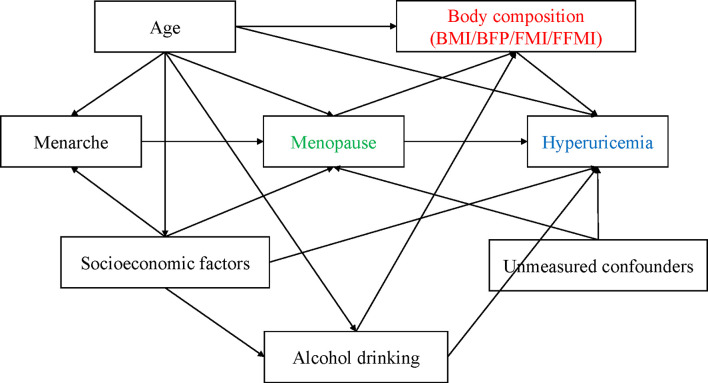
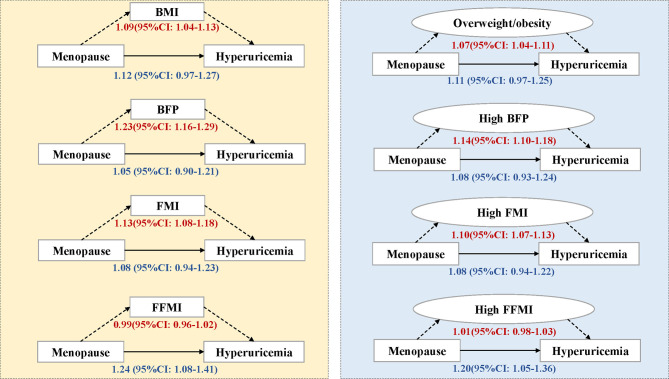
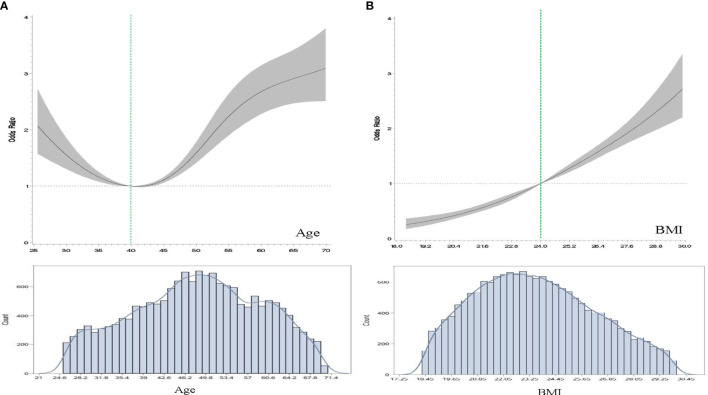
Reproductive factors have been demonstrated to be associated with hyperuricemia. Body composition is an essential determinant influencing serum uric acid (SUA), but it is largely unknown whether increased SUA was influenced by changed body composition during the menopausal transition. As a secondary analysis of China National Health Survey from 2012-to 2017, this study included 18,997 women aged 20 to 80. Menarche age and menopause information were collected by questionnaire interview. Body mass index (BMI), body fat percentage (BFP), fat mass index (FMI), and fat-free mass index (FFMI) were used as body composition indexes. Hyperuricemia was defined as SUA higher than 360μmol/L (approximately 6 mg/dl). Mediation analysis was performed to explore the direct and indirect effects of menopause on hyperuricemia. A 1:2 age-matched case-control data set (n=6202) was designed to control age-related confounders and was used in multivariable analyses. After adjustment of covariates, postmenopausal women had 14.08 (10.89-17.27) μmol/L higher SUA than their premenopausal counterparts. Overweight/obesity and higher levels of BFP, FMI, and FFMI were all found to be positively associated with hyperuricemia. The mediation analysis showed that the total effect of menopause on hyperuricemia was positive, but was substantially mediated by body composition indexes. Forty-five percent of the total effect can be attributed to the indirect effect mediated by BMI (OR for the natural indirect effect (NIE): 1.09, 95%CI: 1.04-1.13), and over 80% mediated by BFP (OR for NIE: 1.23, 95%CI: 1.16-1.29). However, FFMI did not present the mediated role in the association (OR for NIE: 0.99, 95%CI: 0.96-1.02). The findings revealed that body composition, especially the fat mass indexes, significantly mediated the association between menopause and hyperuricemia. The role of body composition as mediator constitutes clinical and public health significance that should be recognized and considered in healthcare for women experiencing their menopause transition.
生殖因素已被证明与高尿酸血症有关。人体成分是影响血清尿酸(SUA)的重要决定因素,但在绝经过渡期间,SUA 的增加是否受身体成分变化的影响,在很大程度上尚不清楚。本研究作为 2012 年至 2017 年中国国家健康调查的二次分析,共纳入 18997 名 20 至 80 岁的女性。通过问卷调查收集初潮年龄和绝经信息。体重指数(BMI)、体脂百分比(BFP)、脂肪质量指数(FMI)和去脂体重指数(FFMI)被用作身体成分指标。高尿酸血症定义为 SUA 高于 360μmol/L(约 6mg/dl)。采用中介分析探讨绝经对高尿酸血症的直接和间接影响。设计了一个 1:2 年龄匹配的病例对照数据集(n=6202),以控制与年龄相关的混杂因素,并用于多变量分析。在调整协变量后,绝经后女性的 SUA 比绝经前女性高 14.08(10.89-17.27)μmol/L。超重/肥胖以及较高的 BFP、FMI 和 FFMI 水平均与高尿酸血症呈正相关。中介分析显示,绝经对高尿酸血症的总效应为正,但主要由身体成分指标介导。绝经对高尿酸血症总效应的 45%可归因于 BMI 介导的间接效应(自然间接效应的比值比(OR):1.09,95%CI:1.04-1.13),超过 80%可归因于 BFP 介导的间接效应(OR:1.23,95%CI:1.16-1.29)。然而,FFMI 在该关联中没有表现出中介作用(OR:1.09,95%CI:1.06-1.13)。研究结果表明,身体成分,尤其是脂肪质量指数,显著介导了绝经与高尿酸血症之间的关系。身体成分作为中介的作用具有临床和公共卫生意义,在女性经历绝经过渡期间的医疗保健中应得到认识和考虑。