National Food Safety Authority (NFSA), Aswan, Egypt.
Ministry of Tourism and Antiquities, Aswan, Egypt.
EMBO Mol Med. 2022 Aug 8;14(8):e16287. doi: 10.15252/emmm.202216287. Epub 2022 Jun 27.
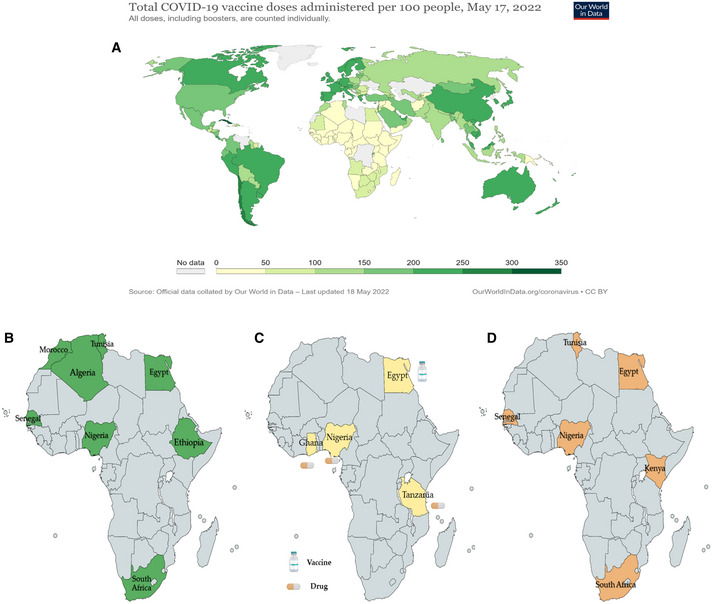
Africa carries a high burden of infectious diseases. Every year, millions of Africans contract tuberculosis, malaria, and many other diseases. Malaria kills hundreds of thousands of children under the age of five years annually. More than 11,000 people died during the 2014-2016 Ebola outbreak in West Africa; still, occasional cases of Ebola, as well as monkeypox, periodically appear in the Democratic Republic of Congo. Since most of the African countries gained their independence during the 1960s, the continent has relied heavily on the outside world for diagnostics, medicines, vaccines, personal protective equipment, and other medical supplies. Africa consumes nearly 25% of the globally produced vaccines but imports 99% and 95% of its vaccines and medicines, respectively. The 55 African countries were not able to ensure the health of 1.3 billion Africans during the COVID-19 pandemic but had to rely on other global initiatives and other countries for help and support. However, the pandemic and the shortage of vaccines may have been the much-needed trigger for this situation to change. "When misfortunes increase, they erase each other." Naguib Mahfouz (1911-2006).
非洲承担着传染病的沉重负担。每年,数以百万计的非洲人感染结核病、疟疾和许多其他疾病。疟疾每年导致数十万五岁以下儿童死亡。在 2014-2016 年西非埃博拉疫情期间,超过 11000 人死亡;尽管如此,埃博拉病毒和猴痘的偶发病例仍定期出现在刚果民主共和国。自 20 世纪 60 年代大多数非洲国家获得独立以来,该大陆在诊断、药品、疫苗、个人防护设备和其他医疗用品方面严重依赖外部世界。非洲消耗了全球生产的疫苗的近 25%,但分别进口了其疫苗和药品的 99%和 95%。在 COVID-19 大流行期间,55 个非洲国家无法确保 13 亿非洲人的健康,但不得不依靠其他全球倡议和其他国家的帮助和支持。然而,这场大流行和疫苗短缺可能是改变这种状况的急需契机。“当不幸增多时,它们会相互抵消。”纳吉布·马哈福兹(1911-2006)。