Harding Center for Risk Literacy, University of Potsdam, Potsdam, Germany.
Department of Psychology, The Ohio State University, Cleveland Heights.
JAMA Netw Open. 2022 Jun 1;5(6):e2218804. doi: 10.1001/jamanetworkopen.2022.18804.
The probability of a conjunction of 2 independent events is the product of the probabilities of the 2 components and therefore cannot exceed the probability of either component; violation of this basic law is called the conjunction fallacy. A common medical decision-making scenario involves estimating the probability of a final outcome resulting from a sequence of independent events; however, little is known about physicians' ability to accurately estimate the overall probability of success in these situations.
To ascertain whether physicians are able to correctly estimate the overall probability of a medical outcome resulting from 2 independent events.
DESIGN, SETTING, AND PARTICIPANTS: This survey study consisted of 3 separate substudies, in which 215 physicians were asked via internet-based survey to estimate the probability of success of each of 2 components of a diagnostic or prognostic sequence as well as the overall probability of success of the 2-step sequence. Substudy 1 was performed from April 2 to 4, 2021, substudy 2 from November 2 to 11, 2021, and substudy 3 from May 13 to 19, 2021. All physicians were board certified or board eligible in the primary specialty germane to the substudy (ie, obstetrics and gynecology for substudies 1 and 3 and pulmonology for substudy 2), were recruited from a commercial survey service, and volunteered to participate in the study.
Case scenarios presented in an online survey.
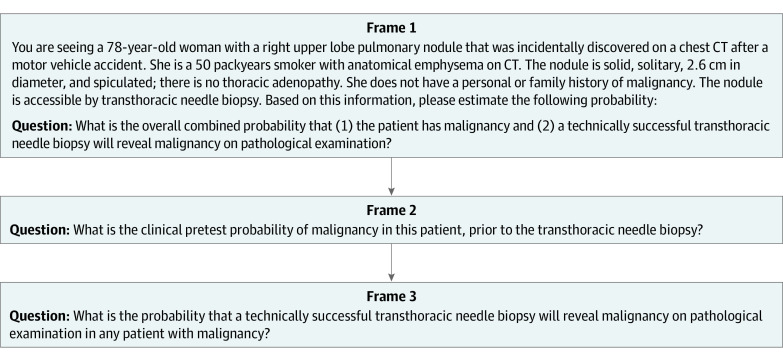
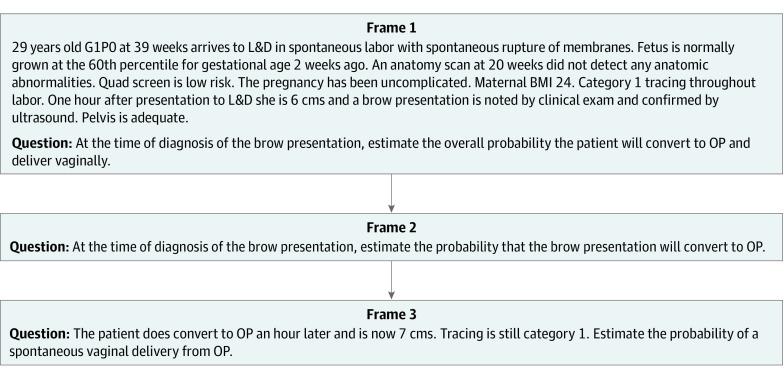
Respondents were asked to provide their demographic information in addition to 3 probability estimates. The first substudy included a scenario describing a brow presentation discovered during labor; the 2 conjuncts were the probabilities that the brow presentation would resolve and that the delivery would be vaginal. The second substudy involved a diagnostic evaluation of an incidentally discovered pulmonary nodule; the 2 conjuncts were the probabilities that the patient had a malignant condition and that a technically successful transthoracic needle biopsy would reveal a malignant condition. The third substudy included a modification of the first substudy in an attempt to debias the conjunction fallacy prevalent in the first substudy. Respondents' own probability estimates of the individual events were used to calculate the mathematically correct conjunctive probability.
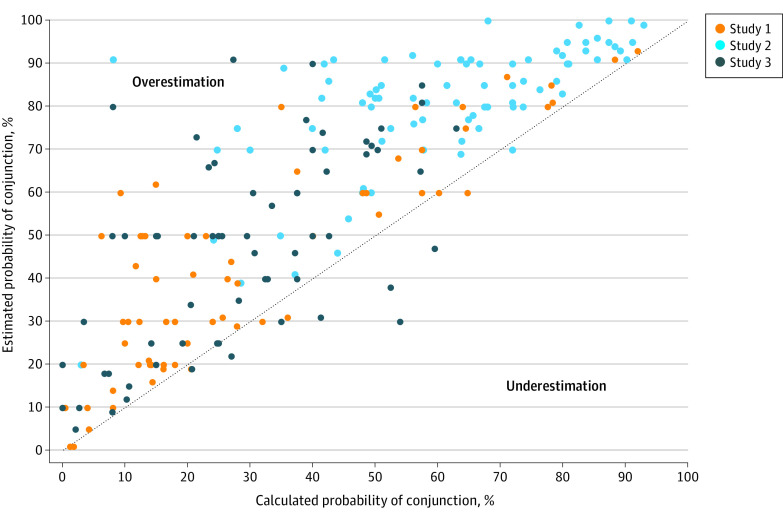
Among 215 respondents, the mean (SD) age was 54.0 (9.5) years; 142 respondents (66.0%) were male. Data on race and ethnicity were not collected. A total of 168 physicians (78.1%) estimated the probability of the 2-step sequence to be greater than the probability of at least 1 of the 2 component events. Compared with the product of their 2 estimated components, respondents overestimated the combined probability by 12.8% (95% CI, 9.6%-16.1%; P < .001) in substudy 1, 19.8% (95% CI, 16.6%-23.0%; P < .001) in substudy 2, and 18.0% (95% CI, 13.4%-22.5%; P < .001) in substudy 3, results that were mathematically incoherent (ie, formally illogical and mathematically incorrect).
In this survey study of 215 physicians, respondents consistently overestimated the combined probability of 2 events compared with the probability calculated from their own estimates of the individual events. This biased estimation, consistent with the conjunction fallacy, may have substantial implications for diagnostic and prognostic decision-making.
两个独立事件的联合概率是两个组成部分概率的乘积,因此不能超过任何一个组成部分的概率;违反这一基本定律被称为联合谬误。一个常见的医学决策场景涉及估计一系列独立事件导致的最终结果的概率;然而,人们对医生在这些情况下准确估计总体成功概率的能力知之甚少。
确定医生是否能够正确估计两个独立事件导致的医疗结果的总体概率。
设计、地点和参与者:这项调查研究包括三个独立的子研究,其中 215 名医生通过基于互联网的调查被要求估计诊断或预后序列的两个组成部分中的每一个的成功概率,以及两步序列的整体成功概率。子研究 1 于 2021 年 4 月 2 日至 4 日进行,子研究 2 于 2021 年 11 月 2 日至 11 日进行,子研究 3 于 2021 年 5 月 13 日至 19 日进行。所有医生都在相关子研究的主要专业领域(即子研究 1 和 3 的妇产科和子研究 2 的肺病学)中获得了认证或有资格获得认证,他们是从一家商业调查服务机构招募的,并自愿参与了这项研究。
在线调查中呈现的病例情况。
要求受访者提供他们的人口统计学信息,以及 3 个概率估计值。第一个子研究包括一个描述在分娩过程中发现眉位的情况;两个连接是眉位会解决和分娩会是阴道的概率。第二个子研究涉及对偶然发现的肺结节的诊断评估;两个连接是患者有恶性疾病和技术上成功的经胸针活检会发现恶性疾病的概率。第三个子研究包括对第一个子研究中常见的联合谬误进行修改,试图消除偏见。受访者自己对单个事件的概率估计用于计算数学上正确的联合概率。
在 215 名受访者中,平均(SD)年龄为 54.0(9.5)岁;142 名受访者(66.0%)为男性。种族和民族的数据没有收集。共有 168 名医生(78.1%)估计两步序列的概率大于至少一个组成事件的概率。与他们估计的两个组成部分的乘积相比,受访者在子研究 1 中高估了联合概率 12.8%(95%CI,9.6%-16.1%;P<0.001),在子研究 2 中高估了 19.8%(95%CI,16.6%-23.0%;P<0.001),在子研究 3 中高估了 18.0%(95%CI,13.4%-22.5%;P<0.001),结果在数学上是不一致的(即形式上不合逻辑且数学上不正确)。
在这项对 215 名医生的调查研究中,与从自己对单个事件的估计中计算出的概率相比,受访者一致高估了两个事件的联合概率。这种有偏差的估计与联合谬误一致,可能对诊断和预后决策产生重大影响。