Department of Orthopaedics, Rheumatology, and Musculoskeletal Sciences, University of Oxford, Oxford, UK.
University Institute and Rheumatology Unit, Hospital Italiano de Buenos Aires, Buenos Aires, Argentina.
Nat Rev Rheumatol. 2022 Aug;18(8):465-479. doi: 10.1038/s41584-022-00798-0. Epub 2022 Jun 27.
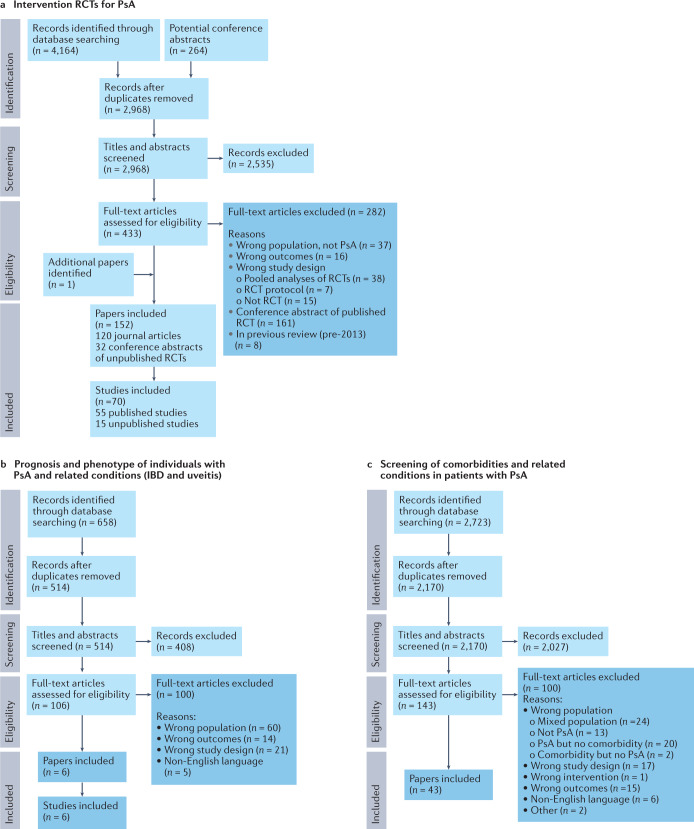
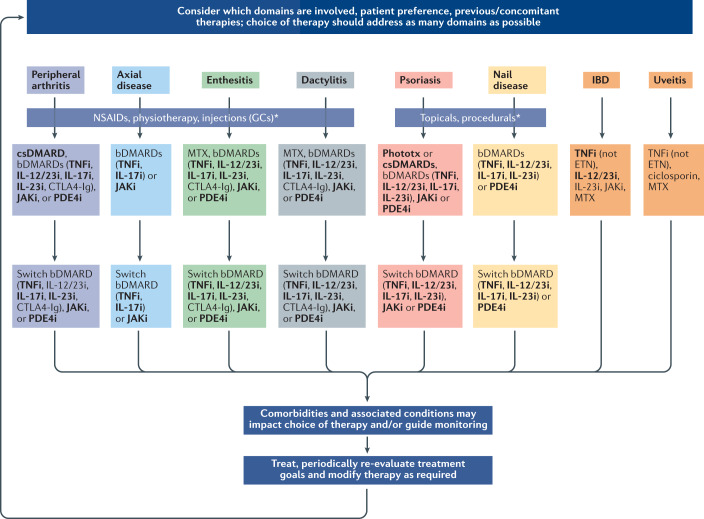
Since the second version of the Group for Research and Assessment of Psoriasis and Psoriatic Arthritis (GRAPPA) treatment recommendations were published in 2015, therapeutic options for psoriatic arthritis (PsA) have advanced considerably. This work reviews the literature since the previous recommendations (data published 2013-2020, including conference presentations between 2017 and 2020) and reports high-quality, evidence-based, domain-focused recommendations for medication selection in PsA developed by GRAPPA clinicians and patient research partners. The overarching principles for the management of adults with PsA were updated by consensus. Principles considering biosimilars and tapering of therapy were added, and the research agenda was revised. Literature searches covered treatments for the key domains of PsA: peripheral arthritis, axial disease, enthesitis, dactylitis, and skin and nail psoriasis; additional searches were performed for PsA-related conditions (uveitis and inflammatory bowel disease) and comorbidities. Individual subcommittees used a GRADE-informed approach, taking into account the quality of evidence for therapies, to generate recommendations for each of these domains, which were incorporated into an overall schema. Choice of therapy for an individual should ideally address all disease domains active in that patient, supporting shared decision-making. As safety issues often affect potential therapeutic choices, additional consideration was given to relevant comorbidities. These GRAPPA treatment recommendations provide up-to-date, evidence-based guidance on PsA management for clinicians and people with PsA.
自 2015 年发布第二版银屑病和银屑病关节炎(GRAPPA)治疗建议以来,银屑病关节炎(PsA)的治疗选择已有了显著进展。本综述回顾了自上次建议(2013-2020 年发表的数据,包括 2017 年至 2020 年的会议报告)以来的文献,并报告了 GRAPPA 临床医生和患者研究合作伙伴针对 PsA 药物选择制定的高质量、基于证据、针对特定领域的建议。成年人 PsA 管理的总体原则通过共识进行了更新。新增了考虑生物类似药物和治疗减停的原则,并修订了研究议程。文献检索涵盖了针对 PsA 的关键领域的治疗方法:外周关节炎、中轴疾病、附着点炎、指(趾)炎以及皮肤和指甲银屑病;针对与 PsA 相关的疾病(葡萄膜炎和炎症性肠病)和合并症进行了额外的检索。各子委员会采用 GRADE 知情方法,考虑到治疗方法的证据质量,为这些领域中的每一个领域生成建议,并将其纳入总体方案。个体治疗选择应理想地针对该患者中所有活跃的疾病领域,以支持共同决策。由于安全性问题通常会影响潜在的治疗选择,因此还考虑了相关合并症。这些 GRAPPA 治疗建议为临床医生和患有 PsA 的患者提供了最新的基于证据的 PsA 管理指南。