Department of Orthopedics, Shangrao People's Hospital, No. 86, Shuyuan Road, Shangrao, 334000, Jiangxi, China.
Orthopaedic Medical Center, the Second Hospital of Jilin University, No. 218, Ziqiang Street, Changchun, 130041, Jilin, China.
J Orthop Surg Res. 2022 Jun 27;17(1):332. doi: 10.1186/s13018-022-03181-7.
As a skeletal malignancy, osteosarcoma has high incidence among primary malignant bone tumors. With increasing researches on molecules which mediate cancer progression, molecular mechanism has gradually become the pivot of osteosarcoma research and treatment.
Our study aimed at investigating the function of G3BP stress granule assembly factor 2 (G3BP2), which is an oncogene for breast cancer (BC) and prostate cancer but remains unknown in osteosarcoma cells.
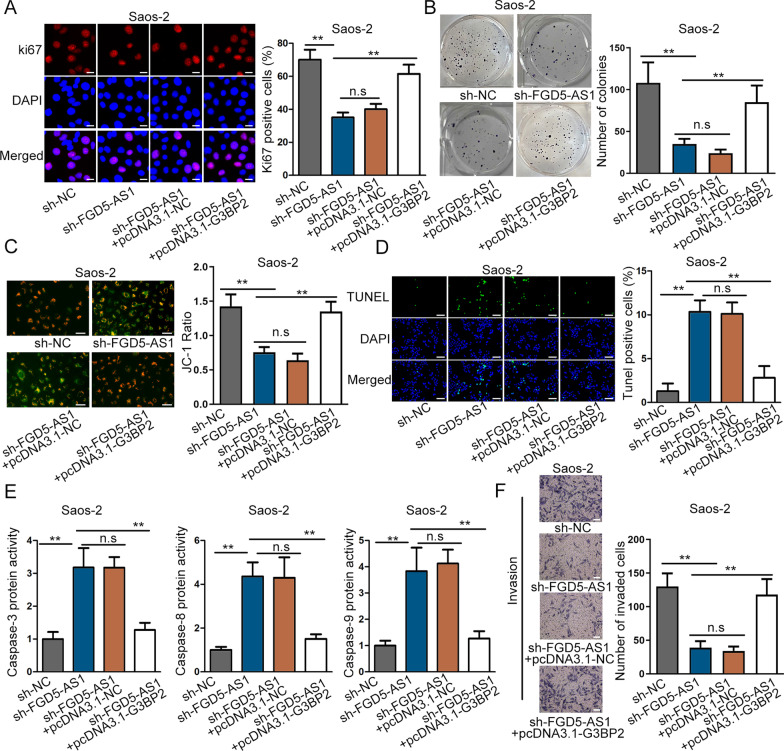
Related gene expression was confirmed by RT-qPCR. Functional assays including immunofluorescence (IF), colony formation, transferase-mediated dUTP nick-end labeling (TUNEL) as well as transwell assays were utilized to test the cell biological process caused by the genes. Meanwhile, RNA pull-down assay, along with luciferase reporter and RNA immunoprecipitation (RIP) assays, was utilized to detect the interaction G3BP2, miR-124-3p and FGD5 antisense RNA 1 (FGD5-AS1) may exert on the regulation of osteosarcoma cells.
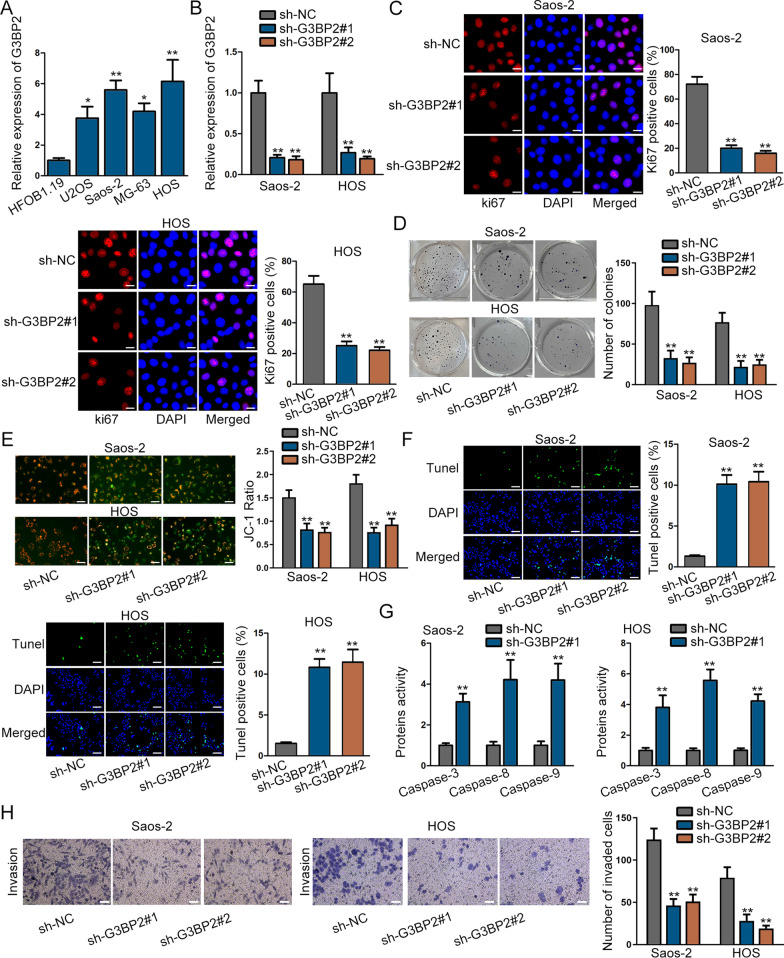
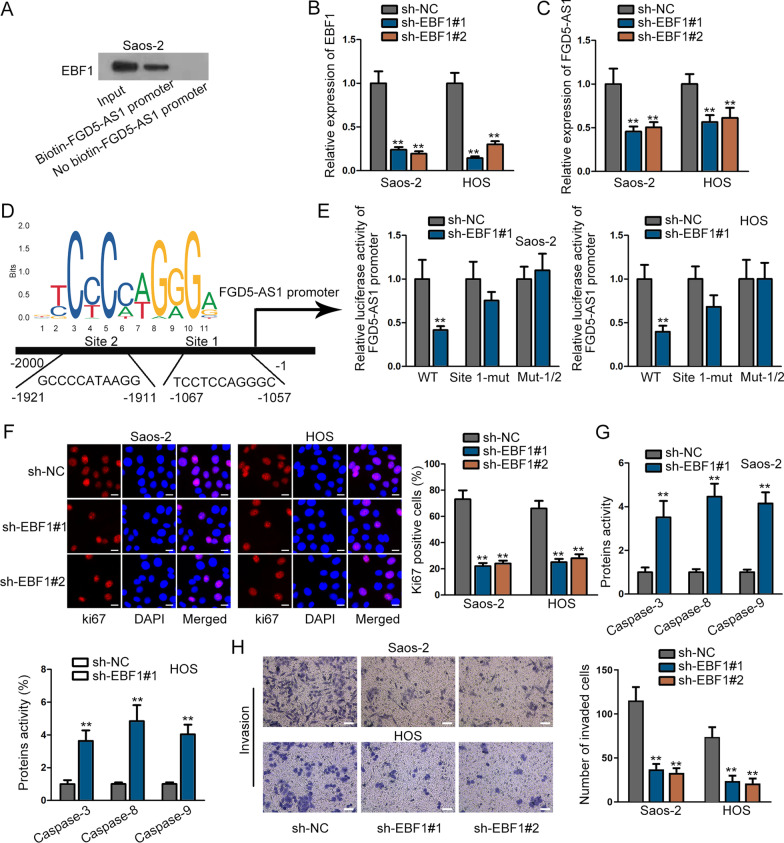
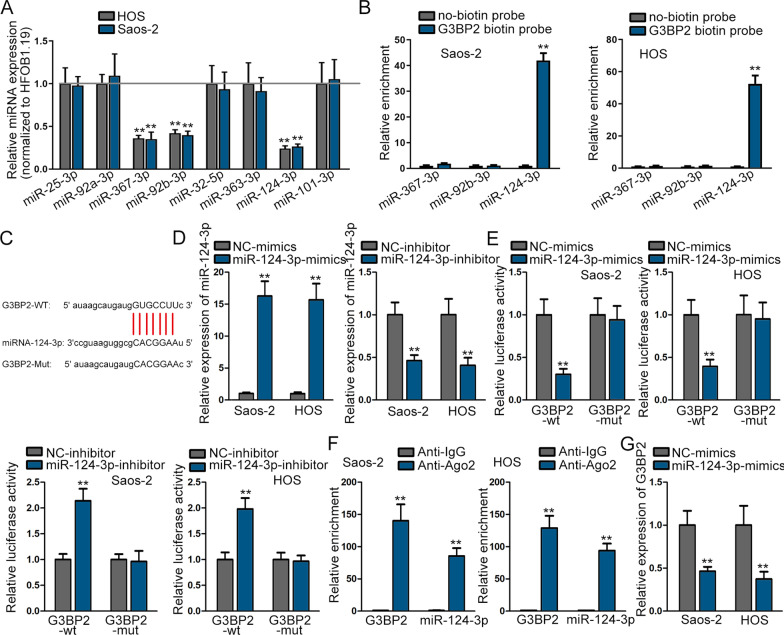
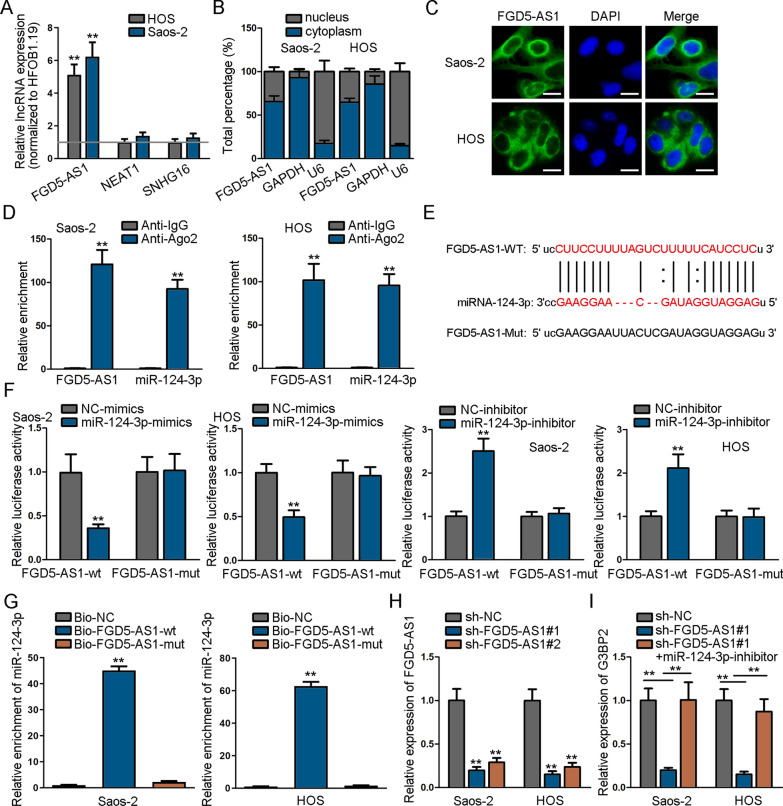
G3BP2 was with high expression in osteosarcoma cells, and it aggravated the malignant cell behaviors in osteosarcoma. Additionally, miR-124-3p was verified to negatively regulate G3BP2 expression in osteosarcoma cells. Moreover, lncRNA FGD5-AS1 was predicted and testified to be the sponge of miR-124-3p and modulated G3BP2 expression positively. Subsequently, FGA5-AS1 accelerated osteosarcoma cell proliferation through up-regulating G3BP2. Furthermore, we identified EBF transcription factor 1 (EBF1) as the transcription factor for FGA5-AS1, and EBF1 served as a tumor facilitator in osteosarcoma cells.
EBF1 induced-FGA5-AS1 aggravated osteosarcoma cell malignancy by targeting miR-124-3p and G3BP2.
成骨肉瘤作为一种骨骼恶性肿瘤,在原发性恶性骨肿瘤中发病率较高。随着对介导癌症进展的分子的研究不断深入,分子机制逐渐成为成骨肉瘤研究和治疗的重点。
本研究旨在研究乳腺癌(BC)和前列腺癌的致癌基因 G3BP 应激颗粒组装因子 2(G3BP2)在成骨肉瘤细胞中的功能,目前其在成骨肉瘤细胞中的作用尚不清楚。
通过 RT-qPCR 证实相关基因表达。利用免疫荧光(IF)、集落形成、转移酶介导的 dUTP 缺口末端标记(TUNEL)以及 Transwell 测定等功能测定方法,检测基因引起的细胞生物学过程。同时,利用 RNA 下拉测定法以及荧光素酶报告基因和 RNA 免疫沉淀(RIP)测定法,检测 G3BP2、miR-124-3p 和 FGD5 反义 RNA 1(FGD5-AS1)之间可能对成骨肉瘤细胞调控作用的相互作用。
G3BP2 在成骨肉瘤细胞中高表达,并加重了成骨肉瘤细胞的恶性行为。此外,miR-124-3p 被证实可负调控成骨肉瘤细胞中的 G3BP2 表达。此外,lncRNA FGD5-AS1 被预测并证实是 miR-124-3p 的海绵体,并正向调节 G3BP2 的表达。随后,FGD5-AS1 通过上调 G3BP2 促进成骨肉瘤细胞增殖。此外,我们确定 EBF 转录因子 1(EBF1)是 FGD5-AS1 的转录因子,并且 EBF1 在成骨肉瘤细胞中充当肿瘤促进剂。
EBF1 诱导的 FGD5-AS1 通过靶向 miR-124-3p 和 G3BP2 加重成骨肉瘤细胞的恶性程度。