Franic Josip
Institute of Public Finance, Smiciklasova 21, 10000 Zagreb, Croatia.
AI Soc. 2022 Jun 23:1-20. doi: 10.1007/s00146-022-01490-3.
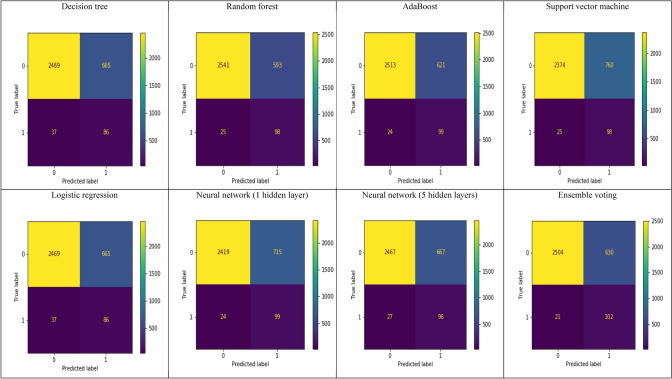
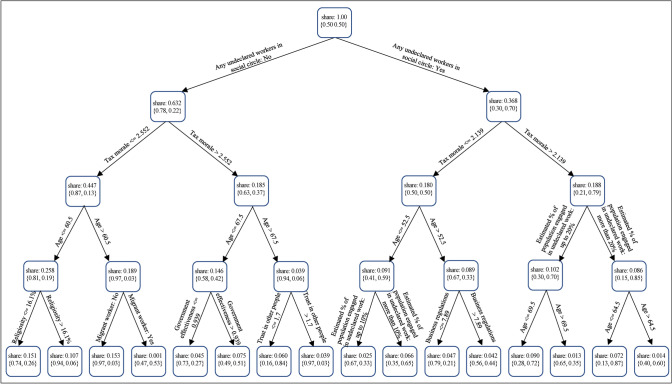
It is nowadays widely understood that undeclared work cannot be efficiently combated without a holistic view on the mechanisms underlying its existence. However, the question remains whether we possess all the pieces of the . To fill the gap, in this paper, we test if the features so far known to affect the behaviour of taxpayers are sufficient to detect noncompliance with outstanding precision. This is done by training seven supervised machine learning models on the compilation of data from the 2019 Special Eurobarometer on undeclared work and relevant figures from other sources. The conducted analysis not only does attest to the completeness of our knowledge concerning the drivers of undeclared work but also paves the way for wide usage of artificial intelligence in monitoring and confronting this detrimental practice. The study, however, exposes the necessity of having at disposal considerably larger datasets compared to those currently available if successful real-world applications of machine learning are to be achieved in this field. Alongside the apparent theoretical contribution, this paper is thus also expected to be of particular importance for policymakers, whose efforts to tackle tax evasion will have to be expedited in the period after the COVID-19 pandemic.
如今人们普遍认识到,如果对未申报工作存在的潜在机制没有全面的认识,就无法有效地打击未申报工作。然而,问题仍然是我们是否掌握了所有相关信息。为了填补这一空白,在本文中,我们测试了迄今为止已知的影响纳税人行为的特征是否足以高精度地检测出违规行为。这是通过对2019年关于未申报工作的特别欧洲晴雨表的数据汇编以及其他来源的相关数据进行训练,来训练七个监督式机器学习模型实现的。所进行的分析不仅证明了我们关于未申报工作驱动因素的知识的完整性,也为人工智能在监测和应对这种有害做法中的广泛应用铺平了道路。然而,该研究表明,如果要在这一领域成功实现机器学习的实际应用,与目前可用的数据集相比,需要有规模大得多的数据集。除了明显的理论贡献外,本文预计对政策制定者也具有特别重要的意义,在新冠疫情之后的时期,他们打击逃税的努力将必须加快。