Langton David J, Bhalekar Rohan M, Joyce Thomas J, Rushton Stephen P, Wainwright Benjamin J, Nargol Matthew E, Shyam Nish, Lie Benedicte A, Pabbruwe Moreica B, Stewart Alan J, Waller Susan, Natu Shonali, Ren Renne, Hornick Rachelle, Darlay Rebecca, Su Edwin P, Nargol Antoni V F
ExplantLab, The Biosphere, Newcastle Helix, Newcastle-upon-Tyne, England.
Newcastle University, Newcastle-upon-Tyne, England.
Commun Med (Lond). 2022 Jun 24;2:73. doi: 10.1038/s43856-022-00137-0. eCollection 2022.
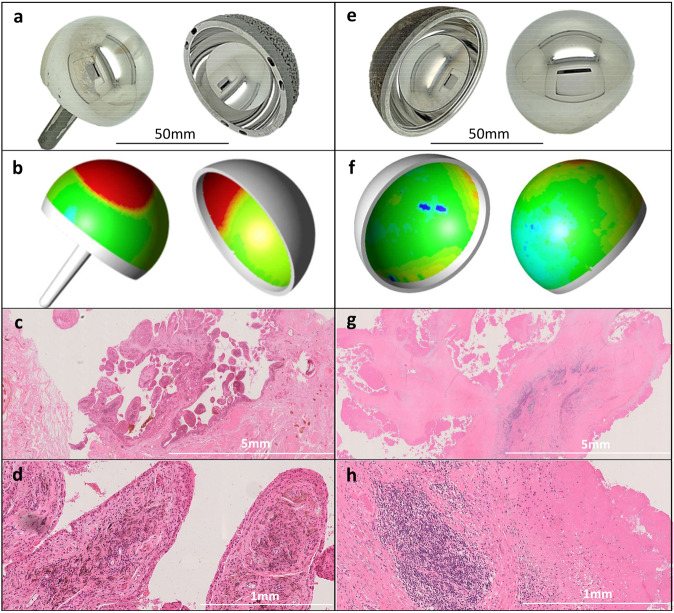
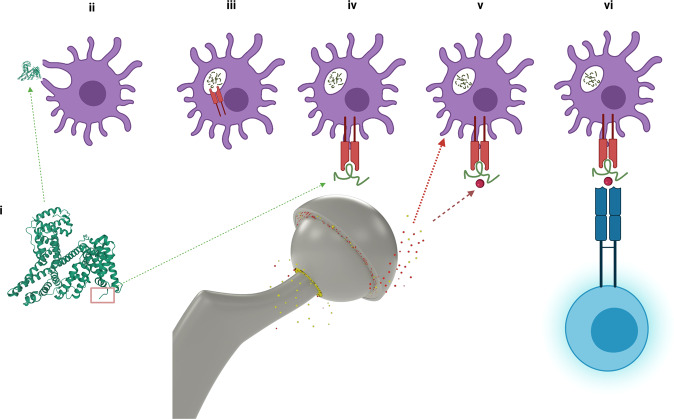
Over five million joint replacements are performed across the world each year. Cobalt chrome (CoCr) components are used in most of these procedures. Some patients develop delayed-type hypersensitivity (DTH) responses to CoCr implants, resulting in tissue damage and revision surgery. DTH is unpredictable and genetic links have yet to be definitively established.
At a single site, we carried out an initial investigation to identify HLA alleles associated with development of DTH following metal-on-metal hip arthroplasty. We then recruited patients from other centres to train and validate an algorithm incorporating patient age, gender, HLA genotype, and blood metal concentrations to predict the development of DTH. Accuracy of the modelling was assessed using performance metrics including time-dependent receiver operator curves.
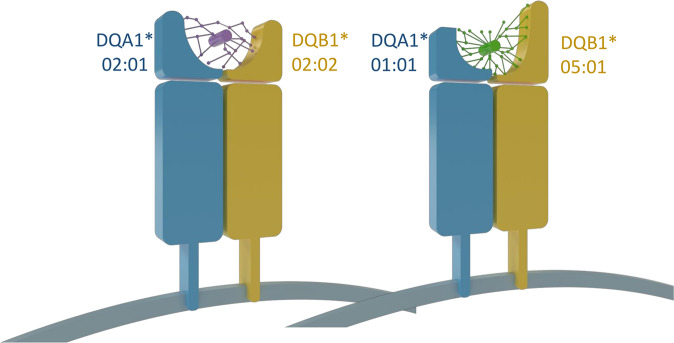
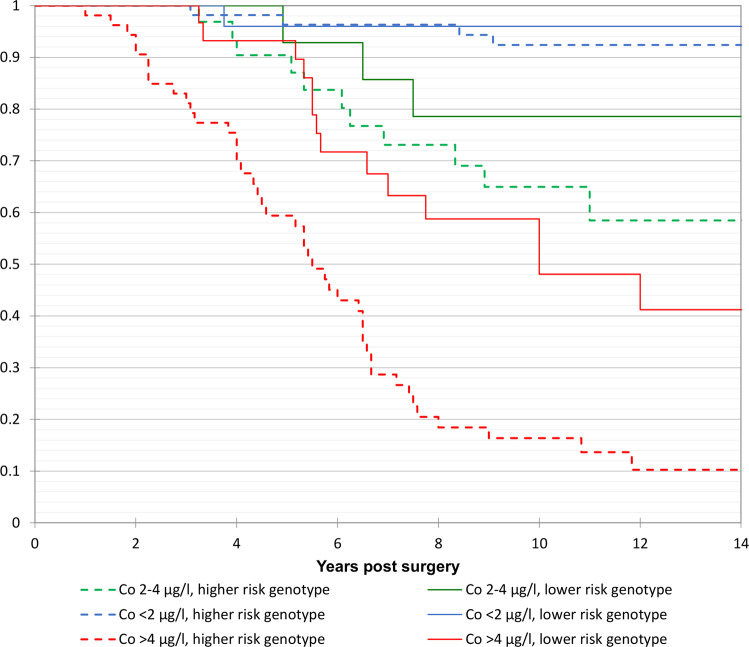
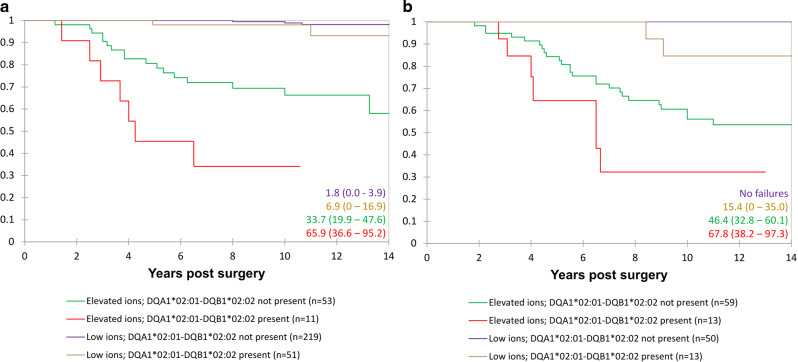
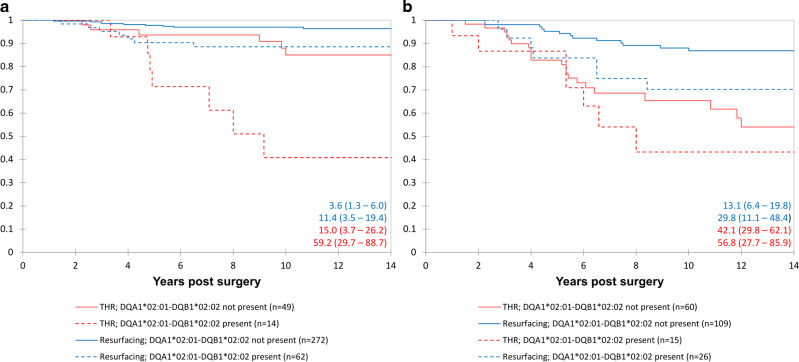
Using next-generation sequencing, here we determine the HLA genotypes of 606 patients. 176 of these patients had experienced failure of their prostheses; the remaining 430 remain asymptomatic at a mean follow up of twelve years. We demonstrate that the development of DTH is associated with patient age, gender, the magnitude of metal exposure, and the presence of certain HLA class II alleles. We show that the predictive algorithm developed from this investigation performs to an accuracy suitable for clinical use, with weighted mean survival probability errors of 1.8% and 3.1% for pre-operative and post-operative models respectively.
The development of DTH following joint replacement appears to be determined by the interaction between implant wear and a patient's genotype. The algorithm described in this paper may improve implant selection and help direct patient surveillance following surgery. Further consideration should be given towards understanding patient-specific responses to different biomaterials.
全球每年进行超过500万例关节置换手术。其中大部分手术使用钴铬(CoCr)部件。一些患者对CoCr植入物产生迟发型超敏反应(DTH),导致组织损伤和翻修手术。DTH不可预测,其遗传联系尚未明确确立。
在单一地点,我们进行了初步调查,以确定与金属对金属髋关节置换术后DTH发生相关的HLA等位基因。然后,我们从其他中心招募患者,以训练和验证一种结合患者年龄、性别、HLA基因型和血液金属浓度的算法,用于预测DTH的发生。使用包括时间依赖性受试者操作曲线在内的性能指标评估建模的准确性。
我们使用下一代测序确定了606例患者的HLA基因型。其中176例患者假体出现故障;其余430例在平均12年的随访中仍无症状。我们证明,DTH的发生与患者年龄、性别、金属暴露程度以及某些HLA II类等位基因的存在有关。我们表明,从这项研究中开发的预测算法的准确性适用于临床使用,术前和术后模型的加权平均生存概率误差分别为1.8%和3.1%。
关节置换术后DTH的发生似乎由植入物磨损与患者基因型之间的相互作用决定。本文描述的算法可能会改善植入物的选择,并有助于指导术后患者的监测。应进一步考虑了解患者对不同生物材料的特异性反应。