Langton D J, Natu S, Harrington C F, Bowsher J G, Nargol A V F
Northern Retrieval Registry, The Biosphere, Newcastle Helix, Newcastle upon Tyne, UK.
University Hospital of North Tees, Stockton-on-Tees, UK.
Bone Joint Res. 2019 Apr 2;8(3):146-155. doi: 10.1302/2046-3758.83.BJR-2018-0049.R1. eCollection 2019 Mar.
We investigated the reliability of the cobalt-chromium (CoCr) synovial joint fluid ratio (JFR) in identifying the presence of a severe aseptic lymphocyte-dominated vasculitis-associated lesion (ALVAL) response and/or suboptimal taper performance (SOTP) following metal-on-metal (MoM) hip arthroplasty. We then examined the possibility that the CoCr JFR may influence the serum partitioning of Co and Cr.
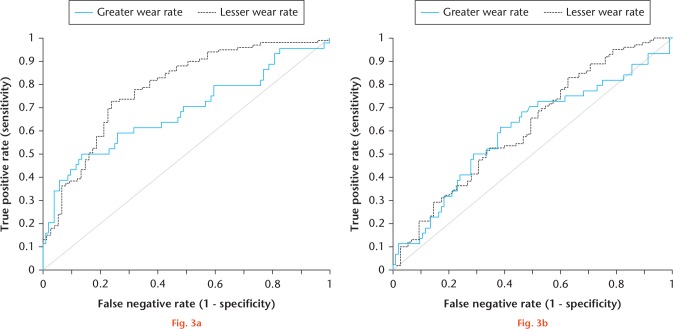
For part A, we included all revision surgeries carried out at our unit with the relevant data, including volumetric wear analysis, joint fluid (JF) Co and Cr concentrations, and ALVAL grade (n = 315). Receiver operating characteristic curves were constructed to assess the reliability of the CoCr JFR in identifying severe ALVAL and/or SOTP. For part B, we included only patients with unilateral prostheses who had given matched serum and whole blood samples for Co and Cr analysis (n = 155). Multiple regression was used to examine the influence of JF concentrations on the serum partitioning of Co and Cr in the blood.
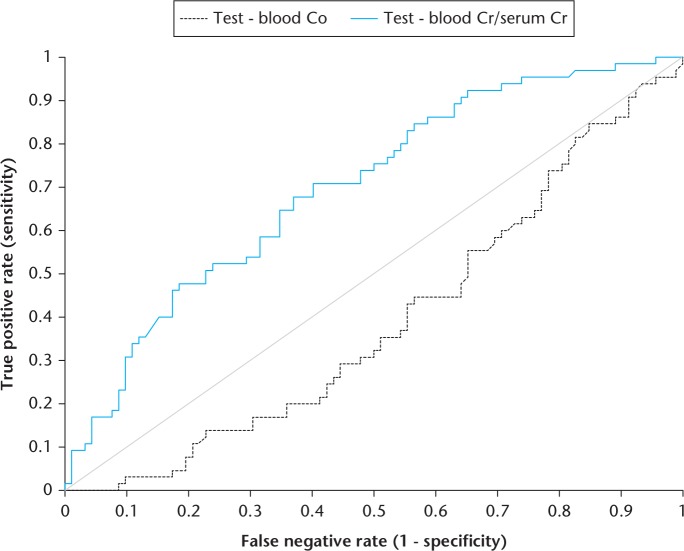
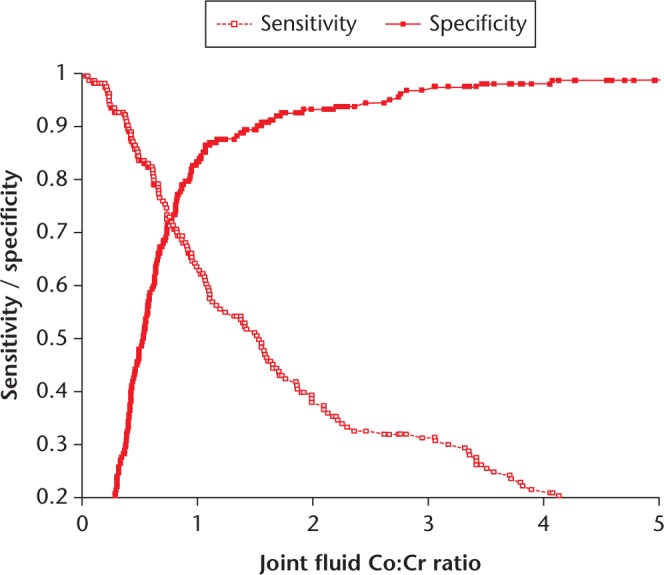
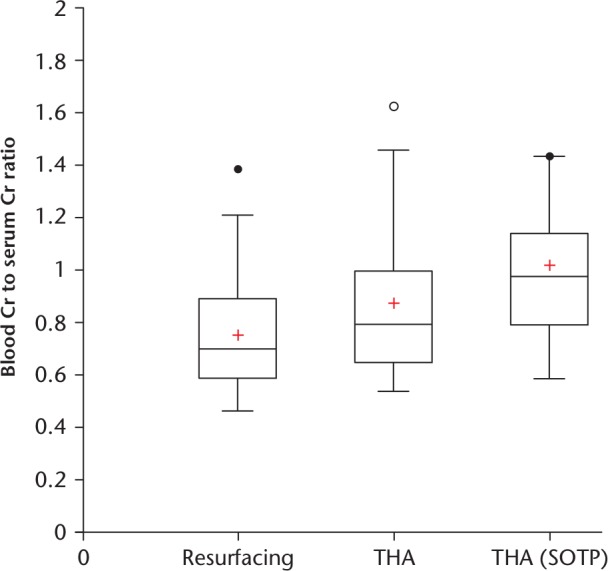
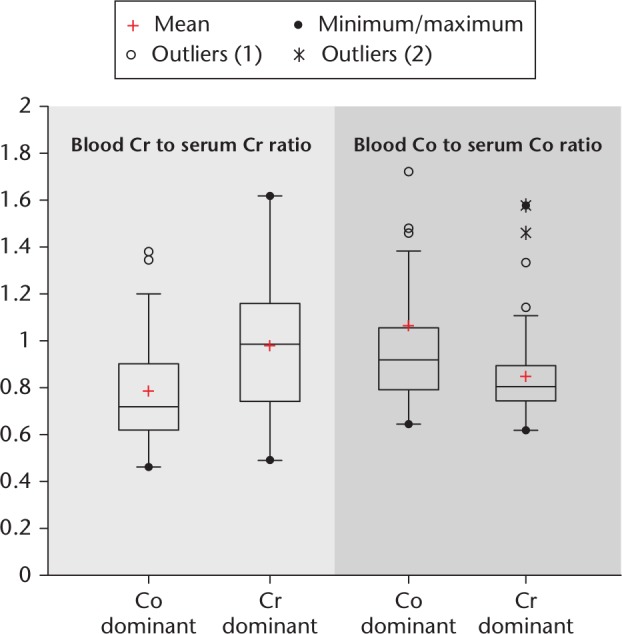
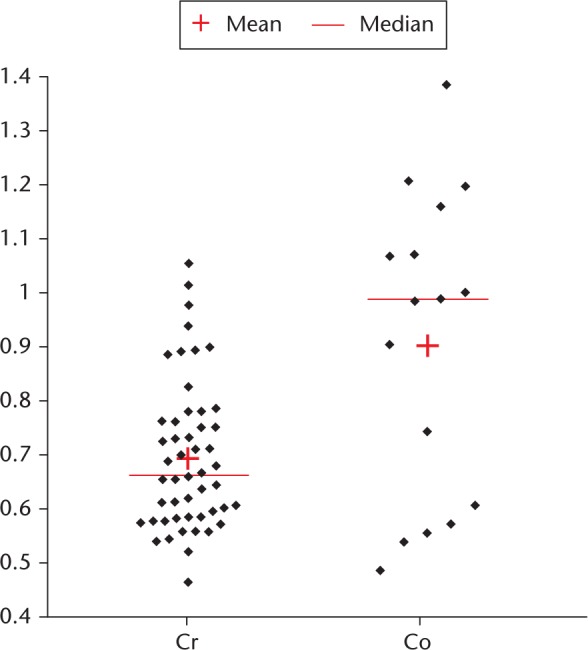
A CoCr JFR > 1 showed a specificity of 83% (77% to 88%) and sensitivity of 63% (55% to 70%) for the detection of severe ALVAL and/or SOTP. In patients with CoCr JFRs > 1, the median blood Cr to serum Cr ratio was 0.99, compared with 0.71 in patients with CoCr JFRs < 1 (p < 0.001). Regression analysis demonstrated that the blood Cr to serum Cr value was positively associated with the JF Co concentration (p = 0.011) and inversely related to the JF Cr concentration (p < 0.001).
Elevations in CoCr JFRs are associated with adverse biological (severe ALVAL) or tribocorrosive processes (SOTP). Comparison of serum Cr with blood Cr concentrations may be a useful additional clinical tool to help to identify these conditions.: D. J. Langton, S. Natu, C. F. Harrington, J. G. Bowsher, A. V. F. Nargol. Is the synovial fluid cobalt-to-chromium ratio related to the serum partitioning of metal debris following metal-on-metal hip arthroplasty? 2019;8:146-155. DOI: 10.1302/2046-3758.83.BJR-2018-0049.R1.
我们研究了钴铬(CoCr)滑膜关节液比率(JFR)在识别金属对金属(MoM)髋关节置换术后严重无菌性淋巴细胞为主的血管炎相关病变(ALVAL)反应和/或 taper 性能欠佳(SOTP)方面的可靠性。然后,我们研究了 CoCr JFR 可能影响钴和铬血清分配的可能性。
对于 A 部分,我们纳入了在我们科室进行的所有翻修手术,并获取了相关数据,包括体积磨损分析、关节液(JF)中钴和铬的浓度以及 ALVAL 分级(n = 315)。构建受试者工作特征曲线以评估 CoCr JFR 在识别严重 ALVAL 和/或 SOTP 方面的可靠性。对于 B 部分,我们仅纳入了单侧假体患者,这些患者提供了匹配的血清和全血样本用于钴和铬分析(n = 155)。使用多元回归来研究 JF 浓度对血液中钴和铬血清分配的影响。
CoCr JFR > 1 在检测严重 ALVAL 和/或 SOTP 时的特异性为 83%(77%至 88%),敏感性为 63%(55%至 70%)。CoCr JFR > 1 的患者中,血液铬与血清铬的中位数比率为 0.99,而 CoCr JFR < 1 的患者中该比率为 0.71(p < 0.001)。回归分析表明,血液铬与血清铬的值与 JF 钴浓度呈正相关(p = 0.011),与 JF 铬浓度呈负相关(p < 0.001)。
CoCr JFR 的升高与不良生物学反应(严重 ALVAL)或摩擦腐蚀过程(SOTP)相关。比较血清铬与血液铬浓度可能是一种有用的额外临床工具,有助于识别这些情况。:D. J. 兰顿、S. 纳图、C. F. 哈林顿、J. G. 鲍舍尔、A. V. F. 纳戈尔。金属对金属髋关节置换术后滑膜液钴铬比与金属碎屑的血清分配有关吗?2019;8:146 - 155。DOI:10.1302/2046 - 3758.83.BJR - 2018 - 0049.R1。