From the Department of Radiology, Seoul National University Hospital, Seoul National University College of Medicine, Seoul, Korea (S.H.Y., J.H.L.); and Department of Internal Medicine, Inje University Sanggye Paik Hospital, Inje University College of Medicine, Seoul 01757, Korea (B.N.K.).
Radiology. 2023 Jan;306(1):252-260. doi: 10.1148/radiol.220676. Epub 2022 Jun 28.
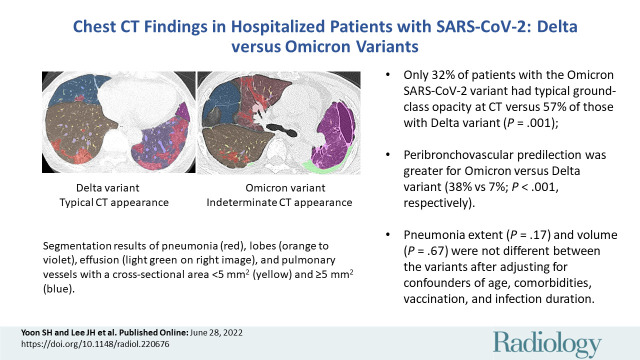
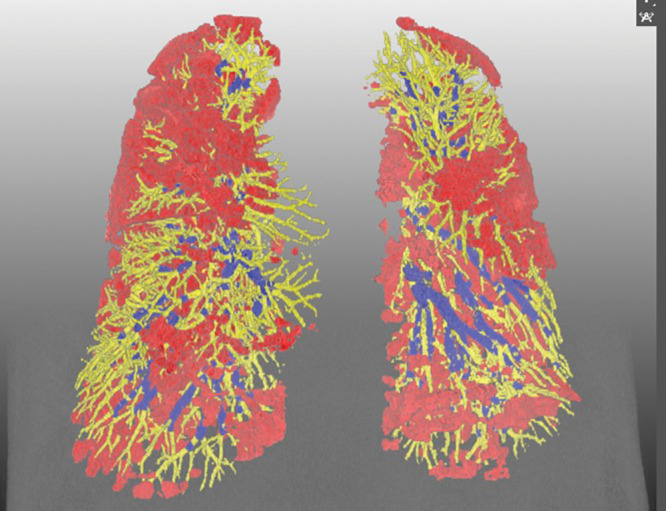
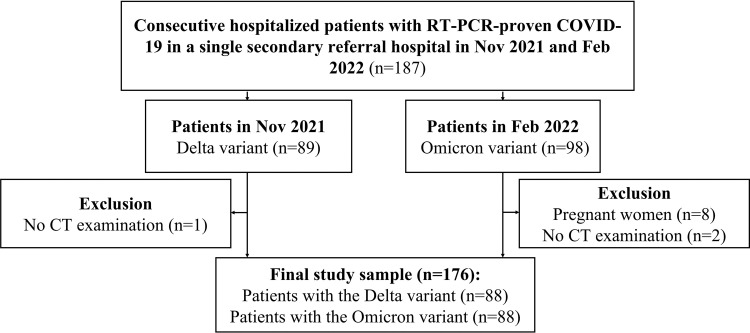
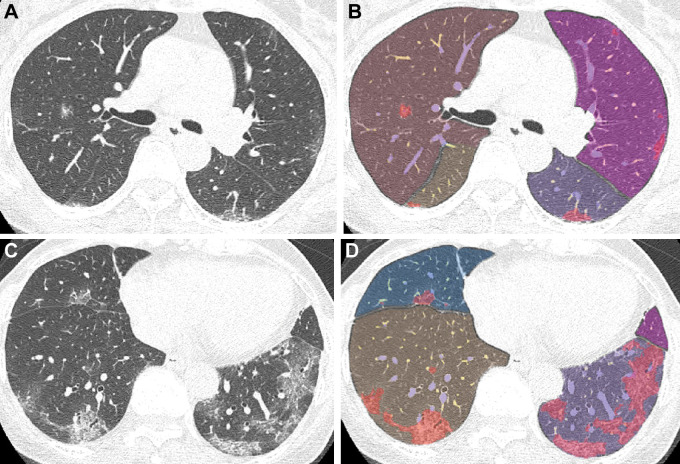
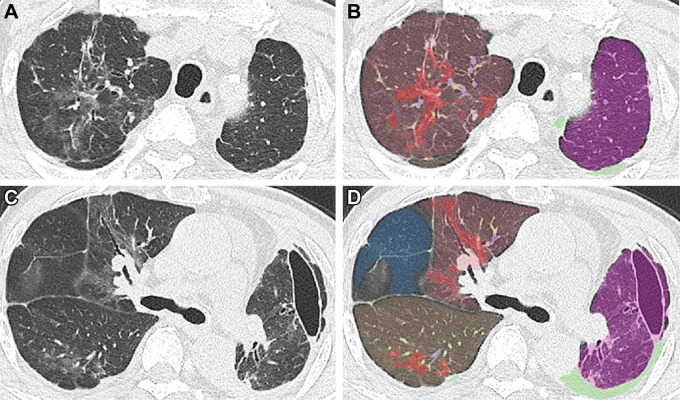
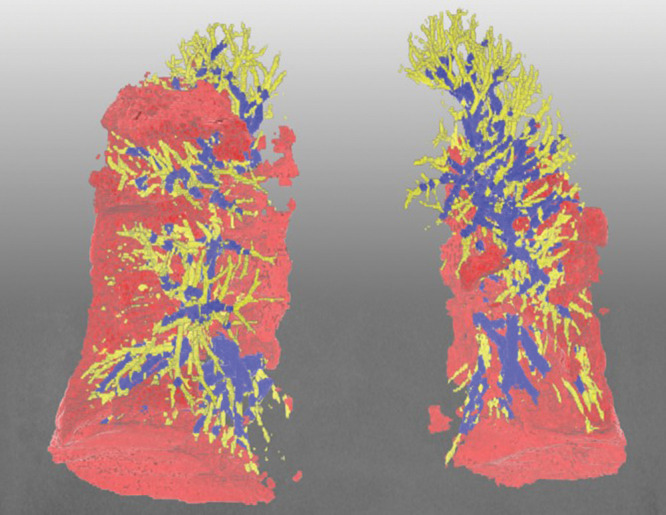
Background CT manifestations of SARS-CoV-2 may differ among variants. Purpose To compare the chest CT findings of SARS-CoV-2 between the Delta and Omicron variants. Materials and Methods This retrospective study collected consecutive baseline chest CT images of hospitalized patients with SARS-CoV-2 from a secondary referral hospital when the Delta and Omicron variants were predominant. Two radiologists categorized CT images according to the RSNA classification system for COVID-19 and visually graded pneumonia extent. Pneumonia, pleural effusion, and intrapulmonary vessels were segmented and quantified on CT images using a priori-developed neural networks, followed by reader confirmation. Multivariable logistic and linear regression analyses were performed to examine the associations between the variants and CT category, distribution, severity, and peripheral vascularity. Results In total, 88 patients with the Delta variant (mean age, 67 years ± 15 [SD]; 46 men) and 88 patients with the Omicron variant (mean age, 62 years ± 19; 51 men) were included. Omicron was associated with less frequent, typical peripheral bilateral ground-glass opacity (32% [28 of 88] vs 57% [50 of 88], = .001), more frequent peribronchovascular predilection (38% [25 of 66] vs 7% [five of 71], < .001), lower visual pneumonia extent (5.4 ± 6.0 vs 7.7 ± 6.6, = .02), similar pneumonia volume (5% ± 1 vs 7% ± 11, = .14), and a higher proportion of vessels with a cross-sectional area smaller than 5 mm relative to the total pulmonary blood volume (BV5%; 48% ± 11 vs 44% ± 8; = .004). In adjusted analyses, Omicron was associated with a nontypical appearance (odds ratio, 0.34; = .006), peribronchovascular predilection (odds ratio, 9.2; < .001), and higher BV5% (β = 3.8; = .01) but similar visual pneumonia extent ( = .17) and pneumonia volume ( = .67) relative to the Delta variant. Conclusion At chest CT, the Omicron SARS-COV-2 variant showed nontypical peribronchovascular pneumonia and less pulmonary vascular involvement than did the Delta variant in hospitalized patients with similar disease severity. © RSNA, 2022
SARS-CoV-2 的 CT 表现可能因变体而异。目的:比较德尔塔和奥密克戎变体的 SARS-CoV-2 之间的胸部 CT 发现。材料与方法:本回顾性研究收集了一家二级转诊医院住院的 SARS-CoV-2 患者的连续基线胸部 CT 图像,当时德尔塔和奥密克戎变体占主导地位。两位放射科医生根据 RSNA 分类系统对 CT 图像进行分类,并对肺炎程度进行视觉分级。使用预先开发的神经网络对 CT 图像上的肺炎、胸腔积液和肺内血管进行分割和量化,然后由读者确认。进行多变量逻辑和线性回归分析,以检查变体与 CT 类别、分布、严重程度和周围血管性之间的关联。结果:共纳入 88 例德尔塔变体患者(平均年龄,67 岁±15[标准差];46 名男性)和 88 例奥密克戎变体患者(平均年龄,62 岁±19;51 名男性)。奥密克戎与更常见的非典型双侧外周性磨玻璃影(32%[28/88]与 57%[50/88],.001)、更常见的支气管周围血管偏好(38%[25/66]与 7%[5/71], <.001)、较低的视觉肺炎程度(5.4±6.0 与 7.7±6.6,.02)、相似的肺炎体积(5%±1 与 7%±11, =.14)和更大比例的截面积小于总肺血容积(BV5%)的血管(48%±11 与 44%±8, =.004)有关。在调整分析中,奥密克戎与非典型表现(比值比,0.34;.006)、支气管周围血管偏好(比值比,9.2; <.001)和更高的 BV5%(β=3.8;.01)相关,但与德尔塔变体相比,视觉肺炎程度( =.17)和肺炎体积( =.67)相似。结论:在胸部 CT 上,与德尔塔变体相比,住院患者中奥密克戎 SARS-COV-2 变体表现为非典型性支气管周围性肺炎,肺血管受累程度较低,且疾病严重程度相似。