From the Department of Radiology, Chonnam National University Hospital, Gwangju, Korea (J.E.L., Y.H.K.); Department of Radiology and Biomedical Research Institute, Pusan National University Hospital, 179 Gudeok-ro, Seo-gu, Busan 49241, Korea (M.H., Y.J.J.); Department of Radiology and Center for Imaging Science, Samsung Medical Center, Sungkyunkwan University School of Medicine, Seoul, Korea (M.J.C.); Department of Radiology, Namwon Medical Center, Namwon, Korea (B.H.S.); Department of Radiology, Research Institute of Clinical Medicine of Jeonbuk National University-Biomedical Research Institute of Jeonbuk National University Hospital, Jeonju, Korea (K.J.C.); and Department of Radiology, Chungbuk National University Hospital, Cheongju, Korea (J.Y.Y.).
Radiology. 2022 Jun;303(3):682-692. doi: 10.1148/radiol.213072. Epub 2022 Feb 1.
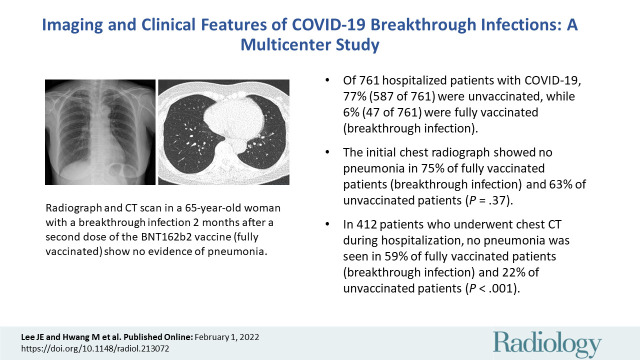
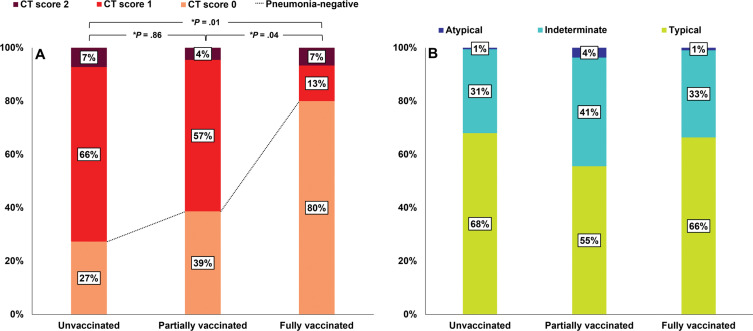
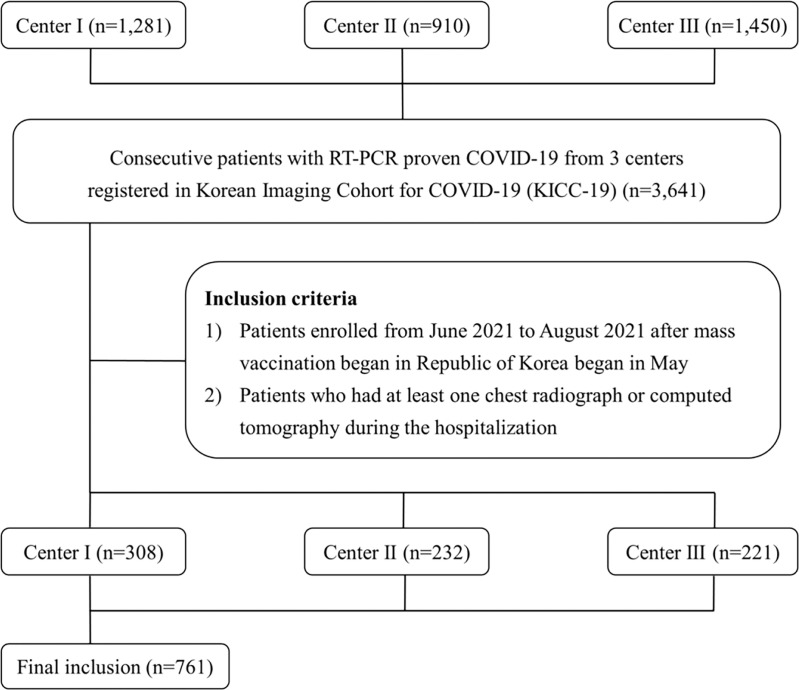
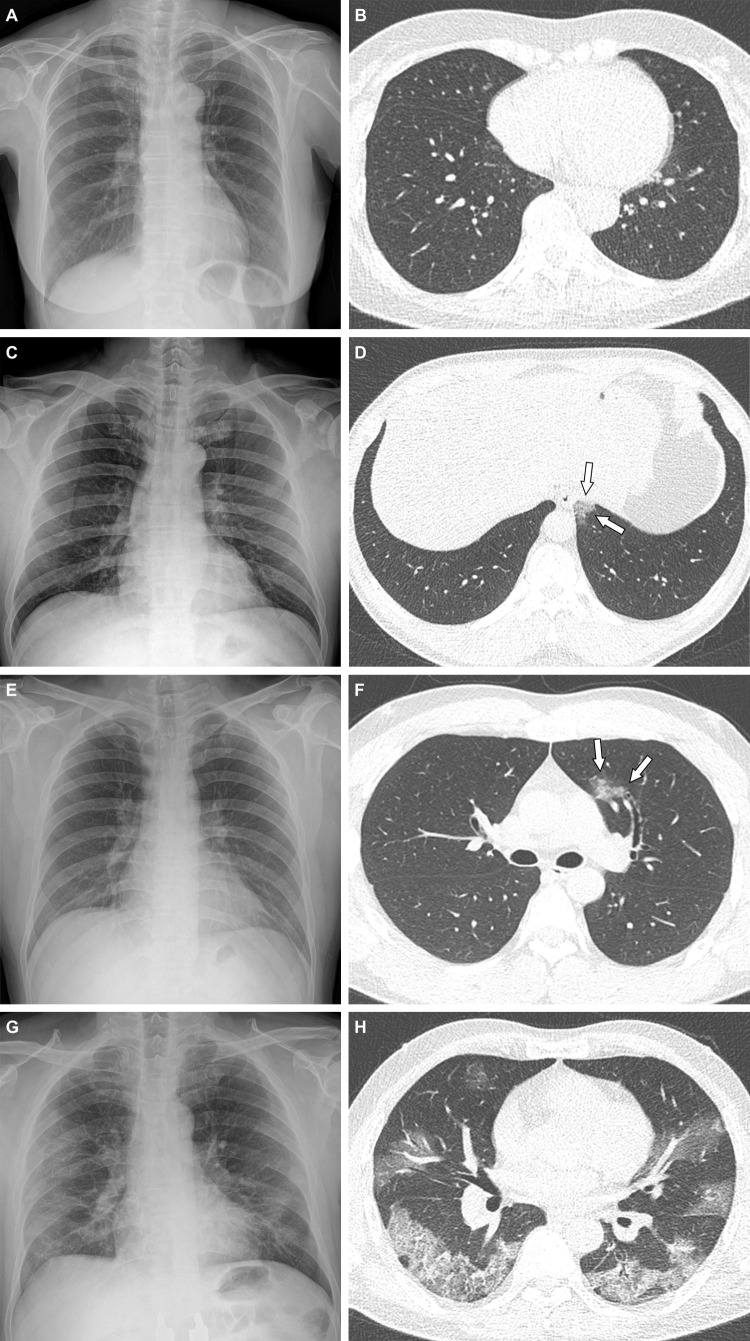
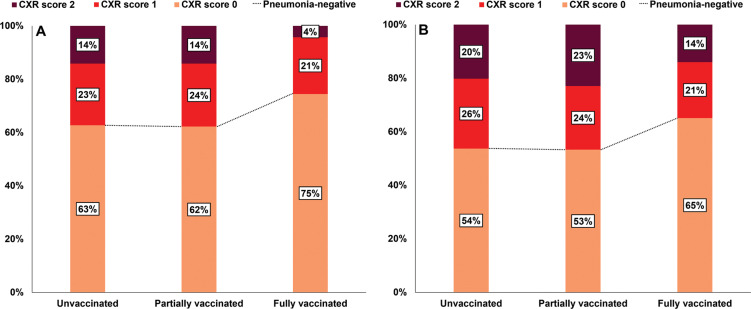
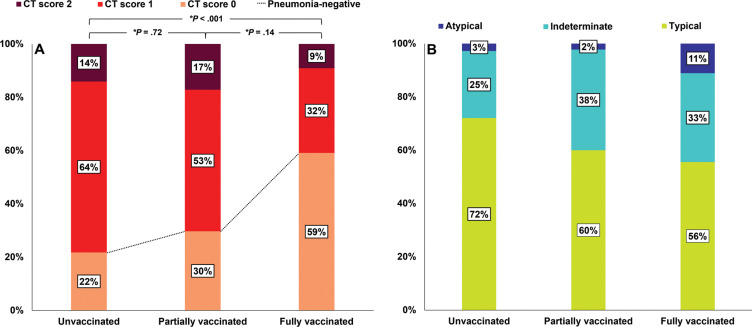
Background Since vaccines against COVID-19 became available, rare breakthrough infections have been reported despite their high efficacies. Purpose To evaluate the clinical and imaging characteristics of patients with COVID-19 breakthrough infections and compare them with those of unvaccinated patients with COVID-19. Materials and Methods In this retrospective multicenter cohort study, the authors analyzed patient (aged ≥18 years) data from three centers that were registered in an open data repository for COVID-19 between June and August 2021. Hospitalized patients with baseline chest radiographs were divided into three groups according to their vaccination status. Differences between clinical and imaging features were analyzed using the Pearson χ test, Fisher exact test, and analysis of variance. Univariable and multivariable logistic regression analyses were used to evaluate associations between clinical factors, including vaccination status and clinical outcomes. Results Of the 761 hospitalized patients with COVID-19, the mean age was 47 years and 385 (51%) were women; 47 patients (6%) were fully vaccinated (breakthrough infection), 127 (17%) were partially vaccinated, and 587 (77%) were unvaccinated. Of the 761 patients, 412 (54%) underwent chest CT during hospitalization. Among the patients who underwent CT, the proportions without pneumonia were 22% of unvaccinated patients (71 of 326), 30% of partially vaccinated patients (19 of 64), and 59% of fully vaccinated patients (13 of 22) ( < .001). Fully vaccinated status was associated with a lower risk of requiring supplemental oxygen (odds ratio [OR], 0.24 [95% CI: 0.09, 0.64; = .005]) and lower risk of intensive care unit admission (OR, 0.08 [95% CI: 0.09, 0.78; = .02]) compared with unvaccinated status. Conclusion Patients with COVID-19 breakthrough infections had a significantly higher proportion of CT scans without pneumonia compared with unvaccinated patients. Vaccinated patients with breakthrough infections had a lower likelihood of requiring supplemental oxygen and intensive care unit admission. © RSNA, 2022 See also the editorial by Schiebler and Bluemke in this issue.
自 COVID-19 疫苗问世以来,尽管其有效性很高,但仍有罕见的突破性感染报告。目的:评估 COVID-19 突破性感染患者的临床和影像学特征,并将其与未接种 COVID-19 疫苗的患者进行比较。材料与方法:本回顾性多中心队列研究分析了 2021 年 6 月至 8 月期间在 COVID-19 开放数据存储库中登记的来自三个中心的患者(年龄≥18 岁)数据。根据基线胸部 X 线片,将住院患者分为三组,根据其接种状态。采用 Pearson χ 检验、Fisher 确切检验和方差分析比较临床和影像学特征的差异。采用单变量和多变量逻辑回归分析评估包括接种状态和临床结局在内的临床因素之间的关联。结果:761 例住院 COVID-19 患者中,平均年龄为 47 岁,385 例(51%)为女性;47 例(6%)为完全接种(突破性感染),127 例(17%)为部分接种,587 例(77%)未接种。761 例患者中,412 例(54%)在住院期间接受了胸部 CT 检查。在接受 CT 检查的患者中,无肺炎的比例分别为未接种组(326 例中 71 例,22%)、部分接种组(64 例中 19 例,30%)和完全接种组(22 例中 13 例,59%)(<.001)。与未接种组相比,完全接种组需要补充氧气的风险较低(比值比,0.24[95%CI:0.09,0.64; =.005]),入住重症监护病房的风险也较低(比值比,0.08[95%CI:0.09,0.78; =.02])。结论:与未接种疫苗的患者相比,COVID-19 突破性感染患者的 CT 扫描无肺炎的比例显著更高。突破性感染的接种患者需要补充氧气和入住重症监护病房的可能性较低。版权声明:©2022 RSNA,见本期社论,由 Schiebler 和 Bluemke 撰写。