Department of Biopharmaceutics, Graduate School of Pharmaceutical Sciences, Kumamoto University, Kumamoto, Japan.
Division of Pharmacodynamics, Faculty of Pharmacy, Keio University, Tokyo, Japan.
Redox Biol. 2022 Aug;54:102371. doi: 10.1016/j.redox.2022.102371. Epub 2022 Jun 22.
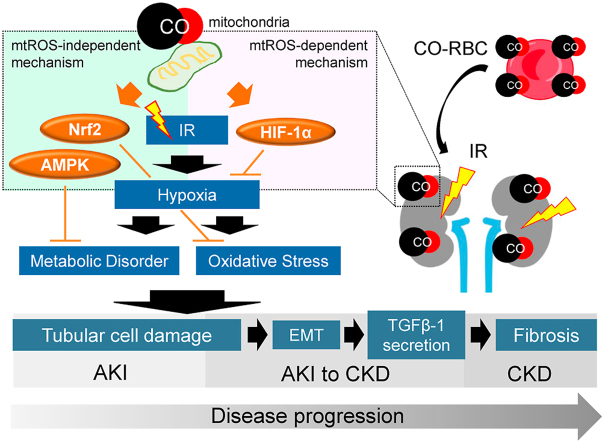
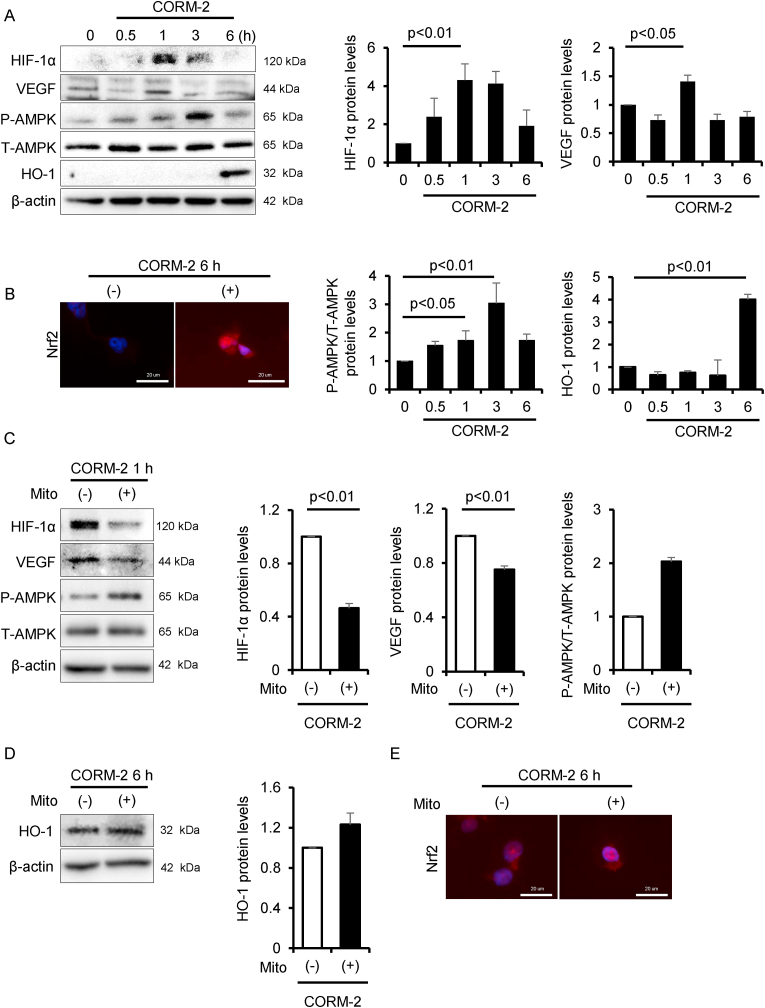
Renal ischemia-reperfusion (IR)-induced tissue hypoxia causes impaired energy metabolism and oxidative stress. These conditions lead to tubular cell damage, which is a cause of acute kidney injury (AKI) and AKI to chronic kidney disease (CKD). Three key molecules, i.e., hypoxia-inducible factor-1α (HIF-1α), AMP-activated protein kinase (AMPK), and nuclear factor E2-related factor 2 (Nrf2), have the potential to protect tubular cells from these disorders. Although carbon monoxide (CO) can comprehensively induce these three molecules via the action of mitochondrial reactive oxygen species (mtROS), the issue of whether CO induces these molecules in tubular cells remains unclear. Herein, we report that CO-enriched red blood cells (CO-RBC) cell therapy, the inspiration for which is the in vivo CO delivery system, exerts a renoprotective effect on hypoxia-induced tubular cell damage via the upregulation of the above molecules. Experiments using a mitochondria-specific antioxidant provide evidence to show that CO-driven mtROS partially contributes to the upregulation of the aforementioned molecules in tubular cells. CO-RBC ameliorates the pathological conditions of IR-induced AKI model mice via activation of these molecules. CO-RBC also prevents renal fibrosis via the suppression of epithelial mesenchymal transition and transforming growth factor-β1 secretion in an IR-induced AKI to CKD model mice. In conclusion, our results confirm that the bioinspired CO delivery system prevents the pathological conditions of both AKI and AKI to CKD via the amelioration of hypoxia inducible tubular cell damage, thereby making it an effective cell therapy for treating the progression to CKD.
肾缺血再灌注(IR)引起的组织缺氧导致能量代谢和氧化应激受损。这些情况导致肾小管细胞损伤,这是急性肾损伤(AKI)和 AKI 向慢性肾脏病(CKD)发展的原因。三种关键分子,即缺氧诱导因子-1α(HIF-1α)、AMP 激活的蛋白激酶(AMPK)和核因子 E2 相关因子 2(Nrf2),有潜力保护肾小管细胞免受这些疾病的影响。虽然一氧化碳(CO)可以通过线粒体活性氧(mtROS)的作用综合诱导这三种分子,但 CO 是否在肾小管细胞中诱导这些分子的问题尚不清楚。在此,我们报告富 CO 红细胞(CO-RBC)细胞疗法通过上调上述分子对缺氧诱导的肾小管细胞损伤具有肾保护作用,该疗法的灵感来自于体内 CO 输送系统。使用线粒体特异性抗氧化剂的实验提供了证据,表明 CO 驱动的 mtROS 部分有助于肾小管细胞中上述分子的上调。CO-RBC 通过激活这些分子改善 IR 诱导的 AKI 模型小鼠的病理状况。CO-RBC 还通过抑制上皮间质转化和转化生长因子-β1 在 IR 诱导的 AKI 向 CKD 模型小鼠中的分泌来预防肾纤维化。总之,我们的结果证实,仿生 CO 输送系统通过改善缺氧诱导的肾小管细胞损伤来预防 AKI 和 AKI 向 CKD 的病理状况,从而成为治疗 CKD 进展的有效细胞疗法。