Taniguchi Leandro Utino, Avelino-Silva Thiago Junqueira, Dias Murilo Bacchini, Jacob-Filho Wilson, Aliberti Márlon Juliano Romero
Emergency Medicine Discipline, Medical Department, Hospital das Clinicas HCFMUSP, Faculdade de Medicina da Universidade de São Paulo, São Paulo, Brazil.
Intensive care medicine department, Hospital Sirio LIbanes, São Paulo, Brazil.
Crit Care Explor. 2022 May 25;4(6):e0712. doi: 10.1097/CCE.0000000000000712. eCollection 2022 Jun.
Few studies have explored the effect of frailty on the long-term survival of COVID-19 patients after ICU admission. Furthermore, the Clinical Frailty Scale (CFS) validity in critical care patients remains debated. We investigated the association between frailty and 6-month survival in critically ill COVID-19 patients. We also explored whether ICU resource utilization varied according to frailty status and examined the concurrent validity of the CFS in this setting.
Ancillary study of a longitudinal prospective cohort.
University hospital in São Paulo.
Patients with severe COVID-19 admitted to ICU.
None.
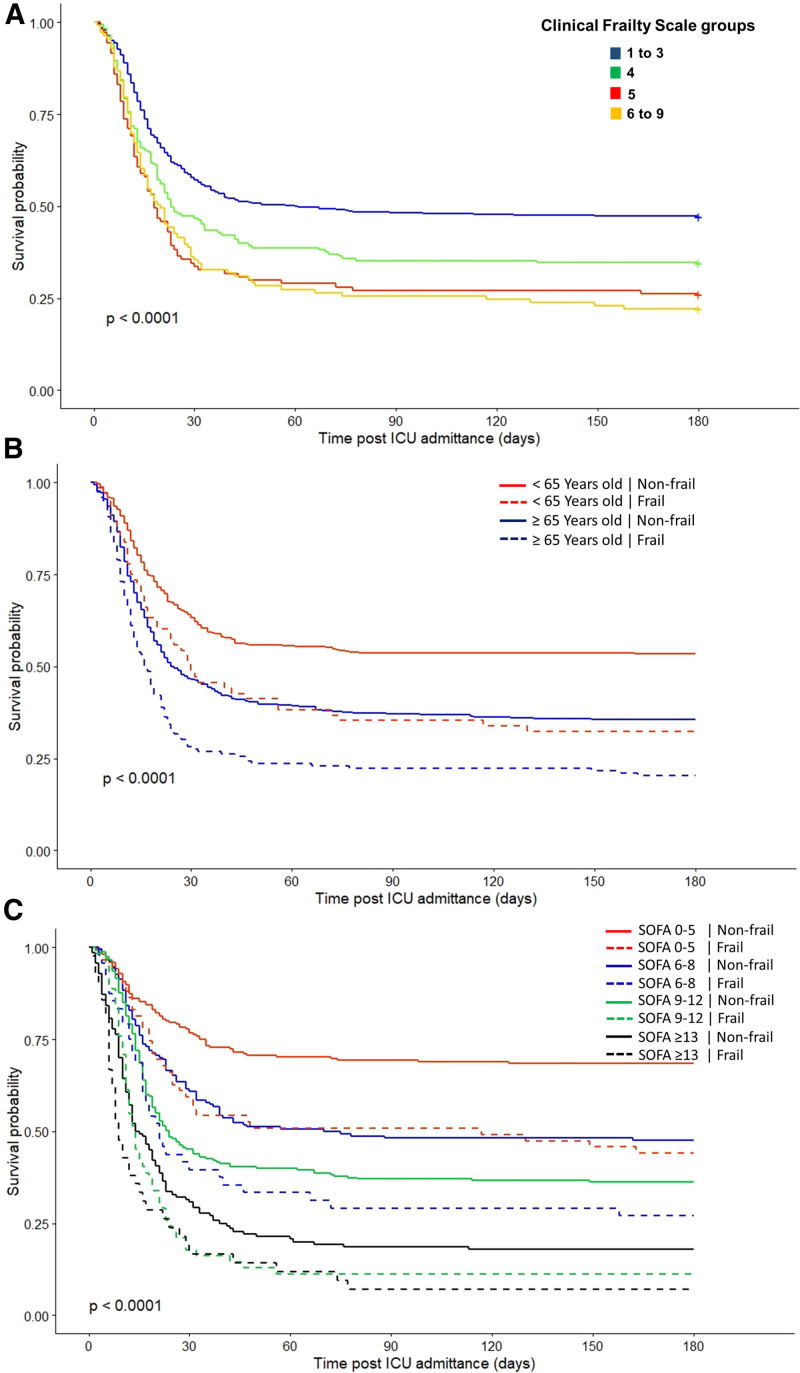
We assessed baseline frailty using the CFS (1-9; frail ≥ 5) and used validated procedures to compute a Frailty Index (0-1; frail > 0.25). We used Cox models to estimate associations of frailty status with 6-month survival after ICU admission and area under the receiver operating characteristic curves (AUCs) to estimate CFS's accuracy in identifying frailty according to Frailty Index. We included 1,028 patients (mean age, 66 yr; male, 61%). Overall, 224 (22%) patients were frail (CFS ≥ 5), and 608 (59%) died over the 6-month follow-up. Frailty was independently associated with lower 6-month survival and further stratified mortality in patients with similar age and Sequential Organ Failure Assessment scores. We additionally verified that the CFS was highly accurate in identifying frailty as defined by the Frailty Index (AUC, 0.91; 95% CI, 0.89-0.93). Although treatment modalities did not diverge according to frailty status, higher CFS scores were associated with withholding organ support due to refractory organ failure.
One in five COVID-19 patients admitted to the ICU was frail. CFS scores greater than or equal to 5 were associated with lower long-term survival and decisions on withholding further escalation of invasive support for multiple organ failure in the ICU. Clinicians should consider frailty alongside sociodemographic and clinical measures to have a fuller picture of COVID-19 prognosis in critical care.
很少有研究探讨衰弱对新冠病毒疾病(COVID-19)患者入住重症监护病房(ICU)后的长期生存的影响。此外,临床衰弱量表(CFS)在危重症患者中的有效性仍存在争议。我们调查了危重症COVID-19患者衰弱与6个月生存率之间的关联。我们还探讨了ICU资源利用是否因衰弱状态而异,并检验了CFS在这种情况下的同时效度。
纵向前瞻性队列的辅助研究。
圣保罗的大学医院。
入住ICU的重症COVID-19患者。
无。
我们使用CFS(1 - 9分;衰弱≥5分)评估基线衰弱情况,并使用经过验证的程序计算衰弱指数(0 - 1;衰弱>0.25)。我们使用Cox模型估计衰弱状态与ICU入院后6个月生存率之间的关联,并使用受试者工作特征曲线下面积(AUC)来估计CFS根据衰弱指数识别衰弱的准确性。我们纳入了1028例患者(平均年龄66岁;男性占61%)。总体而言,224例(22%)患者衰弱(CFS≥5),608例(59%)在6个月的随访期内死亡。在年龄和序贯器官衰竭评估评分相似的患者中,衰弱与较低的6个月生存率及进一步分层的死亡率独立相关。我们还验证了CFS在识别由衰弱指数定义的衰弱方面具有高度准确性(AUC,0.91;95%可信区间,0.89 - 0.93)。尽管治疗方式未因衰弱状态而有所不同,但较高的CFS评分与因难治性器官衰竭而停止器官支持相关。
入住ICU的COVID-19患者中有五分之一衰弱。CFS评分大于或等于5分与较低的长期生存率以及决定停止对ICU中多器官衰竭进行进一步强化的侵入性支持相关。临床医生在全面了解危重症COVID-19患者的预后时,应将衰弱与社会人口学和临床指标一并考虑。