Department of Population, Family and Reproductive Health, Johns Hopkins Bloomberg School of Public Health, Baltimore, Maryland, USA.
Stud Fam Plann. 2022 Sep;53(3):527-548. doi: 10.1111/sifp.12206. Epub 2022 Jun 29.
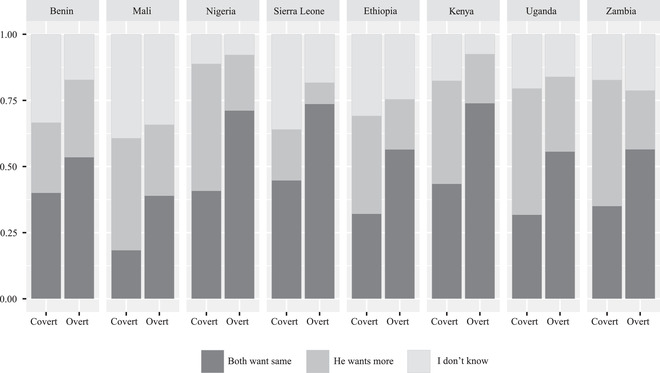
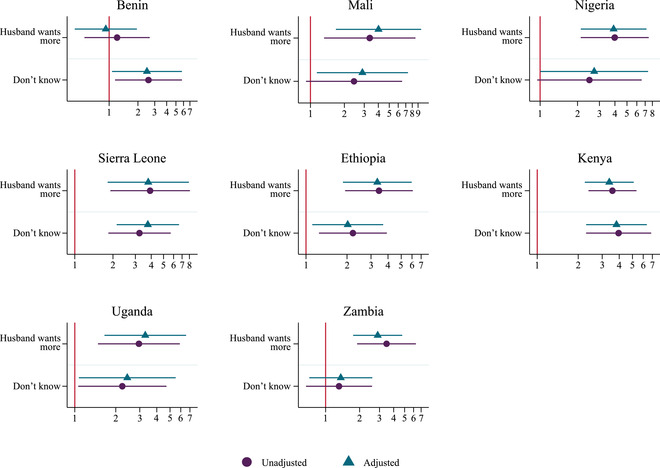
Covert use of contraception is a common but underreported and understudied phenomenon where one partner uses contraception without the other's knowledge. We used Demographic and Health Survey couple data to examine the relationship between wives' perceptions of husbands' fertility preferences and type of contraceptive use (overt vs. covert) in Benin, Ethiopia, Kenya, Mali, Nigeria, Sierra Leone, Uganda, and Zambia using logistic regression. Wives who perceived that their husbands wanted more children than them had increased odds of using covertly, compared to those who perceived that husbands wanted the same number of children in all countries except Benin, and the strength of the relationships ranged from adjusted odds ratio (aOR) 2.89 (95 percent confidence interval (CI) 1.75-4.76) in Zambia to aOR 4.01 (95 percent CI 1.68-9.58) in Mali. Wives who reported not knowing their husbands' fertility preferences had increased odds of using covertly compared to wives who perceived that their husbands wanted the same number of children in all countries except Zambia, ranging from aOR 2.02 (95 percent CI 1.11-3.69) in Ethiopia to aOR 3.82 (95 percent CI 2.29-6.37) in Kenya. Our findings indicate that efforts to increase partner engagement to align couple's fertility preferences may encourage overt use.
隐瞒避孕是一种常见但报道和研究不足的现象,即一方在另一方不知情的情况下使用避孕措施。我们使用人口与健康调查的夫妇数据,使用逻辑回归检验了贝宁、埃塞俄比亚、肯尼亚、马里、尼日利亚、塞拉利昂、乌干达和赞比亚的妻子对丈夫生育偏好的看法与避孕方法(公开与隐瞒)之间的关系。与那些认为丈夫与自己生育意愿相同的妻子相比,认为丈夫想要更多孩子的妻子隐瞒使用避孕措施的可能性更大,除了贝宁之外,所有国家的关系强度都表现为调整后的优势比(aOR)从 2.89(95%置信区间(CI)1.75-4.76)到马里的 4.01(95%CI 1.68-9.58)。与那些认为丈夫与自己生育意愿相同的妻子相比,报告不知道丈夫生育偏好的妻子隐瞒使用避孕措施的可能性更大,除了赞比亚之外,所有国家的调整后优势比(aOR)范围从埃塞俄比亚的 2.02(95%CI 1.11-3.69)到肯尼亚的 3.82(95%CI 2.29-6.37)。我们的研究结果表明,努力增加伴侣参与度以协调夫妻的生育意愿,可能会鼓励公开使用避孕措施。