Majmudar Maulik D, Chandra Siddhartha, Yakkala Kiran, Kennedy Samantha, Agrawal Amit, Sippel Mark, Ramu Prakash, Chaudhri Apoorv, Smith Brooke, Criminisi Antonio, Heymsfield Steven B, Stanford Fatima Cody
Amazon, Inc., Seattle, WA, USA.
Pennington Biomedical Research Center, Louisiana State University System, Baton Rouge, LA, USA.
NPJ Digit Med. 2022 Jun 29;5(1):79. doi: 10.1038/s41746-022-00628-3.
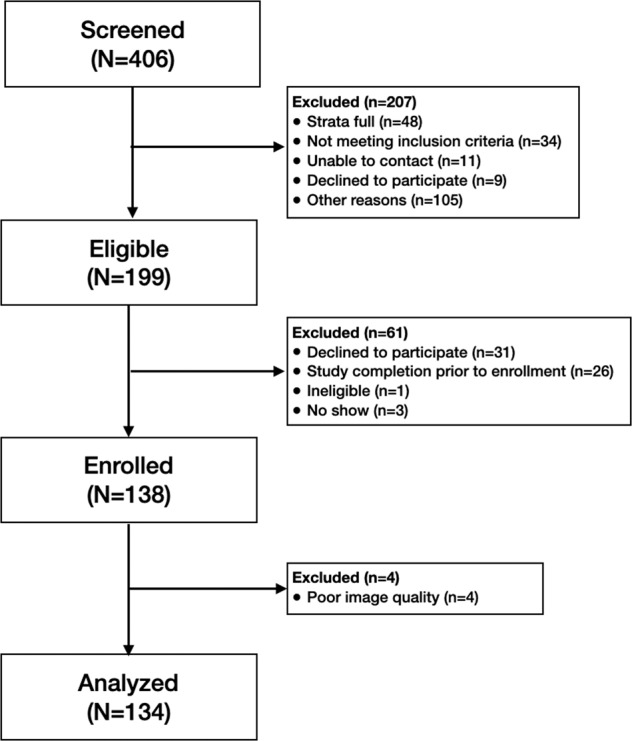
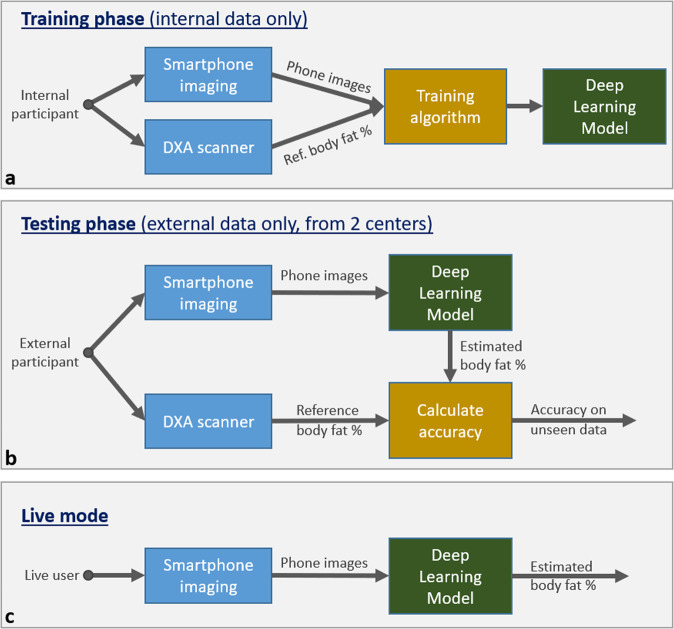
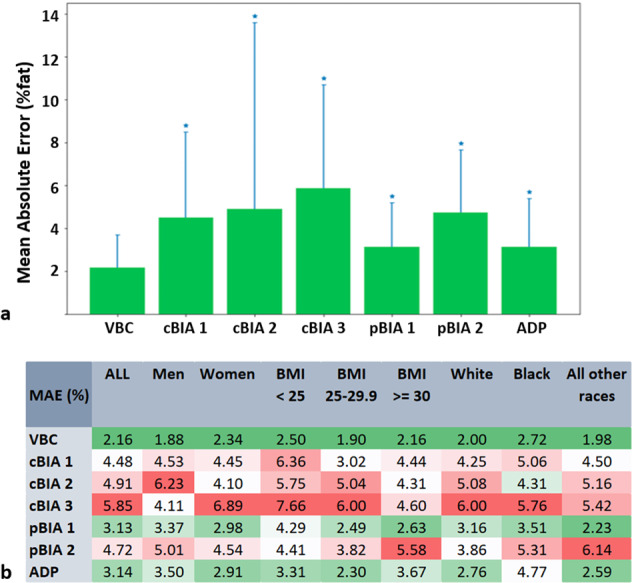
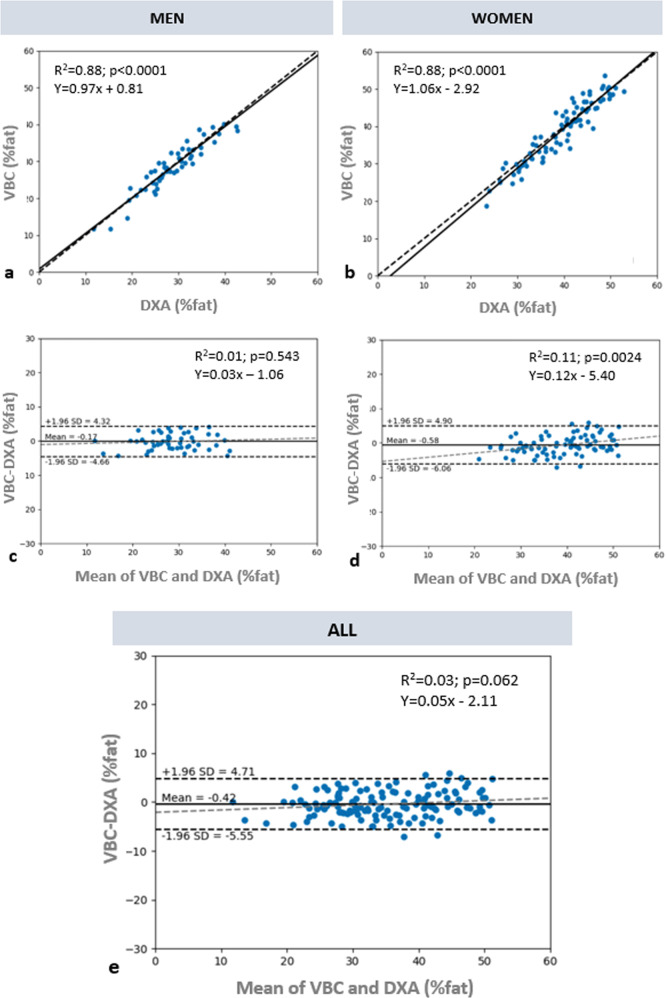
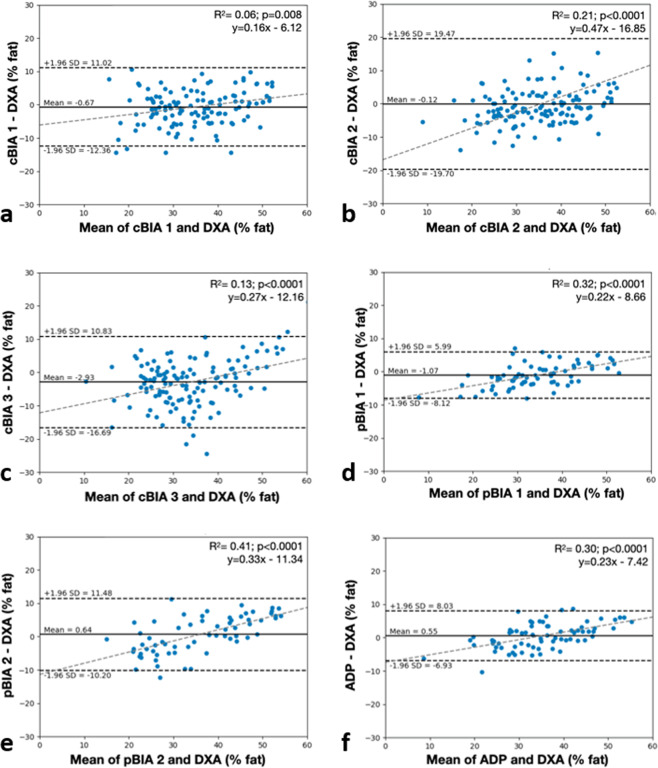
Body composition is a key component of health in both individuals and populations, and excess adiposity is associated with an increased risk of developing chronic diseases. Body mass index (BMI) and other clinical or commercially available tools for quantifying body fat (BF) such as DXA, MRI, CT, and photonic scanners (3DPS) are often inaccurate, cost prohibitive, or cumbersome to use. The aim of the current study was to evaluate the performance of a novel automated computer vision method, visual body composition (VBC), that uses two-dimensional photographs captured via a conventional smartphone camera to estimate percentage total body fat (%BF). The VBC algorithm is based on a state-of-the-art convolutional neural network (CNN). The hypothesis is that VBC yields better accuracy than other consumer-grade fat measurements devices. 134 healthy adults ranging in age (21-76 years), sex (61.2% women), race (60.4% White; 23.9% Black), and body mass index (BMI, 18.5-51.6 kg/m) were evaluated at two clinical sites (N = 64 at MGH, N = 70 at PBRC). Each participant had %BF measured with VBC, three consumer and two professional bioimpedance analysis (BIA) systems. The PBRC participants also had air displacement plethysmography (ADP) measured. %BF measured by dual-energy x-ray absorptiometry (DXA) was set as the reference against which all other %BF measurements were compared. To test our scientific hypothesis we run multiple, pair-wise Wilcoxon signed rank tests where we compare each competing measurement tool (VBC, BIA, …) with respect to the same ground-truth (DXA). Relative to DXA, VBC had the lowest mean absolute error and standard deviation (2.16 ± 1.54%) compared to all of the other evaluated methods (p < 0.05 for all comparisons). %BF measured by VBC also had good concordance with DXA (Lin's concordance correlation coefficient, CCC: all 0.96; women 0.93; men 0.94), whereas BMI had very poor concordance (CCC: all 0.45; women 0.40; men 0.74). Bland-Altman analysis of VBC revealed the tightest limits of agreement (LOA) and absence of significant bias relative to DXA (bias -0.42%, R = 0.03; p = 0.062; LOA -5.5% to +4.7%), whereas all other evaluated methods had significant (p < 0.01) bias and wider limits of agreement. Bias in Bland-Altman analyses is defined as the discordance between the y = 0 axis and the regressed line computed from the data in the plot. In this first validation study of a novel, accessible, and easy-to-use system, VBC body fat estimates were accurate and without significant bias compared to DXA as the reference; VBC performance exceeded those of all other BIA and ADP methods evaluated. The wide availability of smartphones suggests that the VBC method for evaluating %BF could play an important role in quantifying adiposity levels in a wide range of settings.Trial registration: ClinicalTrials.gov Identifier: NCT04854421.
身体组成是个体和人群健康的关键组成部分,而肥胖过多与患慢性病风险增加相关。体重指数(BMI)以及其他用于量化体脂(BF)的临床或商用工具,如双能X线吸收法(DXA)、磁共振成像(MRI)、计算机断层扫描(CT)和光子扫描仪(3DPS),往往不准确、成本过高或使用不便。本研究的目的是评估一种新型自动计算机视觉方法——视觉身体组成(VBC)的性能,该方法使用通过传统智能手机摄像头拍摄的二维照片来估计全身脂肪百分比(%BF)。VBC算法基于先进的卷积神经网络(CNN)。假设是VBC比其他消费级脂肪测量设备具有更高的准确性。在两个临床地点对134名年龄在21至76岁之间、性别(61.2%为女性)、种族(60.4%为白人;23.9%为黑人)和体重指数(BMI,18.5至51.6kg/m²)的健康成年人进行了评估(麻省总医院64名,太平洋生物医学研究中心70名)。每位参与者使用VBC、三种消费级和两种专业生物电阻抗分析(BIA)系统测量了%BF。太平洋生物医学研究中心的参与者还进行了空气置换体积描记法(ADP)测量。将通过双能X线吸收法(DXA)测量的%BF设定为参考标准,与所有其他%BF测量结果进行比较。为了检验我们的科学假设,我们进行了多次成对的Wilcoxon符号秩检验,将每个竞争测量工具(VBC、BIA等)与相同的地面真值(DXA)进行比较。相对于DXA,与所有其他评估方法相比,VBC的平均绝对误差和标准差最低(2.16±1.54%)(所有比较p<0.05)。VBC测量的%BF与DXA也具有良好的一致性(林氏一致性相关系数,CCC:全部为0.96;女性为0.93;男性为0.94),而BMI的一致性非常差(CCC:全部为0.45;女性为0.40;男性为0.74)。对VBC的Bland-Altman分析显示,相对于DXA,一致性界限(LOA)最窄且无显著偏差(偏差-0.42%,R=0.03;p=0.062;LOA为-5.5%至+4.7%),而所有其他评估方法均有显著(p<0.01)偏差且一致性界限更宽。Bland-Altman分析中的偏差定义为y=0轴与根据图中数据计算的回归线之间的不一致性。在这项对一种新型、可获取且易于使用的系统的首次验证研究中,与作为参考的DXA相比,VBC身体脂肪估计准确且无显著偏差;VBC的性能超过了所有其他评估的BIA和ADP方法。智能手机的广泛普及表明,用于评估%BF的VBC方法在广泛的环境中量化肥胖水平方面可能发挥重要作用。试验注册:ClinicalTrials.gov标识符:NCT04854421。