Eder-Moreau Elizabeth, Zhu Xi, Fisch Chana T, Bergman Maja, Neria Yuval, Helpman Liat
New York State Psychiatric Institute, Columbia University Irving Medical Center, New York, NY, United States.
Department of Psychiatry, Columbia University Irving Medical Center, New York, NY, United States.
Front Psychiatry. 2022 Jun 13;13:862476. doi: 10.3389/fpsyt.2022.862476. eCollection 2022.
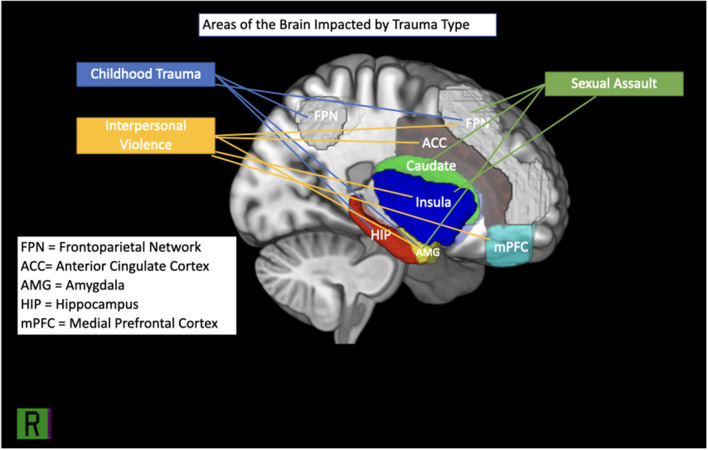
Most females experience at least one traumatic event in their lives, but not all develop PTSD. Despite considerable research, our understanding of the key factors that constitute risk for PTSD among females is limited. Previous research has largely focused on sex differences, neglecting within group comparisons, thereby obviating differences between females who do and do not develop PTSD following exposure to trauma. In this systematic review, we conducted a search for the extent of existing research utilizing magnetic resonance imaging (MRI) to examine neurobiological differences among females of all ages, with and without PTSD. Only studies of females who met full diagnostic criteria for PTSD were included. Fifty-six studies were selected and reviewed. We synthesized here findings from structural MRI (sMRI), functional MRI (fMRI), diffusion tensor imaging (DTI), and resting state functional connectivity (rs-FC MRI) studies, comparing females with and without PTSD. A range of biopsychosocial constructs that may leave females vulnerable to PTSD were discussed. First, the ways timing and type of exposure to trauma may impact PTSD risk were discussed. Second, the key role that cognitive and behavioral mechanisms may play in PTSD was described, including rumination, and deficient fear extinction. Third, the role of specific symptom patterns and common comorbidities in female-specific PTSD was described, as well as sex-specific implications on treatment and parenting outcomes. We concluded by identifying areas for future research, to address the need to better understand developmental aspects of brain alterations, the differential impact of trauma types and timing, the putative role of neuroendocrine system in neurobiology of PTSD among females, and the impact of social and cultural factors on neurobiology in females with PTSD.
大多数女性在其一生中至少经历过一次创伤性事件,但并非所有人都会患上创伤后应激障碍(PTSD)。尽管进行了大量研究,但我们对女性中构成PTSD风险的关键因素的理解仍然有限。先前的研究主要集中在性别差异上,忽略了组内比较,从而忽略了遭受创伤后患上PTSD和未患上PTSD的女性之间的差异。在这项系统综述中,我们搜索了利用磁共振成像(MRI)检查所有年龄段患有和未患有PTSD的女性神经生物学差异的现有研究范围。仅纳入了符合PTSD完整诊断标准的女性研究。共筛选并综述了56项研究。我们在此综合了来自结构MRI(sMRI)、功能MRI(fMRI)、扩散张量成像(DTI)和静息态功能连接(rs-FC MRI)研究的结果,比较了患有和未患有PTSD的女性。讨论了一系列可能使女性易患PTSD的生物心理社会因素。首先,讨论了创伤暴露的时间和类型可能影响PTSD风险的方式。其次,描述了认知和行为机制在PTSD中可能发挥的关键作用,包括反复思考和恐惧消退不足。第三,描述了特定症状模式和常见共病在女性特定PTSD中的作用,以及对治疗和育儿结果的性别特异性影响。我们通过确定未来研究的领域得出结论,以满足更好地理解大脑改变的发育方面、创伤类型和时间的差异影响、神经内分泌系统在女性PTSD神经生物学中的假定作用,以及社会和文化因素对患有PTSD的女性神经生物学的影响的需求。