Hicks Richard E, Kenny Bridget, Stevenson Simone, Vanstone Daisy M
School of Psychology, Faculty of Society and Design, Bond University, Australia.
Heliyon. 2022 Jun 17;8(6):e09745. doi: 10.1016/j.heliyon.2022.e09745. eCollection 2022 Jun.
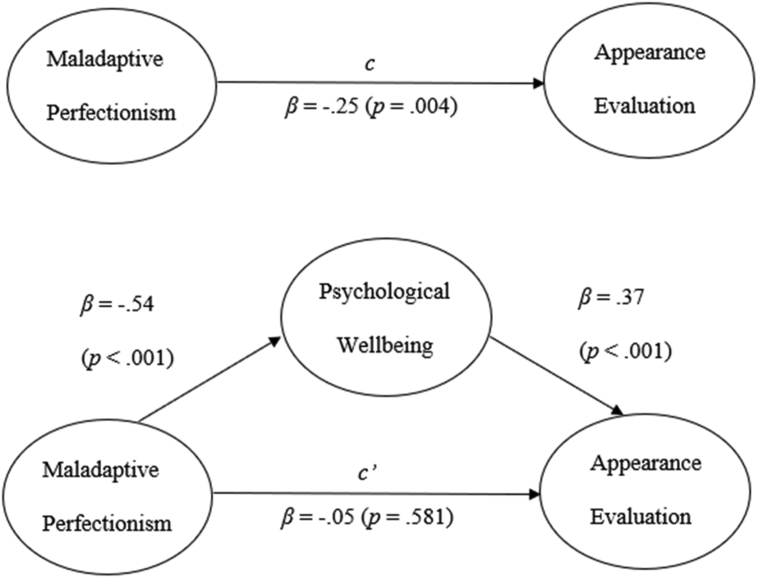
Discontent with one's appearance (body image dissatisfaction) has become a global phenomenon, associated with the development of extreme behaviours in order to correct perceived body image problems. Much of the literature has focused on associated destructive behaviours that result from body image dissatisfaction; however, there has been a dearth of research examining risk factors for body image problems in adults. Thus, the current study aimed to investigate risk factors associated with adult body image problems, focusing on two variables highlighted in the literature (gender and maladaptive perfectionism). The current study (1) compared gender differences in body image dissatisfaction and (2) investigated psychological wellbeing as a mediator between maladaptive perfectionism and body image dissatisfaction. The sample included 139 Australian adults from universities (55.7%) and the community (44.3%). Participants completed demographic questions, the Frost Multidimensional Perfectionism Scale, the Psychological Wellbeing questionnaire, the Multidimensional Body-Self Relations Questionnaire, and Marlowe-Crowne Social Desirability Scale. In contrast to predictions, females had higher body area satisfaction and appearance evaluation scores. Furthermore, in line with the hypotheses, psychological wellbeing fully mediated the relationship between maladaptive perfectionism and poor body image. The findings suggest gender, maladaptive perfectionism, and psychological wellbeing may act as risk factors for body image dissatisfaction.
对自身外貌的不满(身体意象不满)已成为一种全球现象,与为纠正感知到的身体意象问题而产生的极端行为相关。许多文献都聚焦于身体意象不满所导致的相关破坏性行为;然而,针对成年人身体意象问题风险因素的研究却很匮乏。因此,本研究旨在调查与成年人体意象问题相关的风险因素,重点关注文献中突出的两个变量(性别和适应不良的完美主义)。本研究(1)比较了身体意象不满方面的性别差异,以及(2)将心理健康作为适应不良的完美主义与身体意象不满之间的中介进行了调查。样本包括139名来自澳大利亚大学(55.7%)和社区(44.3%)的成年人。参与者完成了人口统计学问题、弗罗斯特多维完美主义量表、心理健康问卷、多维身体 - 自我关系问卷以及马洛 - 克劳恩社会赞许性量表。与预测相反,女性在身体部位满意度和外貌评价得分上更高。此外,与假设一致,心理健康完全中介了适应不良的完美主义与不良身体意象之间的关系。研究结果表明,性别、适应不良的完美主义和心理健康可能是身体意象不满的风险因素。