University College London Hospitals NHS Foundation Trust, London.
Department of Haematology, University Medical Center Utrecht, University Utrecht, Utrecht.
Haematologica. 2022 Sep 1;107(9):2037-2050. doi: 10.3324/haematol.2022.280953.
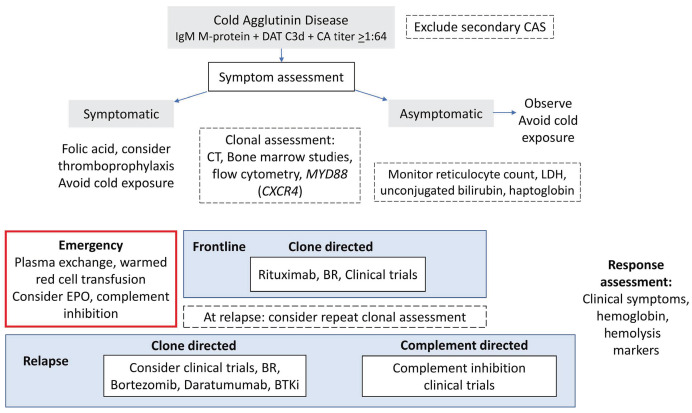
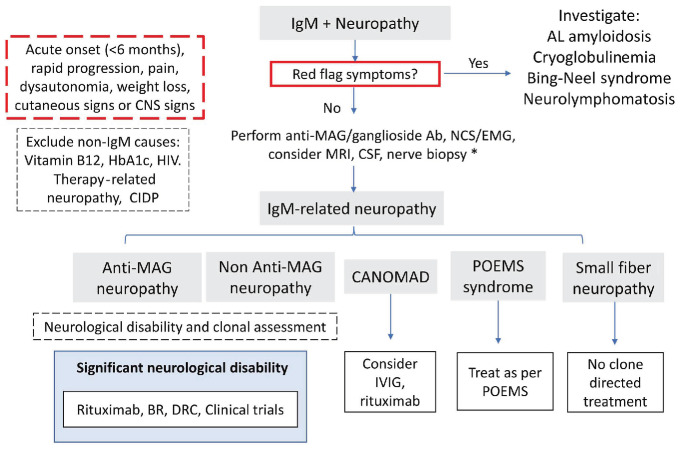
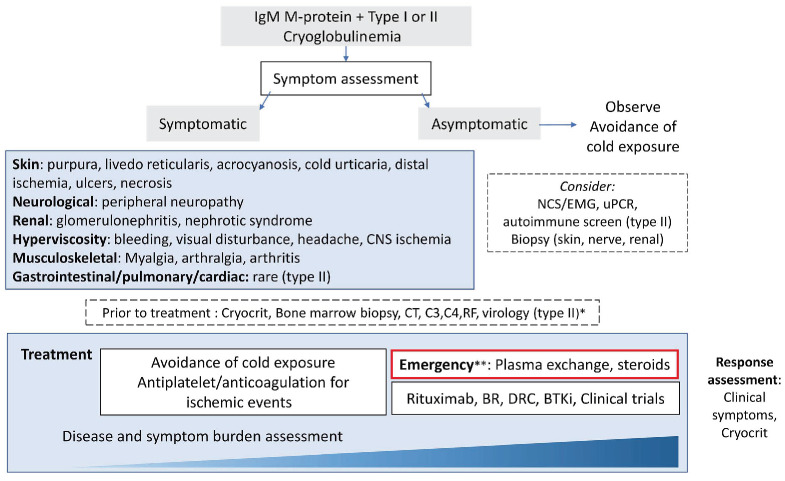
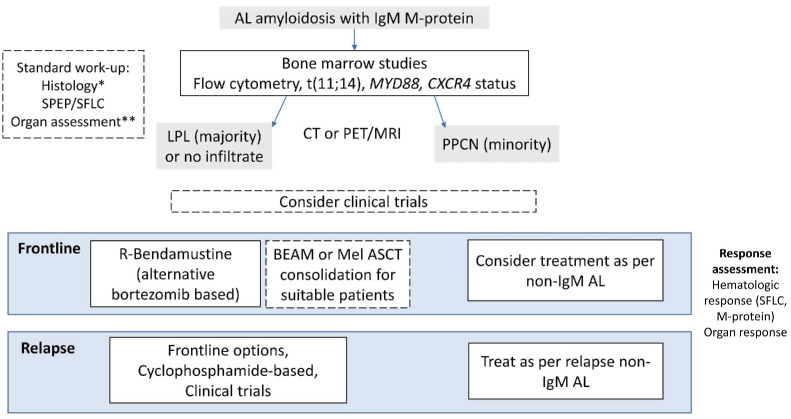
IgM monoclonal gammopathy of undetermined significance is a pre-malignant condition for Waldenström macroglobulinemia and other B-cell malignancies, defined by asymptomatic circulating IgM monoclonal protein below 30 g/L with a lymphoplasmacytic bone marrow infiltration of less than 10%. A significant proportion, however, develop unique immunological and biochemical manifestations related to the monoclonal protein itself in the absence of overt malignancy and are termed IgM-related disorders or, more recently, monoclonal gammopathy of clinical significance. The indication for treatment in affected patients is dictated by the pathological characteristics of the circulating IgM rather than the tumor itself. The clinical workup and treatment options vary widely and differ from those for Waldenström macroglobulinemia. The aim of this review is to alert clinicians to IgM monoclonal gammopathy of clinical significance and to provide practical guidance on when to screen for these phenotypes. We discuss clinical characteristics, the underlying clonal profile, diagnostic workup and treatment considerations for five important subtypes: cold agglutinin disease, type I and II cryoglobulinemia, IgM-associated peripheral neuropathy, Schnitzler syndrome and IgM-associated AL amyloidosis. The inhibition of the pathogenic effects of the IgM has led to great success in cold agglutinin disease and Schnitzler syndrome, whereas the other treatments are centered on eradicating the underlying clone. Treatment approaches in cryoglobulinemia and IgM-associated peripheral neuropathy are the least well developed. A multidisciplinary approach is required, particularly for IgM-related neuropathies and Schnitzler syndrome. Future work exploring novel, clone-directed agents and pathogenic IgM-directed therapies is welcomed.
意义未明的单克隆免疫球蛋白血症是华氏巨球蛋白血症和其他 B 细胞恶性肿瘤的前恶性状态,定义为无症状循环 IgM 单克隆蛋白低于 30 g/L,且淋巴浆细胞性骨髓浸润小于 10%。然而,相当一部分患者会出现独特的免疫和生化表现,这些表现与单克隆蛋白本身有关,但没有明显的恶性肿瘤,因此被称为 IgM 相关疾病,或者最近称为具有临床意义的单克隆丙种球蛋白病。受影响患者的治疗指征取决于循环 IgM 的病理特征,而不是肿瘤本身。临床评估和治疗选择差异很大,与华氏巨球蛋白血症不同。本综述旨在提醒临床医生注意具有临床意义的 IgM 单克隆丙种球蛋白病,并提供关于何时筛查这些表型的实用指导。我们讨论了五种重要亚型的临床特征、潜在克隆谱、诊断评估和治疗考虑因素:冷凝集素病、I 型和 II 型冷球蛋白血症、IgM 相关周围神经病、 Schnitzler 综合征和 IgM 相关 AL 淀粉样变性。抑制 IgM 的致病作用已在冷凝集素病和 Schnitzler 综合征中取得巨大成功,而其他治疗方法则集中在根除潜在的克隆。冷球蛋白血症和 IgM 相关周围神经病的治疗方法最不发达。需要采用多学科方法,特别是对于 IgM 相关神经病和 Schnitzler 综合征。欢迎探索新型、靶向克隆的药物和针对致病性 IgM 的治疗方法的未来工作。