Department of Respiratory Medicine, Kobe City Medical Center General Hospital, Kobe, Hyogo, Japan.
Department of Respiratory Medicine, Japanese Red Cross Maebashi Hospital, Maebashi, Gunma, Japan.
Am J Respir Crit Care Med. 2022 Dec 1;206(11):1326-1335. doi: 10.1164/rccm.202201-0199OC.
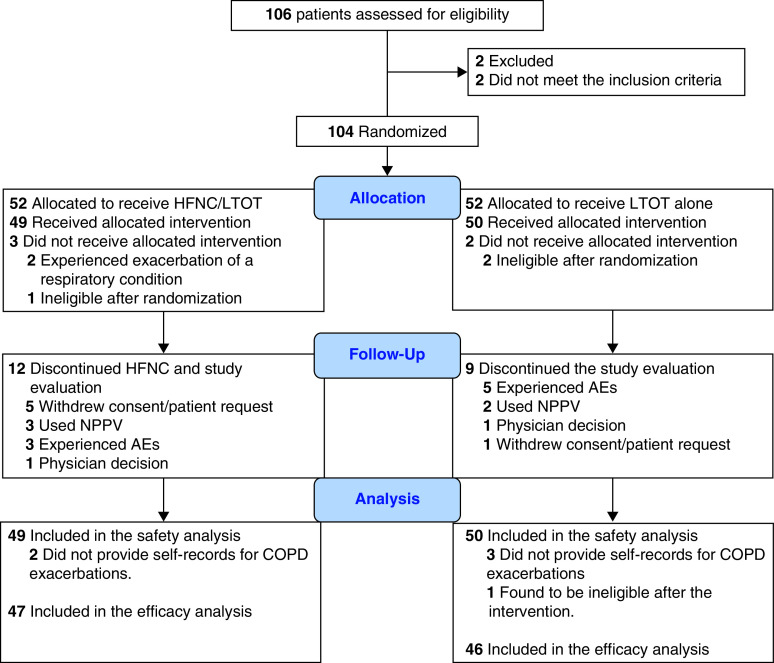
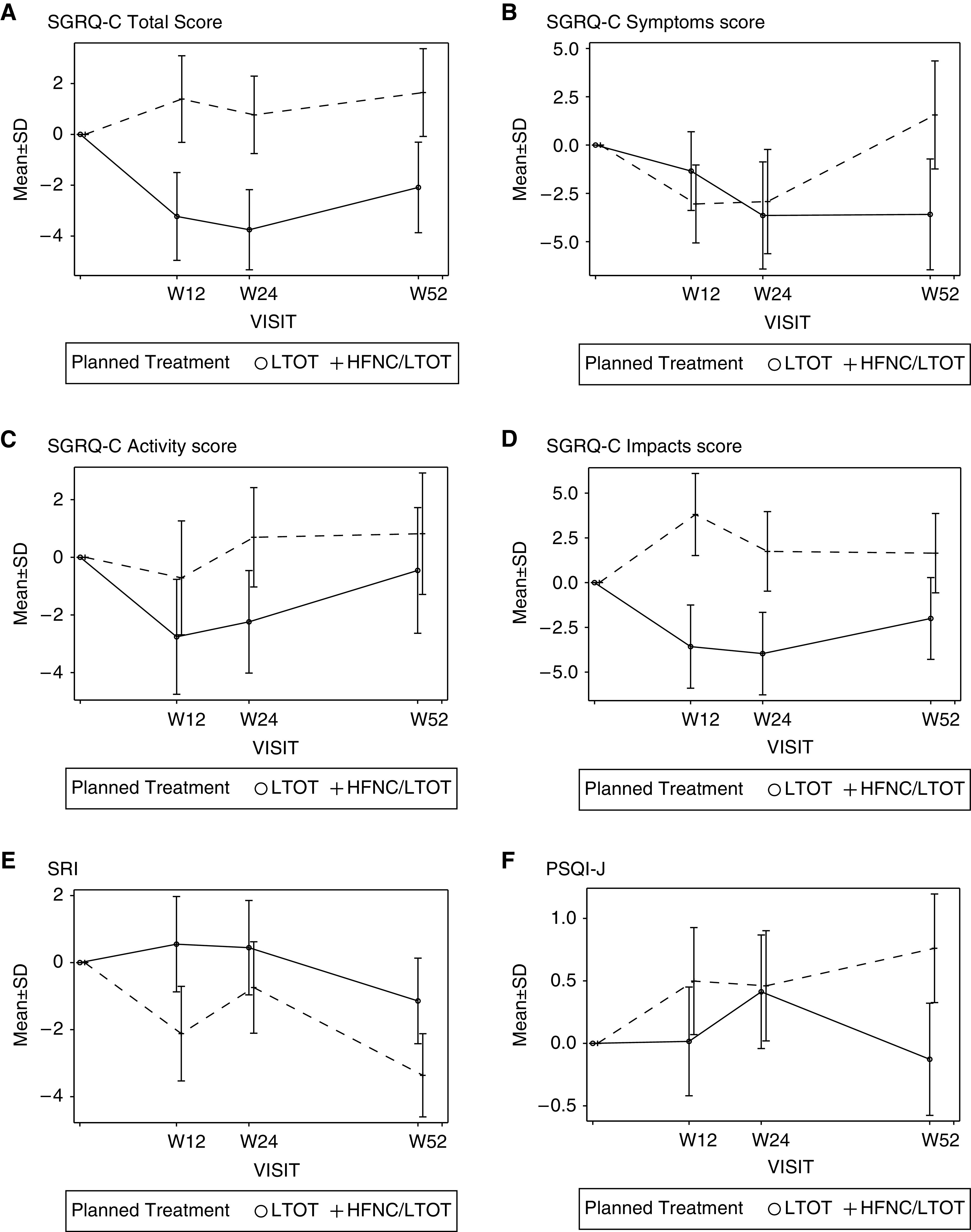
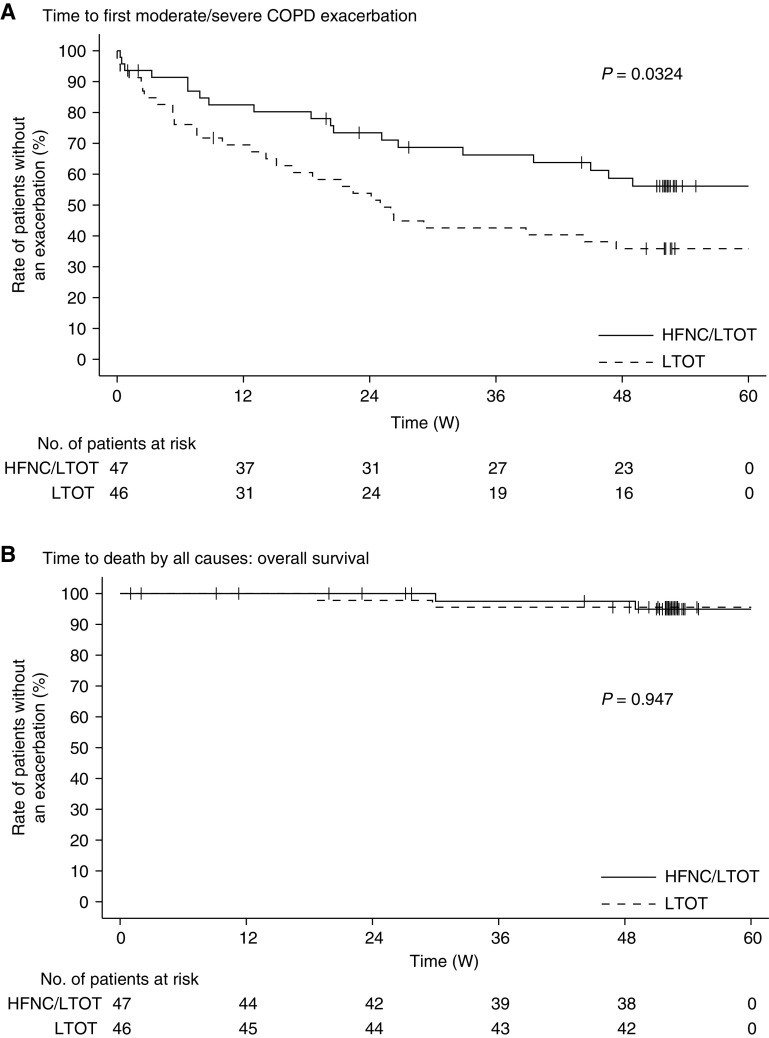
The long-term effects of using a high-flow nasal cannula for chronic hypercapnic respiratory failure caused by chronic obstructive pulmonary disease remain unclear. To assess whether long-term high-flow nasal cannula use reduces the number of exacerbations and improves other physiological parameters in patients with chronic hypercapnic respiratory failure caused by chronic obstructive pulmonary disease. We enrolled 104 participants (aged ⩾40 yr) with daytime hypercapnia (Global Initiative for Chronic Obstructive Lung Disease stages 2-4) receiving long-term oxygen therapy (⩾16 h/d for ⩾1 mo) and randomly assigned them to high-flow nasal cannula/long-term oxygen therapy and long-term oxygen therapy groups. The primary endpoint was the moderate or severe exacerbation rate. We compared changes from baseline in arterial blood gas values, peripheral oxygen saturation, pulmonary function, health-related quality-of-life scores, and the 6-minute-walk test. High-flow nasal cannula use significantly reduced the rate of moderate/severe exacerbations (unadjusted mean count 1.0 vs. 2.5, a ratio of the adjusted mean count between groups [95% confidence interval] of 2.85 [1.48-5.47]) and prolonged the duration without moderate or severe exacerbations. The median time to first moderate or severe exacerbation in the long-term oxygen therapy group was 25 (14.1-47.4) weeks; this was not reached in the high-flow nasal cannula/long-term oxygen therapy group. High-flow nasal cannula use significantly improved health-related quality of life scores, peripheral oxygen saturation, and specific pulmonary function parameters. No safety concerns were identified. A high-flow nasal cannula is a reasonable therapeutic option for patients with stable hypercapnic chronic obstructive pulmonary disease and a history of exacerbations. Clinical trial registered with www.umin/ac.jp (UMIN000028581) and www.clinicaltrials.gov (NCT03282019).
高流量鼻导管在慢性阻塞性肺疾病所致慢性高碳酸血症呼吸衰竭中的长期作用尚不清楚。为评估长期高流量鼻导管通气是否能减少慢性高碳酸血症呼吸衰竭患者的加重次数,并改善其他生理参数。我们纳入了 104 名(年龄 ⩾40 岁)有日间高碳酸血症(慢性阻塞性肺疾病全球倡议 2-4 期)、长期氧疗(每天 ⩾16 小时,至少 1 个月)的患者,并将他们随机分为高流量鼻导管/长期氧疗组和长期氧疗组。主要终点是中重度加重的发生率。我们比较了两组患者从基线到动脉血气值、外周血氧饱和度、肺功能、健康相关生活质量评分和 6 分钟步行试验的变化。高流量鼻导管通气显著降低了中重度加重的发生率(未校正平均计数 1.0 与 2.5,组间校正平均计数比 [95%置信区间]为 2.85 [1.48-5.47]),并延长了无中重度加重的时间。长期氧疗组首次发生中重度加重的中位时间为 25(14.1-47.4)周;而高流量鼻导管/长期氧疗组未达到该时间。高流量鼻导管通气显著改善了健康相关生活质量评分、外周血氧饱和度和特定的肺功能参数。未发现安全性问题。高流量鼻导管通气是稳定期高碳酸血症慢性阻塞性肺疾病和加重史患者的合理治疗选择。临床试验在 www.umin.ac.jp(UMIN000028581)和 www.clinicaltrials.gov(NCT03282019)上注册。