Polikarpova A, Ellinghaus A, Schmidt-Bleek O, Grosser L, Bucher C H, Duda G N, Tanaka E M, Schmidt-Bleek K
Research Institute of Molecular Pathology, Vienna, A-1030, Austria.
Julius Wolff Institute and BIH Center for Regenerative Therapies, Berlin Institute of Health at Charité - Universitätsmedizin Berlin, Berlin, DE-13353, Germany.
NPJ Regen Med. 2022 Jun 30;7(1):35. doi: 10.1038/s41536-022-00229-4.
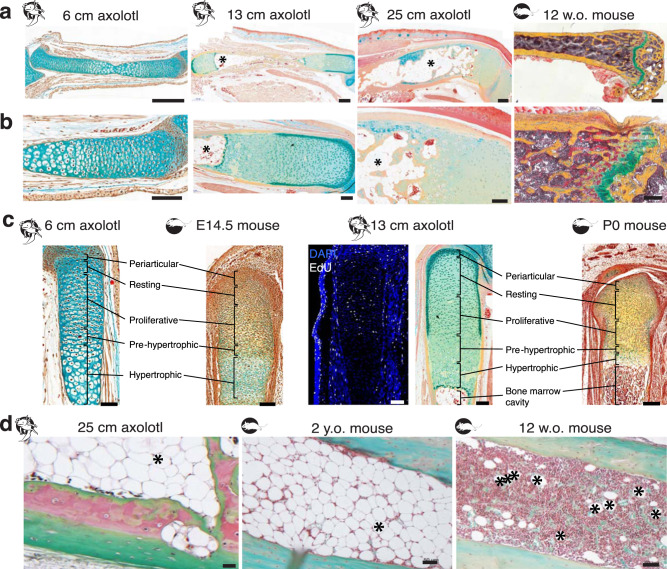
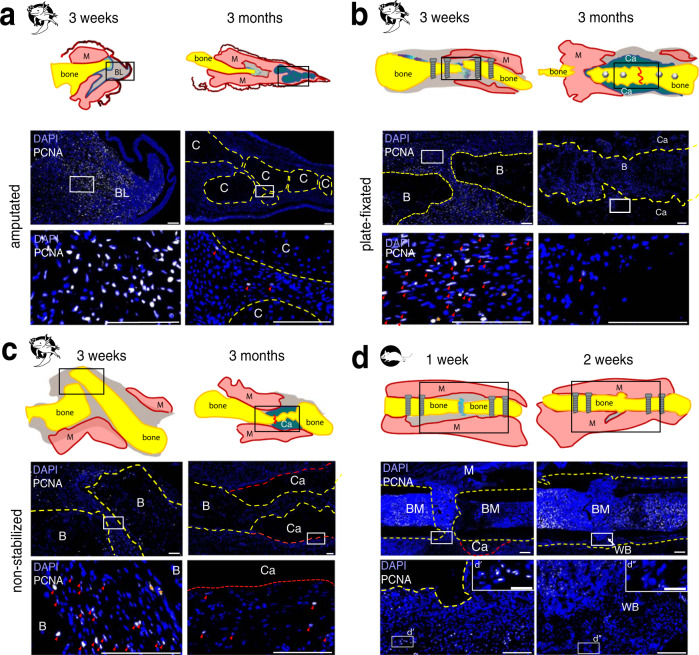
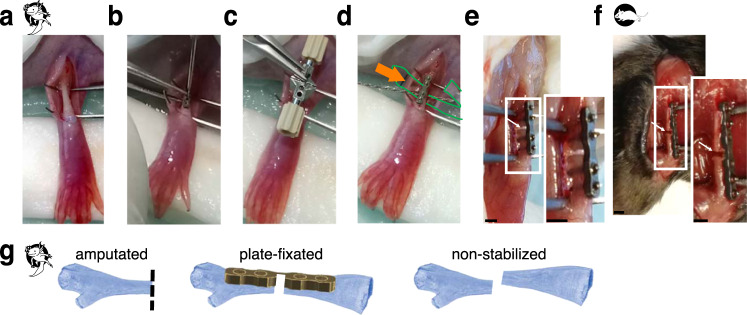
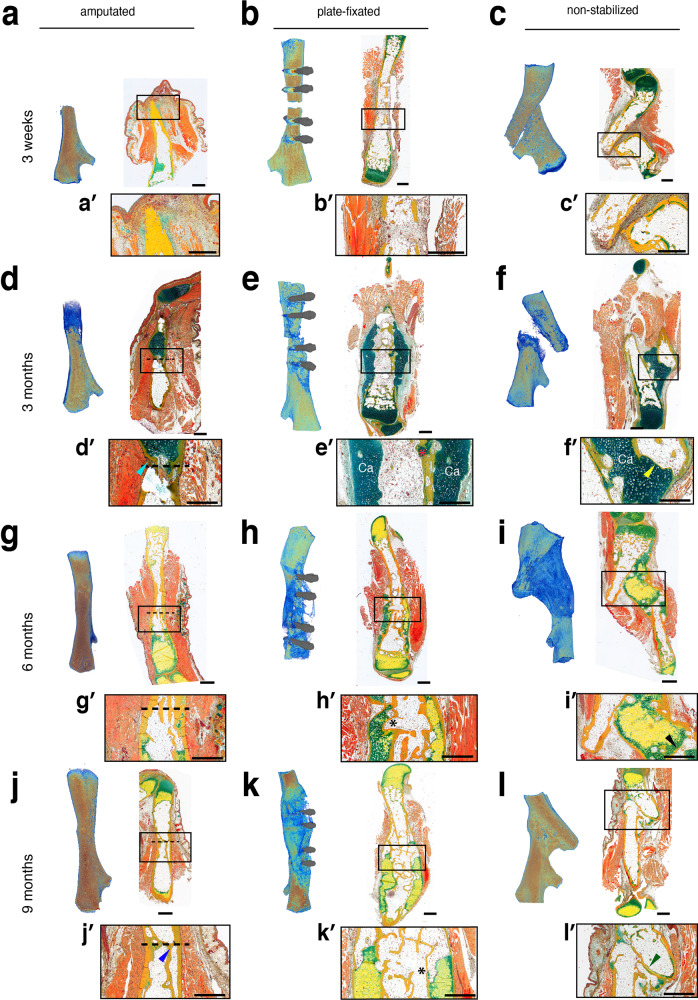
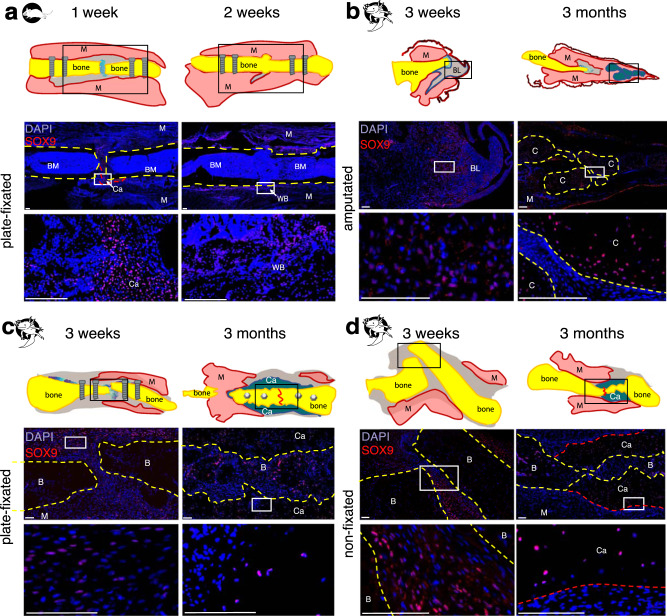
While the axolotl's ability to completely regenerate amputated limbs is well known and studied, the mechanism of axolotl bone fracture healing remains poorly understood. One reason might be the lack of a standardized fracture fixation in axolotl. We present a surgical technique to stabilize the osteotomized axolotl femur with a fixator plate and compare it to a non-stabilized osteotomy and to limb amputation. The healing outcome was evaluated 3 weeks, 3, 6 and 9 months post-surgery by microcomputer tomography, histology and immunohistochemistry. Plate-fixated femurs regained bone integrity more efficiently in comparison to the non-fixated osteotomized bone, where larger callus formed, possibly to compensate for the bone fragment misalignment. The healing of a non-critical osteotomy in axolotl was incomplete after 9 months, while amputated limbs efficiently restored bone length and structure. In axolotl amputated limbs, plate-fixated and non-fixated fractures, we observed accumulation of PCNA proliferating cells at 3 weeks post-injury similar to mouse. Additionally, as in mouse, SOX9-expressing cells appeared in the early phase of fracture healing and amputated limb regeneration in axolotl, preceding cartilage formation. This implicates endochondral ossification to be the probable mechanism of bone healing in axolotls. Altogether, the surgery with a standardized fixation technique demonstrated here allows for controlled axolotl bone healing experiments, facilitating their comparison to mammals (mice).
虽然美西螈完全再生截肢肢体的能力广为人知且已得到研究,但美西螈骨折愈合的机制仍知之甚少。一个原因可能是美西螈缺乏标准化的骨折固定方法。我们提出一种手术技术,用固定板稳定美西螈截骨后的股骨,并将其与未稳定的截骨术以及肢体截肢进行比较。在术后3周、3个月、6个月和9个月,通过微型计算机断层扫描、组织学和免疫组织化学评估愈合结果。与未固定的截骨骨相比,用钢板固定的股骨能更有效地恢复骨完整性,未固定的截骨骨形成了更大的骨痂,可能是为了补偿骨碎片的错位。美西螈非关键性截骨在9个月后愈合不完全,而截肢肢体能有效地恢复骨长度和结构。在美西螈截肢肢体、钢板固定和未固定骨折中,我们在损伤后3周观察到PCNA增殖细胞的积累,这与小鼠相似。此外,与小鼠一样,在美西螈骨折愈合和截肢肢体再生的早期阶段,在软骨形成之前就出现了表达SOX9的细胞。这表明软骨内成骨可能是美西螈骨愈合的机制。总之,本文展示的采用标准化固定技术的手术允许进行可控的美西螈骨愈合实验,便于将其与哺乳动物(小鼠)进行比较。