Winkler T, Sass F A, Duda G N, Schmidt-Bleek K
Julius Wolff Institute, Charité - Universitätsmedizin Berlin and Berlin-Brandenburg Center for Regenerative Therapies, Charité - Universitätsmedizin Berlin, Augustenburger Platz 1, 13353 Berlin, Germany.
Bone Joint Res. 2018 May 5;7(3):232-243. doi: 10.1302/2046-3758.73.BJR-2017-0270.R1. eCollection 2018 Mar.
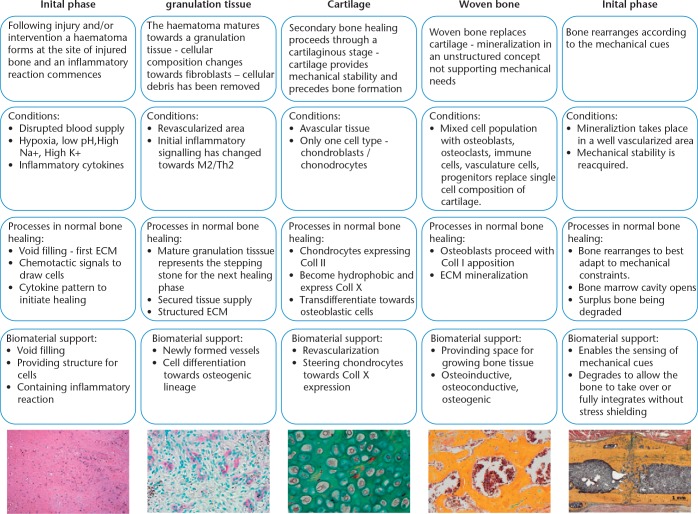
Despite its intrinsic ability to regenerate form and function after injury, bone tissue can be challenged by a multitude of pathological conditions. While innovative approaches have helped to unravel the cascades of bone healing, this knowledge has so far not improved the clinical outcomes of bone defect treatment. Recent findings have allowed us to gain in-depth knowledge about the physiological conditions and biological principles of bone regeneration. Now it is time to transfer the lessons learned from bone healing to the challenging scenarios in defects and employ innovative technologies to enable biomaterial-based strategies for bone defect healing. This review aims to provide an overview on endogenous cascades of bone material formation and how these are transferred to new perspectives in biomaterial-driven approaches in bone regeneration. Cite this article: T. Winkler, F. A. Sass, G. N. Duda, K. Schmidt-Bleek. A review of biomaterials in bone defect healing, remaining shortcomings and future opportunities for bone tissue engineering: The unsolved challenge. 2018;7:232-243. DOI: 10.1302/2046-3758.73.BJR-2017-0270.R1.
尽管骨组织在损伤后具有自我修复形态和功能的内在能力,但它仍可能受到多种病理状况的挑战。虽然创新方法有助于揭示骨愈合的一系列过程,但迄今为止,这些知识并未改善骨缺损治疗的临床效果。最近的研究结果使我们能够深入了解骨再生的生理条件和生物学原理。现在是时候将从骨愈合中学到的经验应用于缺损修复这一具有挑战性的场景中,并采用创新技术来实现基于生物材料的骨缺损愈合策略了。本综述旨在概述骨材料形成的内源性过程,以及这些过程如何在生物材料驱动的骨再生方法中转化为新的视角。引用本文:T. 温克勒,F. A. 萨斯,G. N. 杜达,K. 施密特 - 布勒克。骨缺损愈合中的生物材料综述、现存不足及骨组织工程的未来机遇:未解决的挑战。2018年;7卷:232 - 243页。DOI: 10.1302/2046 - 3758.73.BJR - 2017 - 0270.R1 。