Department of Vertebrate Paleontology, Natural History Museum of Los Angeles County, 900 Exposition Blvd., Los Angeles, CA, 90007, USA.
Key Laboratory of Vertebrate Evolution and Human Origins of Chinese Academy of Sciences, Institute of Vertebrate Paleontology and Paleoanthropology, Chinese Academy of Sciences, Beijing, 100044, China.
Sci Rep. 2022 Jun 30;12(1):10538. doi: 10.1038/s41598-022-13402-y.
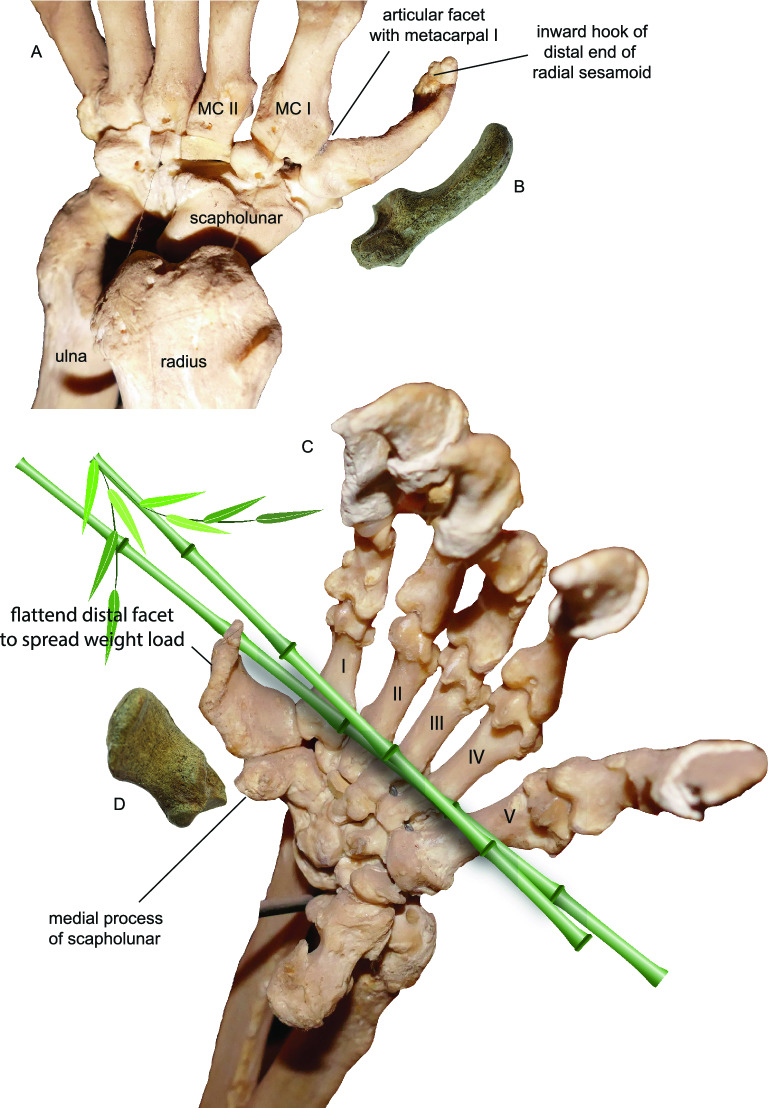
Of the many peculiarities that enable the giant panda (Ailuropoda melanoleuca), a member of the order Carnivora, to adapt to life as a dedicated bamboo feeder, its extra "thumb" is arguably the most celebrated yet enigmatic. In addition to the normal five digits in the hands of most mammals, the giant panda has a greatly enlarged wrist bone, the radial sesamoid, that acts as a sixth digit, an opposable "thumb" for manipulating bamboo. We report the earliest enlarged radial sesamoid, already a functional opposable "thumb," in the ancestral panda Ailurarctos from the late Miocene site of Shuitangba in Yunnan Province, China. However, since the late Miocene, the "thumb" has not enlarged further because it must be balanced with the constraints of weight bearing while walking in a plantigrade posture. This morphological adaptation in panda evolution thus reflects a dual function of the radial sesamoid for both bamboo manipulation and weight distribution. The latter constraint could be the main reason why the panda's false thumb never evolved into a full digit. This crude "thumb" suggests that the origin of the panda's dedicated bamboo diet goes back to as early as 6-7 Ma.
在众多使大熊猫(Ailuropoda melanoleuca)适应以竹子为食的独特特征中,它的额外“拇指”可能是最著名但也是最神秘的一个。除了大多数哺乳动物手上的正常五个手指外,大熊猫的腕骨——桡籽骨——非常发达,它像第六个手指一样,是一个可对向操作的“拇指”,用于操纵竹子。我们在中国云南水塘坝晚中新世遗址中发现了最早的、已经具有功能性可对向操作的桡籽骨,这表明大熊猫祖先已经具有了可对向操作的桡籽骨。然而,自晚中新世以来,由于“拇指”必须在跖行姿势行走时平衡承重的限制,它没有进一步增大。因此,大熊猫桡籽骨的这种形态适应反映了其在竹子操纵和重量分布方面的双重功能。后者的限制可能是熊猫假拇指从未进化成完整手指的主要原因。这种粗糙的“拇指”表明,熊猫对竹子的特殊饮食起源可以追溯到 6-700 万年前。