Department of Public Health, Institute of Tropical Medicine, Antwerp, Belgium.
Department of Clinical Sciences, Institute of Tropical Medicine, Antwerp, Belgium.
J Int AIDS Soc. 2022 Jul;25(7):e25953. doi: 10.1002/jia2.25953.
The number of individuals initiating antiretroviral pre-exposure prophylaxis (PrEP) is increasing, but we do not fully understand who is coming forward for PrEP, how they use it and how they are followed-up. The objective of this study was to examine PrEP user profiles, dynamics in PrEP use and follow-up over time.
We conducted a cohort analysis of longitudinally collected clinical record and questionnaire data among PrEP users at an HIV centre in Antwerp, Belgium, between June 2017 and March 2020. PrEP follow-up and user profiles were examined using descriptive analyses and bivariate logistic regression. We compared early adopting PrEP users (started before June 2018) with late users. We also calculated the probabilities of switching between daily and on-demand PrEP, and interruption, using a naïve estimator.
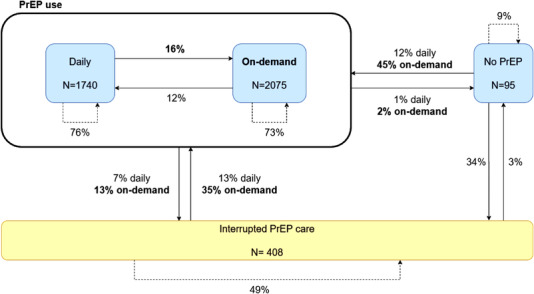
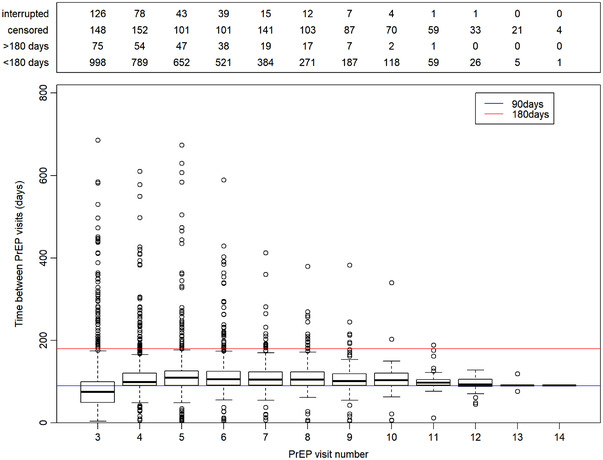
We included 1347 PrEP users in the analysis. After 12 months, retention in care was 72.3%. Median time between PrEP visits was 98 days (IQR 85-119 days). At screening visit, early adopting PrEP users (starting June 2017-May 2018) were significantly more likely to report one or more sexually transmitted infection in the prior 12 months, having used drugs during sex, a higher number of sexual partners and a history of paid sex and PrEP use prior to initiation, compared with PrEP users who initiated later (starting June 2018-February 2020). When taking PrEP daily, the probability of staying on daily PrEP at the next visit was 76%, while this was 73% when taking PrEP on-demand. Those using on-demand PrEP had a higher probability (13%) of interrupting PrEP care than daily PrEP users (7%), whereas those returning to PrEP care would mostly re-start with on-demand (35% vs. 13% for daily).
The majority of PrEP users in this sample remained in care after 12 months. The probability of remaining on the same PrEP regimen at the subsequent visit was high. Though, we observed a diversity of transitions between regimens and interruptions in between visits. Our findings reaffirm the need to provide tailored PrEP services, counselling PrEP users across their life course.
越来越多的人开始使用抗逆转录病毒药物(ART)进行暴露前预防(PrEP),但我们还不完全了解谁会选择 PrEP,他们如何使用以及如何随访。本研究的目的是检查 PrEP 用户的个人资料、PrEP 使用的动态变化以及随时间的随访情况。
我们对 2017 年 6 月至 2020 年 3 月期间在比利时安特卫普的一个 HIV 中心接受 PrEP 的患者进行了前瞻性队列分析,收集了临床记录和问卷数据。使用描述性分析和双变量逻辑回归检查 PrEP 随访和用户概况。我们比较了早期使用 PrEP 的患者(在 2018 年 6 月之前开始)和晚期使用者。我们还使用简单估计计算了每日 PrEP 和按需 PrEP 之间的转换概率以及中断概率。
我们纳入了 1347 名 PrEP 用户进行分析。12 个月后,接受护理的患者比例为 72.3%。PrEP 就诊的中位数时间为 98 天(IQR 85-119 天)。在筛查时,早期使用 PrEP 的患者(2017 年 6 月-2018 年 5 月开始)在过去 12 个月内报告有一个或多个性传播感染、在性接触中使用药物、有更多性伴侣以及有有偿性服务和 PrEP 使用史的可能性显著更高,而与较晚开始使用 PrEP 的患者(2018 年 6 月-2020 年 2 月开始)相比。每日服用 PrEP 时,下一次就诊时继续服用每日 PrEP 的可能性为 76%,而按需服用 PrEP 时为 73%。使用按需 PrEP 的患者中断 PrEP 护理的可能性(13%)高于每日 PrEP 使用者(7%),而返回 PrEP 护理的患者大多会重新开始按需 PrEP(35%比每日 PrEP 使用者的 13%)。
本研究中,大多数 PrEP 用户在 12 个月后仍接受护理。在随后的就诊中继续使用相同的 PrEP 方案的可能性很高。但是,我们观察到方案之间的转换和就诊之间的中断存在多样性。我们的研究结果再次证实,需要为 PrEP 用户提供个性化的服务,在他们的整个生命过程中为他们提供咨询。